Page 19 - Flathead Beacon // 1.7.15
P. 19
FLATHEADBEACON.COM COVER JANUARY 7, 2015 | 19 County Issues at the 2015 Legislature
Water compact, infrastructure costs top thelists
By BEACON STAFF
With the 64th Montana Legislature underway, representatives and sena- tors from around the state are busy for 90 days addressing the issues of Big Sky country.
In Flathead County, likely the big- gest issue lawmakers will address this session is the water compact with the Confederated Salish and Kootenai Tribes.
The Flathead County Commission sent a letter to the compact commission in October outlining some of the coun- ty’s concerns with the current version of the compact, including adequate water rights for existing users in the Flathead.
Commissioner Phil Mitchell, who was recently sworn in as the new com- missioner for District 1, said the water compact would be one of the issues he focuses on in his new term.
The commission has expressed that it believes a water compact is necessary, but the most-recent iteration of the doc- ument needed work. The Legislature is expected to take up the issue during the session.
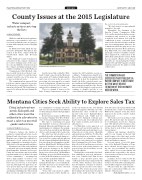
Flathead County Courthouse. BEACON FILE PHOTO Another issue that could affect Flat-
head County comes from the Montana Association of Counties, which is push- ing for an extra step in the process for protesting a decision made by a county board of adjustment, allowing a person to protest a decision to the county com- mission before having to go to court.
There is a gamut of issues on the Lake County Commission’s radar go-
ing into the 2015 legislative session, ac- cording to Commissioner Ann Brower. She said the commission is particularly interested in how the Legislature will handle the hotly contested water com- pact and how it will fund infrastructure improvements around the state. Brower has noted that funds for such projects continue to dwindle and she is con- cerned that the state will simply pass on
the costs to local governments.
“We don’t want to see any unfunded
mandates,” she said.
Meanwhile, the chairman of the
Lincoln County Commission, Mike Cole, said he has faith in that area’s rep- resentatives and senators to do what is right for local citizens. Cole said the commission is more concerned about issues at the federal level that could im- pact forest management. However, the commission will be keeping an eye on a few bills introduced by House District 2 Rep. Mike Cuffe. One of the bills would put in place a way to refund the commu- nities impacted by construction of the Libby Dam and Lake Koocanusa. Cuffe has encouraged officials at the federal level who are renegotiating the Colum- bia River Treaty with Canada to include reimbursements for the land lost south of the border.
THE COMMISSION HAS EXPRESSED THAT IT BELIEVES A WATER COMPACT IS NECESSARY, BUT THE MOST-RECENT ITERATION OF THE DOCUMENT NEEDED WORK.
Montana Cities Seek Ability to Explore Sales Tax
Citing infrastructure needs, Kalispell and other cities want the authority to ask voters to enact a sales tax on retail goods and services
By DILLON TABISH of the Beacon
Trying to balance the burden of paying for rising infrastructure needs, Kalispell and other larger cities across Montana are seeking the authority to implement a local option sales tax in their communities, renewing a decades- old debate for the upcoming Legislature.
Montana is one of five states without a statewide sales tax, alongside Alaska, New Hampshire, Delaware and Oregon. Under the current law, only cities with a population under 5,500 that are deemed “resort communities” — meaning they draw a high number of visitors com- pared to local residents — have the abil- ity to enact a resort tax, or local option sales tax. Through voter approval, a fee of no greater than 3 percent can be add- ed to goods and services at retail, lodging and dining establishments. Those funds then become an added revenue source
for communities to manage the wear- and-tear on local infrastructure without overburdening residents through higher property taxes.
Resort taxes are in place in Whitefish, Red Lodge, Virginia City, West Yellow- stone, St. Regis, Big Sky and Seeley Lake.
The topic is resurfacing yet again this legislative session as city leaders in Kalispell, Missoula and Billings are ask- ing lawmakers to eliminate the popula- tion restriction and allow any Montana city to seek voter approval for a sales tax.
The effort has historically received pushback from the retail and dining sec- tors, as well as county residents who say the sales tax would unfairly shift the bur- den onto them. Area lawmakers, includ- ing Sen. Mark Blasdel, R-Kalispell, have expressed hesitation over the changes and previous attempts at the Capitol have failed to gain widespread support. In the 2009 session, Sen. Jeff Essmann, R-Billings, proposed a bill allowing larg- er cities such as Bozeman to enact resort taxes, but the Legislature killed it.
The Kalispell City Council, citing rising infrastructure costs, formally ad- opted the measure as one of its priorities for the 64th session, which convened Jan. 5 in Helena.
“To me, this comes down to a philo- sophical discussion of who should car-
ry the tax burden in the city? Should property taxpayers subsidize all of the infrastructure that everybody com- ing into town uses?” Kalispell Mayor Mark Johnson said. “Right now we have 20,000 Kalispell residents pay- ing for streets and other infrastructure that county residents and tourists are all using, too.”
In Whitefish, voters approved a 2 percent resort tax in 1995, and the col- lected funds help repair and improve ex- isting streets, storm sewers, sidewalks and underground utilities. To offset the added tax burden on residents, city of- ficials passed an ordinance requiring a property tax reduction for residents based on annual tax collections. White- fish collected $2.1 million in resort taxes in fiscal year 2014, saving $668,000 in property taxes for all residents, accord- ing to city officials.
Kalispell faces a shortfall of $3.5 mil- lion annually in projected infrastruc- ture costs, Johnson said. That doesn’t include a large priority project that could impact the burgeoning north side of town, where business and residen- tial development continues to balloon, creating a greater need for sewer infra- structure. The city needs a large sewer line leading to the wastewater treatment plant on the south end. The so-called
west-side interceptor plan, which would install the line, could cost $14 million. Without the adequate sewer line, devel- opment on the north could be stalled, Johnson said.
“We want to prevent getting to that point. We just don’t have the money to do everything we need to do,” Johnson said. “But when I talk to business own- ers and residents in the community, they tell me they’re sick of their real estate taxes going up.”
Johnson said language should be added to any changes in the law that would require cities that enact a sales tax to provide property tax relief for res- idents and business owners.
A recent survey of over 120 mem- bers of the Kalispell Chamber of Com- merce showed strong support for giv- ing the city government the author- ity to explore a resort tax. Among 121 members who responded to the survey, 73 percent were in favor of the local gov- ernment authority.
A similar survey conducted by the Billings Chamber of Commerce found 77.4 percent of the 288 responding busi- ness members supported the measure.
“We just want the opportunity to have the conversation within our com- munity,” Johnson said.
[email protected]