


Page 23 - Flathead Beacon // 1.13.16
P. 23
Cuthbertson said that while he’s not a physicist, it’s peculiar that two testing methods could return such markedly disparate results on water sam- ples from the same system.
“The EPA accepts both methods, and that is what drives me a little bit crazy,” Cuthbertson said. “We have these subdi- visions using two legal methods that give you radically di erent numbers. They aren’t doing anything wrong. Both meth- ods are legal. It just doesn’t seem right.”
“If I lived out at Lakeshore Heights I would have a reverse osmosis system,” Cuthbertson added. “I don’t like the idea of having that much radioactivity in my water whether it’s a legal loophole or not.”
Wes Kruse, the current systems oper- ator at Lakeshore Heights, said he doesn’t understand the nuances that distinguish the two methods, only that both methods are acceptable by the federal government, and one method consistently returns lower results.
“I wish I could tell you why, but one method gives us a workable number,” Kruse said. “I am the operator and I do take those samples. I don’t analyze them and I don’t know the di erence between the testing methods. All I know is that the EPA allows both, and by us using the lab’s method in Wisconsin we stay in compliance.”
Eugene Pizzini, the DEQ’s supervi- sor of public drinking water supplies, initially shared Cuthbertson’s skeptical reaction when he learned of the dispar- ities in the testing methods, thinking that the homeowners associations were exploiting a quirk in the law.
“I thought, ‘Why would you allow a method that would allow you to under- report?’” Pizzini said. “The only rea- son a subdivision would choose to do that method is so that they would not be forced into installing a million-dollar treatment plant.”
In subsequent interviews with the Beacon, Pizzini changed his views “180 degrees,” and says that the Wisconsin method gives a more accurate repre- sentation of the actual uranium activity compared to the Wyoming lab.
Uranium activity consists of two iso- topes – 234 and 238. But the Wyoming method tests only 238, which makes up about 99 percent of the total uranium mass that a human kidney has to pro- cess. It does not measure for 234, how- ever, which is only responsible for 1 per- cent of the mass but 75 percent of the radioactivity.
Using the Wisconsin method, “the higher uranium value can be subtracted from the gross alpha value, therefore bringing the system into compliance,” explained Ben Schendel, the DEQ’s for- mer radiological rule manager.
In 2010, Schendel helped the Wiscon- sin lab get certi ed in Montana for public water system sampling, and subdivisions from Kila to Bigfork began requesting the lab’s testing method.
Pizzini said now that he understands how the Wisconsin method works he has
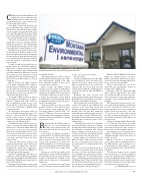
The Montana Environment Laboratory in Kalispell. GREG LINDSTROM | FLATHEAD BEACON
no qualms about it.
“The EPA would not adopt or keep a
method that was allowing people to skirt the requirements,” Pizzini said. “The more expensive method is just a more accurate representation.”
Diane Jordan, the DEQ’s current radiological rule maker for Montana, said the only community water systems she knows of using the Wisconsin lab are in Northwest Montana, in part because a former board member of the Ranch County Water Board in Bigfork helped promulgate information about the alter- native testing method.
“Someone in that area discovered this method and gave a presentation about how it returns lower numbers and is very much approved by the EPA,” Jor- dan said. “They use it because otherwise they would hit the maximum contami- nant level and they would have to put up Ra treatment center.”
esidents like the Millers may or may not see lower numbers by testing their method using the
Wisconsin method, and they hope they won’t have to.
Last month, the Millers installed a specialized water treatment system that strips the radon gas out of their water and a separate ion-exchange  lter that removes the uranium. It cost $10,000, and the family hopes it’s their last major investment  xing a problem they didn’t know existed when they bought their home.
Lisa has never felt better, and the rocks and marbles are gone from her daughter’s head. But she’s still concerned about the dearth of information available to the public about radioactive contaminants in the area.
“I mean, you look at the people buying $250,000 houses out here and they have
no idea,” she said. “It worries me.”
She’s not alone.
Jennifer Benjamin lives near the Mill-
ers, and had her water tested for ura- nium in 2002, after a hair test revealed high concentrations of the radioactive element. She tested her well, and the results showed that her drinking water contained nearly four times the MCL for uranium.
Benjamin did some research and began wondering if the tainted water sup- ply might have something to do with her 16-month-old daughter’s anemia.
Her pediatrician said that while the results were high, it was unlikely that exposure to the water had caused any health problems in her daughter. A few months later, the girl was diagnosed with leukemia, and the family spent the next year at the Seattle Children’s Hos- pital while the girl underwent treatment. Benjamin was convinced it was because of their water.
“Knowing that exposure to uranium increases the risk of cancer, we’ve always thought that it had something to do with her leukemia,” Benjamin said, adding that her daughter, now 14, has been can- cer-free for 10 years, and that the family installed a water treatment system.
Pennie Ulvila, the postmaster at the Kila Post O ce, said she learned of the presence of uranium in the water years ago and hasn’t been drinking the water ever since.
“When I started working at the Post O ce 10 years ago they said, ‘Don’t drink the water, it’s bad.’ And then we had it tested and there were unsafe levels of ura- nium,” Ulvila said. “To treat that was way more costly than just letting us get bottles of Culligan water. That was the  rst time I heard of it. I had been here 10 years and nobody had ever said anything. Now peo- ple are starting to talk about it more.”
Families like the Millers and the Ben- jamins are surprised there’s not more public outreach for homeowners on pri- vate water systems, but DEQ o cials say the resources are not available.
“There’s just nothing we can do for them. We can’t expend public money on private wells,” Pizzini said.
Gillespie, with the Kalispell DEQ o ce, said it’s important to note that the federal standards are based on a life- time of exposure to radioactive elements, and acute, short-term health e ects are unlikely.
“The thing that I always want to reit- erate is that the maximum contaminant level for radiological activity is set for long-term ingestion, so it is certainly not going to have an acute e ect,” she said. “So people need to keep that in mind in terms of how long they want to be in their home and how long they have been in their home.”
Flathead County Public Health O - cer Joe Russell said there’s no public record of testing for radioactivity in pri- vate wells in the area because resources have been reserved for public systems.
“Everything is focused on public water supplies, and anytime private wells are sampled it usually comes in the forms of grants,” he said.
Gillespie said there is information about radioactivity in drinking water on the DEQ website, and encouraged con- cerned members of the public to contact the agency’s Helena o ce, and write their lawmakers.
“We always struggle to have enough time and resources to get those kinds of words out,” Gillespie said. “I think that if that’s something that is important to res- idents they should contact us and contact their state legislator, because that is who decides how we spend our time.”
tscott@ atheadbeacon.com
JANUARY 13, 2016 // FLATHEADBEACON.COM
23


