Page 14 - Flathead Beacon // 1.14.15
P. 14
14 | JANUARY 14, 2015 NEWS FLATHEADBEACON.COM
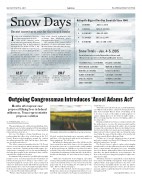
Snow Days ecent snowstorm one for the record books
Kalispell’s Biggest Two-Day Snowfalls Since 1948
RI
t only took a handful of days be-
fore history was made in 2015. Last week’s massive snow- storm, which began burying Western Montana early Jan. 4 and persisted through the late hours of Jan. 5, fin- ished with the third most snow accu- mulation on record in Kalispell in the
last 68 years.
Schools throughout the county
were closed for two days while city plow crews worked overtime try- ing to unclog streets and neighbor- hoods. Police responded to constant calls from stuck vehicles while high-
way crews cleared avalanches and accidents that debilitated travel throughouttheregion.
The severity of the event recalled memories of 2009 and 1996, when Mother Nature unleashed the two big- gest blizzards on record.
Here is a breakdown of the recent storm and where it ranks in city his- tory, based on data from the National Weather Service. Kalispell is one of four official weather stations in the region, while other communities have data provided from storm reporters.
1. 24 INCHES
2. 21 INCHES
3. 19.2 INCHES
4. 17.2 INCHES
5. 15.8 INCHES
JAN. 1-2, 2009 NOV. 19-20, 1996 JAN. 4-5, 2015 DEC. 21-22, 1951 DEC. 31-JAN. 1, 1991
Snow Totals - Jan. 4-5, 2015
Snowfall amounts recorded by weather stations and official storm reporters to the National Weather Service.
COLUMBIA FALLS: 34.5 INCHES NOISY BASIN: 22 INCHES BIGFORK: 21.5 INCHES
OLNEY: 19.8 INCHES
GPIA: 19.2 INCHES
LIBBY: 18 INCHES
ROLLINS: 14 INCHES MARION: 12 INCHES
ESSEX: 12 INCHES
LAKESIDE: 12 INCHES
CONDON: 12 INCHES
WHITEFISH: 11.6 INCHES
12.3"
Amount of snowfall recorded in Kalispell on Jan. 5, the 23rd most snow in one calendar day on record in the city’s history
20.2"
Amount of snowfall in Kalispell on Dec. 27, 1911, the most single-day snowfall total on record in the city’s history
20.1"
Snowfall in Kalispell on Nov. 19, 1996, the second most for any single day on record
- Dillon Tabish
Outgoing Congressman Introduces ‘Ansel Adams Act’
Months after uproar over proposed filming fees in federal wilderness, Texas representative proposes solution
By JUSTIN FRANZ of the Beacon
The Ansel Adams Act, a bill envisioned by Rep. Steve Stockman to protect photographer’s First Amendment rights on federal land, had little chance of passing when it was introduced on Jan. 2.
For one, Stockman, a Texas Republican, was al- ready packing his office after a failed run at the U.S. Senate. However, photographers around the country are rallying around the failed bill in hopes that some- one else will reintroduce it.
The effort comes just months after the U.S. Forest Service created an uproar when it announced it would enforce an obscure regulation that could require spe- cial permits, costing up to $1,500, for anyone filming or shooting photographs in the wilderness that could be considered a commercial activity.
Stockman’s bill promised to prohibit photography permits or fees on federal land. It also would have al- lowed federal agencies to obtain a court order to pre- vent photography in certain cases, such as if it posed a threat to national security. The bill was named after Ansel Adams, the iconic western photographer whose work was instrumental in gathering public support for the creation of Yosemite National Park.
“Future ‘Ansel Adams’ must not have their paths
Photographer takes pictures near Bigfork. GREG LINDSTROM | FLATHEAD BEACON
blocked, regulated and made more expensive with fees and fines, or be threatened with arrest and seizure of their equipment,” the bill reads.
But when Stockman introduced the bill late in the last session there was little chance of it becoming law because there were no co-sponsors who could resubmit it in the new Congress. Jim Moore, a political scientist at Pacific University, told the Salem, Oregon Statesman Journal that Stockman probably introduced the bill to bask in the limelight one more time before leaving of- fice.
“This isn’t common but it does happen, especially from a politician who may think they have a future and can get one last bill on the record, one last story in the paper and say, ‘I was working for you right up to the end,’” Moore told the newspaper.
But even if the bill died, the Professional Outdoor Media Association is encouraging its members to con- tact their representatives in Congress and ask them to
reintroduce it.
“The bill is a breath of fresh air,” said Tony Bynum,
a POMA board member and professional photogra- pher based in East Glacier Park. “Something needs to be done to protect the rights of photographers or anyone taking photos in the wild on public lands ... We’re not impacting the resource by taking a photo or shooting video.”
Bynum said whenever he has a commercial shoot in the wilderness he receives the proper permits and he understands the requirement if a photo shoot is going to impact the environment. However, he thinks it is un- fair for federal officers to hassle professional photogra- phers but not bother tourists who are doing the same exact thing. Because of that he said he often avoids tak- ing photos inside Glacier National Park.
“If there are 50 people taking a picture of an ani- mal, who is going to get busted? It’ll always be the guy with the longest lens,” he said.
The Forest Service’s plan to enforce photography permits and fees in the wilderness drew ire from Mon- tana’s congressional delegation last year, including Sen. Steve Daines. Although he did not say he would re- introduce the Ansel Adams Act, in a statement to the Beacon he said protecting photographer’s rights were important to him.
“Montana is home to unmatched scenery that has been shared worldwide through the work of photog- raphers with a deep appreciation for our state’s out- doors heritage and public lands,” he said. “As Ameri- cans, we know the importance of free speech and ex- pression, and it’s a right that must be extended to pho- tography as well.”
[email protected]