Page 38 - Flathead Beacon // 1.28.15
P. 38
38 | JANUARY 28, 2015
REAL ESTATE
FLATHEADBEACON.COM
MONTANA LIFESTYLES
Changing Times
 It is safe to say that we all know people who are liv- ing life to the fullest in their 70s and 80s, sometimes well into their 90s. Times are changing. Quality of life extends for each generation a bit longer than for most of their ancestors. As we understand the essentials of maintaining a healthy lifestyle, and lead active lives, both physically and mentally, we should be able to ex- perience longer, more productive lives. These trends will impact many aspects of our lives as we age, maybe none so significantly as where we will age.
In the not-so-distant past, many people spent a ma- jority of their lifetime in their houses. They fulfilled their mortgages and enjoyed the comfort, security and stability of their homes. When the time came that they needed assistance, the only option, other than mov- ing in with a grown child, was to relocate to a “nurs- ing home.” Aging became synonymous with the health challenges and an independent lifestyle forfeited. Now, as our population’s life expectancy increases, our re- tirement and assisted living options have expanded as well. Times have changed. As millions of baby boom- ers approach retirement age, families and the assisted living industry have reworked old models to accommo- date our newly defined needs.
Under the prior model’s limited options, all frail- ties were treated alike. No longer. The AARP and the National Association of Home Builders have developed an “aging in place” certification for home modifica- tions, a sort of blueprint for making an existing home a more age appropriate home. Many aging owners prefer to enjoy single-level living and the vast majority of ex- isting homes can be adapted to cater to a new lifestyle; including changes to accommodate wheelchairs and enhanced bathroom facilities or creating a bedroom space on the main level.
Another option that has been increasing in popu- larity is apartment complexes that focus on occupants- of-a-certain-age demographic. These complexes do not provide health care assistance necessarily as a require- ment. They offer like-minded people a place to live independently and also be part of a community that caters to certain needs that they may have and share. These newer accommodations bear very little resem-
blance to their predecessors – they are filled with vi- brant and active people choosing to move away from home ownership and all the physical responsibilities associated with it. These shared-living buildings begin as early as 55 years of age.
The term “village” is also being used to describe and create another living option for our consideration. These communities are a combination of independent living and community outreach. In this scenario, small groups of homeowners ally together to stay in their ex- isting neighborhoods and share the services of profes- sionals to assist with the challenges of home mainte- nance requirements. Many who would choose to fall in this category might prefer to spend time enjoying the outdoors rather than maintaining a lawn or shoveling the driveway. This enables the “villagers” to stay put as long as they choose and their health permits.
If and when health becomes more of an issue, there are quite a few options to explore. The traditional “nursing home” is still many steps away. Shared assist- ed-living quarters where residents live independently and share meals are growing in popularity. With more of a family-type environment, people can have priva- cy with their daily lives and yet come together to dine and be a community. Individual needs can be accom-
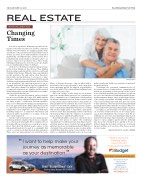
SHUTTERSTOCK PHOTO
modated and some health care assistance is provided. A transitional step.
Continuing care retirement communities also of- fer varying degrees of independence, community and health care depending on each person’s needs or pref- erences. In this particular type of residence, people can choose to enter and live a totally independent lifestyle. As their situation changes, they can participate in more of the facility’s programs, including health care and some assisted living. They will then have the option to take advantage of the full assisted living and finally nursing home facilities when the need arises. This con- tinuity makes the transition gradual and more natural.
As aging is a predetermined certainty, and people are creatures of habit, Boomers are choosing to place a great deal of thought into the next part of life. We are outliving our ancestors and enjoying prolonged good health. Retirement age hasn’t changed so we will have longer to enjoy a simpler, quieter lifestyle. Although time has a way of going by more quickly as we age, it will not change the facts that our lives are of our mak- ing and our future is of our choice. The choices are just ever increasing.
Submitted by PR Committee, NMAR
I want to help make your journey as memorable as your destination.
Proudly serving the Flathead Valley since 1975 with
3 Convenient locations.
Glacier Park Int’l Airport 406-755-7500 Downtown Whitefish 406-862-8170 AMTRAK Whitefish 2988 US HWY 93 South
Brad ”Budget Brad” Cain
Flathead Valley Manager, All Locations
Ask for Brad to receive the special daily rate!
www.budget.com
“
“