Page 17 - Flathead Beacon // 2.25.15
P. 17
FLATHEADBEACON.COM
COVER
FEBRUARY 25, 2015 | 17
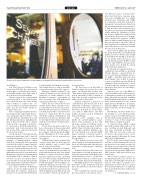
The doors to the Senate Chamber are seen open during recess during the 63rd Legislative Assembly in Helena. BEACON FILE PHOTO
tion. They are open to every state legis- lator, they don’t have corporate mem- bers and everything they do is public and disclosed,” Johnstone said. “ALEC is a departure from that tradition of transparent, non-partisan or bipartisan law reform movements. It is a new mod- el. And in all the states in which it oper- ates there are questions about whether it falls within the definition of lobby- ing because, unlike the traditional law reform model that is based on nonpar- tisan, disinterested expertise, ALEC’s model is built around bringing special interests literally to the same table as state legislators to formulate policy and export that policy to the states without the same level of disclosure.”
Ties between ALEC and the FGA, the group promoting an anti-Medicaid agenda across the country, came to light in 2013 when the watchdog group Cen- ter for Media and Democracy’s open records lawsuit against ALEC revealed evidence that lobbyists and special in- terest groups were driving its agenda rather than state legislators.
Specifically, the lawsuit showed co- ordination between FGA vice president Christie Herrera – previously the di- rector of Health and Human Services for ALEC – and Wisconsin state Sen. Leah Vukmir, who worked in tandem to pass a resolution opposing Medicaid expansion. Herrera even went so far as to write scripts for legislators to parrot when they introduced the anti-Medic- aid resolutions.
Herrera is also one of the FGA’s se- nior fellows who has provided assistance to Montana’s legislators in crafting the GOP’s Medicaid reform plan, including an FGA instructional article on how to draft reform measures for the federal Supplemental Nutritional Assistance Program (SNAP), titled, “It’s a SNAP: Model Language for Food Stamp Re- form.”
But Thomas, the Stevensville sena- tor working to revise Medicaid laws, said he reached out to FGA for help, not the other way around, and made his own revisions to some of their suggestions rather than accepting it as gospel.
“I contacted them (FGA) seeking their help dealing with health care is- sues revolving around Medicaid, and they were absolutely wonderful,” he said. “This was not some cookie-cut- ter deal to take another state’s resolu- tion and bring it to Montana. It’s about what’s best for Montanans.”
Rob Cook, the senator from Conrad, said there’s nothing unusual about seek- ing expertise from outside groups, but not all are created equal. Last session, he and other lawmakers brought in outside experts from the reputable PEW Chari- table Trusts to help draft a bill on pen- sion reform.
“We used those folks in a more-or- less bipartisan matter as a resource for both sides, and I thought it went pretty well,” he said. “There are plenty of or- ganizations out there that are reputa- ble and useful and want to do right, and they aren’t funded by those billionaires out of Kansas.”
[email protected]
and influence.
Sen. Chas Vincent, R-Libby, recent-
ly introduced SB 262, the controversial water rights accord with the Confeder- ated Salish and Kootenai Tribes that is more than 15 years in the making.
Vincent opposed the compact when it was presented to the 2013 Legisla- ture, but in the past two years, he and others worked to address the con- cerns of irrigators and tribal members alike, and he now stands among its strongest advocates.
But a “campaign of misinformation” has inundated the Capitol halls this ses- sion, and despite his best efforts – Vin- cent distributed a detailed packet to all 150 Montana legislators explaining the finer points of how the water compact works and the consequences if it fails – he can’t seem to break through the im- penetrable wall of prevarication that has obscured the compact at the hands of out-of-state groups.
“As the sponsor of the bill, and hav- ing spent so much time on it, I can’t tell you how frustrating it is to see copious amounts of misinformation coming from these groups who have sprung up strictly as the result of compact negotia- tions over the past couple of years,” Vin- cent said. “I am hopeful that in the end, lawmakers are not going to listen to the individuals who are not even residents of Montana, people who are sending emails and YouTube videos and flyers. That is not how you have good policy discus- sion. You have good policy discussion by addressing the facts, and that’s what I’ve been doing until I’m blue in the face.”
Sen. Bruce Tutvedt, R-Kalispell, said he’s been personally attacked for advocating the compact’s ratification, and was even censured by the Flathead
County Republican Committee for alleg- edly raising money to oppose hardline conservatives who oppose the compact.
Although Tutvedt dismissed the censure as meritless, he can’t ignore the rising tide of outside influence on the Montana Legislature, particularly as advocacy groups take aim at Medicaid expansion and the water compact.
“There has never been this level of outside money where they hire these so-called experts to obscure the issues,” Tutvedt said. “I have never seen this lev- el of dark money where you don’t know where it’s coming from. We are seeing it with the compact, with Medicare and Medicaid, it just keeps churning. And we don’t know where that money is com- ing from. It’s dark. Nobody knows who is paying them.”
On the other side of the compact de- bate, critics point out that a group called Farmers and Ranchers for Montana, a pro-compact coalition, has hired a high- profile, Washington, D.C.-based public relations firm to cast its own spin over the compact.
While perhaps the most glaring, the current session isn’t the first time that outside influence and so-called “dark money” has reared its head.
Sandy Welch, organizer of an initia- tive to rein in dark money, is working on a bill with Republican state Sen. Duane Ankney to require all political organi- zations to fully disclose who’s donating money to their groups and how they are spending it on campaigns. But the bill would only apply to donors making con- tributions during an election cycle, and the level of dark money influencing the Legislature while it’s in session is a rela- tively new phenomenon, Welch said, and one not subject to disclosure under elec-
tioneering laws.
“We have never seen this kind of
behavior during the session. It’s a new game,” the Martin City resident said. “The mailers and everything are com- pletely unregulated. This is defined as issue advocacy and everybody has the right to promote their ideas.”
Anthony Johnstone, a professor of constitutional and election law at the University of Montana, said there’s a distinction between the what triggers disclosure in instances of issue advo- cacy, such as AFP’s flyers, and what triggers disclosure in more traditional forms of lobbying.
Other newer examples, such as ALEC, the model-legislation organi- zation, don’t participate in the same disclosure system as lobbying groups. One of the biggest questions raised by ALEC critics is whether the group’s ac- tions legally constitute lobbying activ- ity, even though, as a nonprofit, ALEC hasn’t registered or disclosed any lob- bying expenditures with the Internal Revenue Service.
“That deprives not just voters but other legislators from knowing whether there are hidden agendas driven by ma- jor funders of front groups,” Johnstone said.
In American state politics, there is a long tradition of reform groups promot- ing policy innovation and helping states adopt legislative policies – groups like the National Conference of State Legis- latures and the American Law Institute.
But ALEC appears to be a departure from those groups, Johnstone said, and has come under fire for its lack of trans- parency.
“The reputable law reform groups have no partisan or ideological connec-