


Page 10 - Flathead Beacon // 3.25.15
P. 10
10 | MARCH 25, 2015 NEWS FLATHEADBEACON.COM Oil Train Fires, Leaks Put Rail
Just
Sayin’...
“Today, I am announcing that I am running for president of the United States. It is a time for truth, it is a time for liberty, it is a time to reclaim the Constitution of the United States.”
Texas Sen. Ted Cruz, a Tea Party favorite, announcing his bid for the White House. He is the first high-profile candidate to officially announce his candidacy.
“Anyone in Montana, gun owner or not, can agree we need to keep guns out of the hands of dangerous people, be they criminals
or people who are
seriously mentally ill.”
Jonathan Hutson, a spokesperson for the Brady Campaign to Prevent Gun Violence, speaking about David Lenio, the Kalispell man who pleaded not guilty to charges of criminal defamation and intimidation after allegedly threatening to shoot up a school. Hutson was the first to notice Lenio’s online posts.
“You were looking to the future and ultimately willing to invest in the future and how students learn.”
Gov. Steve Bullock on the
opening of the new $22.5 million Whitefish High School.
Safety Back in the Spotlight
BNSF Railway discovers that a train that ran through the Flathead Valley had been leaking oil on its way to Washington
By JUSTIN FRANZ of the Beacon
In mid-January, BNSF Railway employees in Houser, Idaho discovered oil on the side of a tank car that was part of a 100-car train traveling from North Dakota, through Northwest Montana, to Anacortes, Washington.
The car was inspected and removed from the train. Accord- ing to BNSF officials, it appeared that there were no other cars leaking. However, by the time the train was delivered to the oil refinery north of Seattle, oil was discovered on the side of 15 other tank cars.
The discovery led the Federal Railroad Administration to issue a directive this month ordering tank car owners to replace faulty valves that are prone to leaking. The leaking tank cars, coupled with four explosive oil train derailments across North America in February and March, has once again put the movement of oil-by-rail under scrutiny.
After railroad employees discovered and removed the first leaking car in Hauser, the train continued southwest through Washington and along the Columbia River, to Vancouver, where oil was found on seven other tank cars. As the train continued north to its destination, another six cars were removed in Auburn and two more were found to be leaking oil from the car’s top valve at the refinery north of Seattle. In all, BNSF and Tesoro Refin- ing discovered that 16 of the oil train’s 100 cars had minor valve leaks.
According to railroad spokesperson Matt Jones, about 26 gal- lons of fuel had leaked from the cars (one rail tank car can haul 30,000 gallons) and it appears most of the fuel ended up on the tops or sides of the cars. Jones said that no oil has been discov- ered along BNSF’s right-of-way through North Dakota, Montana, Idaho and Washington.
When the leaks were discovered, the railroad notified Washington environmental officials and the U.S. Department of Transportation. In Vancouver, Federal Railroad Administration inspectors looked at the seven tank cars that had been removed there and found that the top valve fitting seals, made by McKenzie Valve & Machining, were broken. Inspectors found that the valves used on the tank cars, which are owned by the Union Tank Car Company, were not consistent with the standards set by the Association of American Railroads. On March 13, the FRA issued a directive for all tank car owners to replace the faulty valves
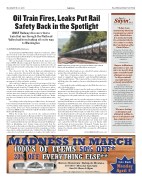
A BNSF freight train carrying tank cars back to the Bakken region of North Dakota rolls through Nyack, east of West Glacier. BEACON FILE PHOTO
within 60 days. Most tank cars are owned by leasing companies and not the railroads that move them.
“Any type of hazardous materials release, no matter how small, is completely unacceptable,” said Acting FRA Adminis- trator Sarah Feinberg. “The removal of these valves from service will help reduce the number of non-accident hazardous materials releases.”
Jones said the railroad fully supports the FRA directive to re- place the faulty valves.
“Although BNSF does not own the tank cars, nothing is more important to us than safely operating through the communities that we serve,” he said. “We will work closely with our customers and shippers as they undertake the steps outlined in the direc- tive.”
But leaking tank cars are not the only issue to have cropped up along North America’s rails this year. In less than three weeks, beginning in mid-February, four oil trains derailed and exploded in North America, including two in Ontario, one in West Virginia and another in Illinois. All four trains that derailed had the CPC- 1232 tank cars, which were believed to be more puncture resistant and safer than the DOT-111 tank cars that were at the center of the deadly 2013 Quebec oil train wreck that killed 47 people and leveled 30 buildings in the small town of Lac-Mégantic.
Following the recent rash of wrecks, Canadian regulators mandated that shippers and railroads start using new tank cars, called the DOT-117, which feature an even thicker shell and thermal protection jackets. Transport Canada has also announced that all CPC-1232 cars, the ones that were meant to replace the old and outdated DOT-111 cars, must be off Canadian rails by 2025.
[email protected]
H
MADN
E
SS
I
N MARC
1000’S OF ITEMS 50% OFF*
EVERYTHING ELSE**
Sale Ends
Historic Downtown • Kalispell, Montana 756-5818 • Mon-Sat 9am-6pm
Sun 10:30am-4:30pm
*50% off originals prices **Excludes Whites.
Monday April 6th


