


Page 22 - Flathead Beacon // 6_10_15
P. 22
NEWS
COVER
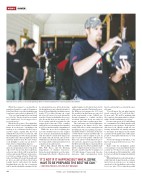
Rudy Geber tests his air filter as crews from the Libby Ranger District on the Kootenai National Forest train for deployment in OperableUnit 3.
While the response to a normal fire is anywhere from 60 seconds to 15 minutes, Sunell said that it can take firefighters up to an hour to get ready to work inside OU3.
“You can’t just jump in the truck and go to the fire like we would on a normal call,” Sunell said. “It’s a long process to get ready and go.”
When they do go into OU3 to fight fires – there has only been a handful of small blazes in recent years – firefighters can work up to 10 or 12 hours. Brent Cooper, another engine captain who has been with the Forest Service for 18 years, said that firefighting in OU3 is tiring and that the masks reduce their peripheral vision and their ability to hear. Because of that, each firefighter carries an air horn to warn others of impending dangers.
After a shift, firefighters have to clean up in decontamination tents set up at the edge of OU3. In one tent, they soak them- selves in water while still wearing their clothes and masks. This prevents asbes- tos from becoming airborne. Then they take everything off except the masks and go into a second tent where they take a regular shower and remove the masks, handing them over the top of a privacy wall to another firefighter assigned to the
decontamination area. After showering, the firefighters go into a third tent and get dressed. Everything the firefighters wear inside OU3 is either thrown out or put into the red boxes to be used during the next fire. Items, including fire hoses, are also discarded after one use inside OU3. Tools, trucks and off-road vehicles (the ranger district has two UTVs, or utility task vehicles, used exclusively to fight fire in OU3) are washed and decontaminated.
While the protocols for fighting fire near the old mine have become tougher in recent years, in many ways, firefighters still don’t know exactly how dangerous the smoke and ash is from a fire in OU3. Until this year, the dirt and bark from the forest has only been burned and tested on a small scale in a laboratory.
But in May, officials with the USFS, EPA, W.R. Grace, and the Montana Department of Natural Resources, burned a small slash pile near the mine. During and after the fire, officials took air
quality samples to determine the toxicity of the smoke and ash. Christina Progess, the EPA’s project manger for OU3, said the results from that burn are expected in the next month or two. Officials are already planning to conduct another test burn, this time about one-tenth of an acre, in late June to gather more data.
The test burns come as the EPA turns its attention to the future of OU3. Cur- rently, W.R. Grace (with oversight from the EPA and others) is putting together a feasibility study to determine how parts of OU3 will be cleaned and what type of institutional controls might be put in place to protect the public. Officials say that some asbestos will always be pres- ent on the site, in part, because it is where the EPA currently disposes material from the cleanup in town. The feasibility study will be completed in the next year or two. It is also possible that the boundaries of OU3 will change, Progess said. In some instances, high contamination levels
have been found in trees outside the oper- able unit.
“It’s still up in the air what institu- tional controls in OU3 will look like,” Progess said. “We will be working with the county to determine what’s realistic, what’s feasible and what’s necessary.”
Because some parts of OU3 will always be contaminated, it is likely that fire will always be a concern there. If a larger fire did start, local officials would use sta- tionary and mobile air quality stations to determine how dangerous the smoke and ash is for the public and could require people to stay inside their homes or even evacuate.
“It’s not if it happens but when, so we have to be prepared the best we can,” Pro- gess said.
That’s why the firefighters gather every spring to train. And while the fire activity in OU3 has been scant, with a low snowpack and dry spring this could be the year all that training is finally put to use.
While fighting fire is already an inher- ently risky job, doing it in such a contam- inated area is even more so. A common question for the firefighters who volun- teer to go into OU3 is why they would
22
JUNE 10, 2015 // FLATHEADBEACON.COM
“IT’S NOT IF IT HAPPENS BUT WHEN, SO WE HAVE TO BE PREPARED THE BEST WE CAN.”
- CHRISTINA PROGESS, EPA PROJECT MANAGER


