


Page 56 - Flathead Beacon // 6.15.16
P. 56
OUT OF BOUNDS 57 EXPLORE 58 Outdoors
Partnership Aims to Piece Collaboration Back into Forest Plan Diverse stakeholders hopeful that  nal plan re ects collaboration
AS THE REVISED FLATHEAD National Forest Plan enters the most recent phase of public com- ment, members of a diverse coalition of stakeholders who collaborated on the draft document are regrouping to weave a spirit of collaboration into the  nal plan.
Formed in 2012, the White sh Range Partnership is a coalition of longtime adversaries who banded together to help inform management of public lands on the Flathead National Forest.
After nearly three years of meetings and analysis, the Flathead National Forest released the draft version of its revised forest plan last month, unveiling a proposed blueprint for all aspects of management on the Flathead National Forest, from recreational opportunities to designated wilderness, timber produc- tion, wildlife and habitat.
But the U.S. Forest Service did not select a preferred alternative among its four proposals before opening the mas- sive long-term steering document to pub- lic comment, which will last 120 days and close Sept. 26.
That was cause for surprise by some members of the partnership, who said none of the alternatives featured a sin- gular measured balance of forest uses the group worked so hard to craft.
Dave Hadden, of Headwaters Montana, who was tasked with drafting the initial recommended wilderness document for the White sh Range Partnership, said elements of the collaborative process are scattered throughout the various alterna- tives, but none of them weave the tapestry of balance the group strove to achieve.
“I’m personally surprised that there was no preferred alternative, given the consid- erable amount of public input and com- ment that the Forest Service has already received,” Hadden said. “The bottom line is that you don’t see any of the collabora- tive elements within the document, so ulti- mately the partnership will work to reiter- ate the areas that it was able to agree on.”
The White sh Range Partnership rep- resented three-dozen interest groups who historically clashed over public land use on Montana’s forests and sought to strike a balance that blended new wil- derness with timber production, mar- ried non-motorized with motorized rec- reation, and commercial interests with wildlife protections.
Speci cally, the longtime adversaries thrashed out the details of a proposal that covers the vast chunk of the White sh Range that lies in the Flathead National
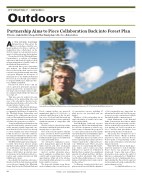
Lands and Resource Manager Paul McKenzie discusses forest management during a tour of F. H. Stoltze land in Haskill Basin. BEACON FILE PHOTO
56
JUNE 15, 2016 // FLATHEADBEACON.COM
Forest, coming together on a proposed management plan for 300,000 acres – a relatively small fraction of the 2.4 mil- lion acres of federal land that make up the local national forest, but requiring a signi cant amount of compromise and concessions.
The Forest Service has developed four alternatives within the plan that include varying degrees of priorities.
Two of the four alternatives identify a range of between 98,000 and 506,919 acres of recommended wilderness while a fourth alternative proposes no additional recommended wilderness.
One alternative emphasizes a more active management approach through timber harvest and other mechanical means, identifying up to 22 percent of the forest as suitable for timber production.
And yet another alternative places heavy emphasis on adding more back- country and non-motorized recreation opportunities, while all of the alterna- tives identify added options for so-called frontcountry recreation.
The proposals identify seven threat- ened or endangered species and 32 species
of conservation concern, including 25 plant species, six terrestrials and one aquatic.
Members of the partnership say no single alternative is tenable on its own, at least at  rst blush.
Paul McKenzie, lands and resource manager for F.H. Stoltze Land and Lum- ber, said the document as a whole cap- tures a range of elements the group tried to come together and meet in the middle on, but the  nal version will likely require piecing together the varied interests.
“I think they did a reasonable job of at least capturing the points people were trying to make in the collaborative pro- cess,” McKenzie said. “There are parts and pieces of certain things like wilder- ness, timber and recreation uses that will have to be parsed out. I think we’ll  nd that there is going to be a signi cant amount of feedback and there will have to be another alternative that cobbles together these di erent pieces to create a balance. But right now we’re just scratch- ing the surface.”
Joe Krueger, team leader for the forest plan revision, has said that the dynamics
of the partnership were important in informing the plan, and that the agency is eager to receive constructive feedback through the public comment period.
Sarah Lundstrum of the National Parks Conservation Association, which helped broker the partnership, said the diverse stakeholders spent more than a year  guring out “how to speak in one voice,” and the draft plan makes clear that the group has more work ahead.
The group was scheduled to meet with Forest Service o cials on Stoltze property on June 13, after the Beacon went to print, to begin hashing out the  ner points of the plan’s environmental impact statement.
“This will be the  rst in-depth oppor- tunity for members to look at what the Forest Service has produced,” Lund- strum said. “I agree that none of these alternatives alone capture the spirit of what we recommended, so I think there is going to be a lot of picking and choos- ing from what the Forest Service put out and weaving back together a plan that the partnership agreed on.”
tscott@ atheadbeacon.com


