


Page 21 - Flathead Beacon // 7.6.16
P. 21
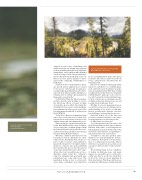
The South Fork Flathead River runs through the Bob Marshall Wilderness. BEACON FILE PHOTO
A westslope cutthroat trout on the South Fork Flathead River.
GREG LINDSTROM | FLATHEAD BEACON
adopted over the course of millennia, and which vary from one neighboring tributary to the next. Although morphologically indis- tinguishable, cutts caught in either Danaher Creek or Young’s Creek—the two main trib- utaries that form the South Fork at its con-  uence—possess genetic markers so diver- gent it’s like comparing a Chihuahua to a Dalmatian.
Scientists now recognize that these drain- age-speci c genetic adaptations are critical to the species’ survival, and rescuing, pre- serving and propagating their genetic diver- sity is the new end goal and the driving force behind a suite of cutting-edge management plans and research studies.
In Northwest Montana,  sheries manag- ers have spent decades working to reverse the deleterious e ects of legacy stocking of nonnative species while  ne tuning the interplay between science-based manipula- tion and nature in order to protect one of the last remaining strongholds of cutthroats in the LOWER 48.
Today, those e orts are beginning to show signs of success, despite a host of new chal- lenges foisted on the native trout species by climate change and other human stressors.
Native westslope cutthroats found in the South Fork Flathead River and elsewhere are precious gems, each  sh equipped with the genes and genetic wiring of its ancestors, traits developed speci cally for survival in a harsh northern Montana climate.
Westslope cutthroat trout have lived in post-glacial western Montana for thou- sands of years. During that time, the species has been able to survive catastrophic  res, massive  oods and severe droughts. And yet in the two centuries since Lewis and Clark  rst inscribed the species into the nation’s vernacular during their famed 1805 expe- dition—the trout’s scienti c name is Onco- rhynchus clarki lewisi—the cutthroat’s range has dwindled and genetically pure populations have come under siege. The population decline is due to stream silt- ation, dams, over shing, and competition
from—and hybridization with—introduced nonnative  sh such as rainbow and brook trout, a phenomenon exacerbated by the warming world.
But a new era of  sheries management has taken root, and e orts to re-establish, jump- start and bolster genetically pure popula- tions are gaining ground, while the potential for applications in other historic strongholds is bright. Massive, landscape-scale conserva- tion e orts are in the works, including trans- location of native species, drainage-speci c stocking, eradication of invasive species, and rearing of genetically pure trout.
Working in concert, management agen- cies and researchers are developing a clearer understanding of the trout’s evolutionary history, overall genetic diversity, conserva- tion challenges, and reproductive success.
And still, despite all of the time and resources exhausted trying to save native trout populations, one question persists.
So what? Isn’t a trout a trout?
“I get that question all of the time,” said Chris Downs,  sheries biologist for Glacier National Park, where a new blueprint for  sh management is in the works, and for the next two decades will serve as a guiding doc- ument for native trout conservation.
“I think it’s a very fair question, and I think we are demonstrating the answer,” he continued. “Beyond the ecological value, there is a cultural and social value. That is why you see as many rod cases as suitcases at our airport. They are here to  sh our native trout.”
Trout  shing brings in tens of millions of dollars in Montana alone, and many anglers are especially eager to catch native cutthroats—they’re as selective about their trout as the trout are about spawning in their natal waters. Westslope cutthroat are among western Montana’s original salmonid
JULY 6, 2016 // FLATHEADBEACON.COM
21


