Page 18 - Flathead Beacon // 7.9.14
P. 18
18 | JULY 9, 2014 NEWS FLATHEADBEACON.COM
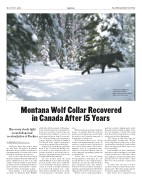
A trail camera in Waterton captured this wolf that dispersed from a pack in North Idaho. COURTESY OF KENT LAUDON
 Montana Wolf Collar Recovered in Canada After 15 Years
Discovery sheds light on wolf dispersal, recolonization of Rockies
By TRISTAN SCOTT of the Beacon
Biologists know that wolves range far and wide throughout Northwest Montana’s dense swaths of wilderness, having naturally recolonized the region after their extirpation 80 years ago.
But a radio collar that turned up in British Columbia’s North Fork Flathead River, administered as part of an early study to help shed light on how wolves proliferate, bolsters data that wolf biolo- gists continue to find valuable to under- stand the elusive and nomadic animal.
Kent Laudon, a wolf management specialist for Montana Fish, Wildlife
and Parks, which assumed wolf manage- ment from the federal government three years ago, recently recovered a radio col- lar that had been affixed to a 2-year-old male gray wolf more than 15 years ago. The collar was lying on the ground in a remote drainage of British Columbia’s North Fork, about 62 miles from where researchers captured the wolf in 1999.
Deployed by Tom Meier and Diane Boyd of the U.S. Fish and Wildlife Ser- vice’s wolf recovery team, the radio col- lar was attached to wolf 4387, who be- longed to the South Camas pack in the North Fork Flathead drainage.
He was tracked with the pack through March of 2000, when he disap- peared, and the collar was recently dis- covered 61.8 miles from his capture lo- cation. It looked as though it may have been chewed off, Laudon said – some- times wolves will help divest one anoth- er of the nuisances – though he can’t be
sure.
While Laudon doesn’t know with any
degree of certainty what the wolf was doing so far from home, he said it’s likely the wolf set out to begin his own pack, or join another, as a disperser.
Wolf dispersal has been a critical behavior in maintaining the genetic di- versity of a pack because it keeps incest rates down, helps balance the wolf-to- ungulate ratio of a population niche, and also reveals how effective they are at breeding and expanding populations geographically.
“Incest rates are very low among wolf populations. Sometimes the crit- ters themselves seem to understand re- latedness,” he said. “It’s almost like the genes themselves have this instinct. Somehow wolves just know, and disper- sal helps a pack maintains itself with the right amount of wolves for a given area.”
Wolves seem to understand when a
pack has reached a tipping point, and if the pack isn’t providing enough food for all of its members, certain wolves will peel off and travel long distances to find another pack or breeding female.
“The theory is that they leave for breeding rights,” Laudon said. “Wolves can be long-distance dispersers, so they can literally go hundreds of miles when they leave their pack. They can go very far, very quickly.”
Some animals are more submissive than others and seem happy to stay with a single pack forever, but others either have alpha personalities that make them predisposed to become breeders, or they have been ostracized due to inner-pack strife.
“It delves into the aspect of biol- ogy that really gets inside their heads,” Laudon said. “They have unique and dif- ferent personalities, just like dogs.”
Gray wolves were eradicated from