


Page 21 - Flathead Beacon // 8.17.16
P. 21
n Aug. 25, 1916, President Woodrow Wilson picked up a dip pen in the White House and scratched his sig- nature on H.R. 15522, the Organic Act, creating the National Park Service.
That simple act of putting pen to paper was the culmination of years of work by naturalists, con- servationists and even industrialists to convince the federal government to create a sin-
gle bureau to care for the 7,290 square miles of park land set aside for the enjoy- ment by the masses.
departed Chicago at 10:15 p.m., arriving in East Gla- cier Park two days later. Those on a budget could secure a spot aboard a lower-class sleeping car for as cheap as $4.75 from Chicago and $3.75 from St. Paul. Regardless of class, however, the train was a luxurious, albeit time-consuming, means of travel- ing across the landscape, according to author Mary Roberts Rinehart, who published “Through Glacier Park” in 1916.
But in the wilds of Northwest Mon-
tana, the creation of a parks bureau passed with lit- tle fanfare in Glacier National Park, which was in the midst of another busy summer tourist season (about 12,800 people visited the park that year, which today is about the same number that passes through the west entrance on an average day in July). Of course, back then, it wasn’t possible to spend a day driving through the park on Going-to-the-Sun Road, which wouldn’t be completed for another 17 years and stands out today as one of the region’s most popu- lar attractions.
ple drop-curtain of the mountains,” she wrote. “An occasional cowboy silhouetted against the sky; thin range cattle; impassive Indians watch- ing the train go by; a sawmill, and not a tree in sight over the vast horizon. Red raspberries as large as strawberries served in the diner, and trout from the mountains that seemed no nearer by mid-day
than at dawn.”
The wooden depot at East Glacier Park (which
still greets Amtrak passengers twice a day) was the  nal stop for passengers heading west to visit the new national park. Blackfeet Indians were hired by the railroad to greet passengers and perform tradi- tional dances at the station and the nearby Glacier Park Lodge that was built and opened by the rail- road in 1913. On occasion, the railroad would even pay the Blackfeet extra to induct special guests into the tribe, which in later years included President Franklin Roosevelt, actor Clark Gable and a prince from Norway. After taking in the show at the sta- tion, passengers would walk across the street to the massive lodge.
The Great Northern Railway built a chain of hotels and chalets in and around Glacier Park in the early
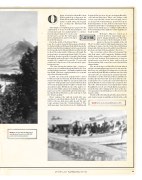
BELOW Tourists on a boat on Lake McDonald, circa 1915.
“The idea of doing the park in a day – of just get- ting in your car and driving up the Sun Road – was an impossibility (in 1916),” said author and historian Ray Dju . “This was a park that had to be seen and experienced from its trails.”
In 1916, one of the most popular ways to travel to Glacier Park was by train. Great Northern Rail- way President Louis Hill was an ardent and early supporter of the park because he knew that such an attraction along his rail line would boost ticket sales aboard his trains. Within weeks of the park’s cre- ation in 1910, Hill’s ad men were  lling city news- papers across the country with advertisements pro- moting the Great Northern as the only way to visit the “American Alps.”
Every summer, the railroad would o er spe- cial fares to and from Glacier Park. It cost $48 in 1916 to ride in a  rst-class cabin aboard the rail- road’s premier train, the “Oriental Limited.” The daily passenger train featured electric lighting and
“Getting to (Glacier), remote as it byjustinfranz seemed, had been surprisingly easy – almost disappointingly easy. Was this, then, going to the borderland of civili- zation, to the last stronghold of the old West? Over  at country, with inquiring prairie dogs sitting up to inspect us, the train of heavy Pullman diners and club cars moved steadily toward the pur-
ABOVE Two buses heading into Many Glacier along Sherburne Reservoir, circa 1915-1920. ALL PHOTOS COURTESY OF NATIONAL PARK SERVICE
AUGUST 17, 2016 // FLATHEADBEACON.COM
21


