


Page 33 - Flathead Beacon // 8.26.15
P. 33
ECONOMIC INDICATORS 34 FINANCIAL CORNER 37 CORPORATIONS 40 BUSINESS IS PERSONAL 41 Business Monthly
NATURAL RESOURCES & ENERGY
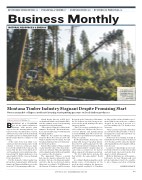
A feller buncher places a tree in a pile to hauled out by a grapple skitter at a trimming project on state land near Echo Lake. BEACON FILE PHOTO
Montana Timber Industry Stagnant Despite Promising Start Overseas market collapses, moderate housing starts putting pressure on local timber producers
BY MOLLY PRIDDY OF THE BEACON
EGINNING AS A PROMISING year for the timber industry in Montana, with modest gains
expected as the housing industry con- tinues to bounce back from the recession, 2015 has lost a good deal of its momentum for lumber producers, while plywood and fiberboard production continues to stay strong.
At the start of the year, while econ- omists predicted housing starts would continue to increase, acting as a major boon for the industry, there was also the notion that the pine-beetle kill in west- ern Canadian forests would slow produc- tion, giving U.S. lumber mills more of an opportunity to fill the overseas demand for wood products.
But the domestic timber market has hit another stagnant point, with market plunges in China and wildfires across the western U.S. throwing up roadblocks.
Chuck Roady, director at F.H. Stol- tze Land and Lumber in Columbia Falls, said the summer started out promising enough after a sluggish spring.
“There was a resurgence earlier in the summer,” Roady said. “But now the mar- ket is just totally being overwhelmed by Canadian lumber.”
While the U.S. market was suffering from the Great Recession in 2008, the Chinese markets were booming. U.S. and Canadian lumber producers found a mar- ket for their logs there.
But just this summer, China’s market crashed and the value of the yuan depre- ciated. As of Aug. 24, China was planning on flooding its market with new liquidity to counteract the devaluation.
The juggernaut Chinese economy had caused a massive demand for wood products, but once the financial market started to dip, the need slowed. And at this point, according to Todd Morgan of the Bureau of Business and Economics
Research at the University of Montana, the U.S. dollar is one of the strongest cur- rencies in the world, making it the most attractive market.
“The U.S. is a more profitable place to sell to right now,” Morgan, the director of forest industry and manufacturing research at BBER, said. “We’re not boom- ing, but we’re probably the best market in town, so to speak.”
For Roady at Stoltze, that means com- peting with cheaper Canadian lumber. Since the U.S. and Canada have two dif- ferent systems for harvesting logs, Roady said Canadian lumber companies have an easier time accessing trees for harvest when compared to the American system.
“It’s two totally diverse systems, but they sell into the same market,” Roady said.
According to Random Lengths, a well- known source of information for the wood-products industry, the American dollar equaled roughly $1.30 Canadian
in July, and the softwood lumber agree- ment (SLA) between the two countries dropped its tax from 15 percent to 5 percent, making the U.S. market more attractive.
“They can way overproduce what they need domestically in Canada so they’re bringing it here and it just smothers our market,” Roady said.
Stoltze has been running its mills in the Flathead at 50 hours per week instead of 80, Roady said. Not only is the market affecting mill hours, but supply is still an issue, he said.
Log prices remain high, up 3 percent from where they were at this time in 2014 and only down 1 percent from the first quarter of 2015, Morgan said.
Mills in Montana are still paying a hefty price for logs, Morgan said, and private landowners tend to be sensitive to price changes and often sell during
CONTINUED ON PAGE 35
AUGUST 26, 2015 // FLATHEADBEACON.COM
33


