


Page 62 - Flathead Beacon // 8.26.15
P. 62
OUT OF BOUNDS 63 Outdoors
Conservation Deal Struck on Prized Land North of Whitefish Whitefish Lake Conservation Project seeks to protect more than 15,000 acres of critical wildlife habitat
BY TRISTAN SCOTT OF THE BEACON
Tangent to the conservation puzzle of Northwest Montana, a colossal piece began falling into place this week when the Trust for Public Land and Plum Creek announced a partnership to conserve 15,334 acres of the timber giant’s forested property north of Whitefish Lake.
The Whitefish Lake Conservation Project marks the culmination of years of work by land managers and environ- mental groups who recognized the devel- opment pressure that could bear down on the prized landscape above Whitefish Lake, which is flanked by the Stillwater State Forest, laced with creeks and trib- utaries and provides some of the most critical habitat to grizzly bear, lynx, bull trout, cutthroat trout, elk, wolves, and white-tail deer in the state.
With its rarefied mix of forested parcels and low wetlands, the block of land offers key habitat connectivity and migration paths between the Whitefish Range and the Cabinet Purcell Mountain Corridor.
“This property has been on our radar for quite some time,” said Alan Wood, regional wildlife mitigation coordinator for Montana Fish, Wildlife and Parks. “It’s a great hunting area, it’s got an exceptional amount of bull trout spawn- ing and rearing habitat and it’s right next to the growing community of Whitefish, so you can imagine the development potential. And wildlife-wise, it has that low-elevation, wet-meadow-and-forest mix. And because it’s surrounded by the state forest it’s this big block of habitat that is really connecting lands all around it.”
Under the agreement, the Trust for Public Land (TPL) will have an option to purchase 1,920 acres and establish a conservation easement on the remain- ing 13,414 acres, which Plum Creek will continue to own and manage as a working forest. The purchased lands will eventu- ally be transferred into public ownership or to a conservation buyer. The agree- ment is subject to final conditions includ- ing appraisal and secured funding.
Tom Ray, vice president of northwest resources and manufacturing for Plum Creek, said the collaboration with TPL is a “win-win” and falls in accordance with the company’s legacy of conservation in the region.
“We have a history of these projects, and when you think of the rate that Whitefish is growing and the importance
of this property to wildlife habitat and recreation, this just made sense,” Ray said. “And it will continue to be a working forest. That’s why it’s a win-win. We will continue to manage those lands for tim- ber production and keep our mills filled.”
While the conservation and recre- ation community praised the easement because it furnishes protections on criti- cal fish and wildlife habitat and provides continued public access for outdoor rec- reation, it will also help secure the city of Whitefish’s water supply, 20 percent of which is drawn from Whitefish Lake, which is immediately adjacent to the property.
Coupled with the nearby Haskill Basin project on land owned by F.H. Stoltze Land and Lumber Co. – the source of the city’s remaining water supply – the Whitefish Lake Conservation Proj- ect affords the final safeguard from the threats of development.
Whitefish Mayor John Muhlfeld said this summer has been a prime example of the city’s reliance on Whitefish Lake, from which it began drawing its water six weeks earlier than usual due to the his- torically dry conditions.
“Haskill Basin and Whitefish Lake are our only water supplies, and we started drawing from the lake in late June when historically we don’t start until early-to- late August,” Muhlfeld said. “Thinking a year or two ahead with our warming trends, the lake becomes increasingly important, and ensuring that its water quality is as clear as possible is critical.”
The cost of pumping and treating water from the lake is much more expen- sive, Muhlfeld said, and maintaining its pristine quality will save the community financially.
Alex Diekmann, project manager for TPL and a primary architect of the deal with Plum Creek, said if completed the easement will stand out as critically sig- nificant on its own. But when it and the other projects it complements are viewed for the sum of their parts, “it’s truly remarkable,” he said.
“When we start piecing together the various conservation projects we have helped coordinate, from a regional and even a national perspective, when you look at Haskill Basin, the North Fork Watershed Protection Act, the White- fish School Trust Lands Neighborhood Plan, these projects are all linked to clean water, wildlife, and, equally important, our economy,” he said. “I don’t think we can point to any other place in the
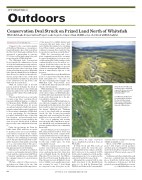
ABOVE The Trust for Public Land
and Plum Creek are collaborating
to protect 15,334 acres of forested
land north of Whitefish Lake.
COURTESY KESTREL AERIAL
LEFT Whitefish Lake Watershed Conservation Project aerial map. The Trust for Public Land and Plum Creek are collaborating to protect 15,334 acres of forested land north of Whitefish Lake.
62
AUGUST 26, 2015 // FLATHEADBEACON.COM
country where the range of projects has accomplished as much as it has in Whitefish.”
If Plum Creek and TPL reach an agreement, under the terms the proj- ect will unfold in three phases, with the first 1,920 acres to be acquired by TPL by the end of calendar year 2016 and the remaining parcels to be acquired at the end of 2017 and 2018, respectively.
Managing the easement will be sim- ilarly structured to the Haskill Basin project, to be held by Montana Fish, Wildlife and Parks in the long run while
ensuring that it’s managed to sustain wildlife and public access.
Wood, of the FWP, said funding the project will require several partners, and that agencies will apply for funding under the federal Forest Legacy Program immediately. That program caps at $7 million.
Diekmann and other stakeholders said they were confident that other funding pieces would also fall into place given the significance of the project, but that private donors would likely be necessary.
[email protected]


