


Page 33 - Flathead Beacon // 8.31.16
P. 33
ECONOMIC INDICATORS 34   FINANCIAL CORNER 37  BUILDING PERMITS 39  CORPORATIONS 40
Business Monthly
ENERGY
SOLAR ENERGY
TAKES ROOT
IN THE FLATHEAD
Community solar project from Flathead Electric Cooperative highlights opportunities in renewable resource development
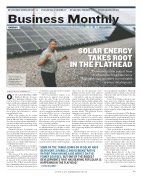
Ross Holter, director of energy and member services with Flathead Electric Cooperative, explains the Solar Utility Network.
GREG LINDSTROM | FLATHEAD BEACON
OBY MOLLY PRIDDY OF THE BEACON
UT IN A GRAVEL FIELD, NEXT to Flathead Electric Coopera- tive’s humming Stillwater Sub-
station, sit four sections of future plans, hopes, and ideals soaking up the sunlight. More than 350 solar panels stand sen- tinel just north of the intersection of White sh Stage Road and Reserve Drive, put in place last September to absorb
energy from the sun.
While solar panels are no longer
uncommon, the Sun Utility Network pro- gram is di erent. Like a community gar- den, this program allows individuals to purchase a single panel in the huge array, and each person reaps the bene ts that the panel produces.
Flathead Electric Cooperative has spearheaded the project for the last few years, and with the o cial dedication cer- emony last September, 356 panels in four sections went online. And of those pan- els, all but 17 were already purchased as of last week, according to FEC spokesper- son Wendy Ostrom Price.
“We didn’t know how it was going to go, so we’re very happy with this,” Ostrom Price said, standing in front of the panels last week.
The success of the project has been exciting for FEC, a company that usually deals with the distribution side of power, as opposed to the creation and cultiva- tion side. The SUN program, Montana’s  rst community solar project, has diver- si ed the cooperative’s energy interests,
Ostrom Price said, and was driven largely by consumer demand.
“We’ve had members express to us their desire to support solar develop- ment,” she said. “People are not buying these solar panels because it’s an econom- ically viable thing to do. They’re doing it to support solar energy. We’re doing it to meet their needs and diversify.”
While it’s true the numbers don’t pen- cil out to automatic wealth, the solar pan- els in the SUN project are a long-term investment. The initial cost is about $900, but after a federal tax credit knocks o  30 percent, a panel costs about $630. This amount can be paid up front, or in $75 per month payments.
Owners can expect to generate about 30 kilowatt-hours per month on their individual panel, and then that power is credited to their account as it goes into the grid. Ross Holter, director of energy and member services, said it equals about $25 per year.
That means the panel will pay for itself in about 21 years, Holter said, though the
owner does get the advantage of pre- paying for power for the next couple of decades at a rate they locked in this year.
Ostrom Price said one customer pur- chased 19 panels, e ectively paying for the power he will need in his simple cabin for the rest of his life. Another woman in her 90s bought panels for each of her grandchildren, knowing she would not see the  nancial payback but hoping her progeny would. (The Flathead Beacon owns two panels as well.)
SUN has made solar energy more accessible, Ostrom Price said, because people don’t have to spend thousands of dollars on home solar kits or worry about installing them on a rental or home they might leave. Already, similar projects have popped up in Missoula and Ravalli counties.
Patrick Barkey, the director of the Bureau of Business and Economic Research, said the interest in such proj- ects shows the emotional connection to renewable energy sources, but there are still many hurdles facing the industry,
most notably the inability to e ciently and e ectively store wind or solar energy when the wind isn’t blowing or the sun isn’t shining.
“Some of the things going on in solar have been more symbolic and demon- strative rather than having a big impact on the power sources,” Barkey said. “But one of the biggest developments that has bearing for solar is happening in the Flathead.”
Barkey was referring to ViZn Energy Systems’ new battery prototype, which is making strides, particularly with inter- est from Germany. But the lack of a stor- age system still plagues many renewable energy projects, Barkey said, because the peak hour of energy usage is rarely during the heart of a sunny day.
“That (peak hour) is usually in the winter, at least in Montana, and is often in the early morning in the winter,” Bar- key said.
Tax credits are another potential road- block in the future for renewable energy source development. The current fed- eral credit knocking 30 percent o  solar installations will end on Dec. 31, shifting down to 26 percent, and then 22 percent before it fully expires in 2021.
Mike Kadas, director of the state Department of Revenue, said the fed- eral tax credits have more of an impact on people’s decisions than smaller state tax credits do, but many Montanans have taken advantage of the state’s  nancial
CONTINUED ON PAGE 35
“SOME OF THE THINGS GOING ON IN SOLAR HAVE BEEN MORE SYMBOLIC AND DEMONSTRATIVE RATHER THAN HAVING A BIG IMPACT ON THE POWER SOURCES, BUT ONE OF THE BIGGEST DEVELOPMENTS THAT HAS BEARING FOR SOLAR IS HAPPENING IN THE FLATHEAD.”
- PATRICK BARKEY
AUGUST 31, 2016 // FLATHEADBEACON.COM
33


