


Page 20 - Flathead Beacon // 9.2.15
P. 20
NEWS
COVER
A RACE AGAINST TIME
For 25 years, Dan Fagre and his team of scientists have worked to chronicle and understand the melting glaciers of Glacier National Park
LACIER NATIONAL PARK BG
the scene unfolding before you.
Across the chilled glacial lake an
amphitheater of mountain peaks reaches for the crystal blue sky. Turn around and the lush Swiftcurrent Valley sprawls out, offering views that on clear days can reach the wide-open plains of the Rocky Mountain Front.
In this small corner of a national park, each turn reveals a view seemingly more spectacular than the next. In this place, dropped jaws and wide eyes are the rule. It’s a fact that makes Daniel Fagre’s body language all the more perplexing.
Wandering in circles through the debris field left behind by the ever-shrink- ing glacier, Fagre has his nose buried in a GPS device and barely pauses to take in the scenery. But if you think the 62-year- old man is uninterested in the glacier you’d be wrong. In fact, he’s fascinated by it.
Fagre is one of the foremost climate change scientists in the United States. For the last 25 years, he has led a group of scientists studying one of the most
20
that required federal agencies to start researching climate change and related issues. The mandate helped create the USGS Climate Change in Mountain Eco- systems program and Fagre arrived in Glacier Park the following year to help spearhead the research there.
America’s national parks were selected as laboratories because they are some of the few landscapes relatively unchanged by humans. Glacier in partic- ular was selected because of its name- sakes, which, according to Fagre, “act
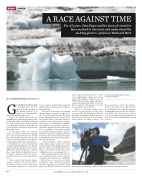
An iceberg breaks off Grinnell Glacier on Aug. 17.
GREG LINDSTROM | FLATHEAD BEACON
like a checking account for the climate.” In 1850 there were more than 150 gla- ciers in the park, but today there are just 25 and within a few decades, all of the gla- ciers will be gone. In order for a body of ice to be considered a glacier it must be at least 25 acres and slowly sliding toward sea level.
y JUSTIN FRANZ of the Beacon
– Standing just a few feet away from the icy mass of the Grinnell Glacier it is hard not to be awestruck by
iconic examples of that change in North America: the melting glaciers of Glacier National Park.
In his role as research ecologist and climate change research coordinator for the U.S. Geological Survey’s Northern Rocky Mountain Science Center, Fagre has written three books and dozens of scientific articles. He has given countless interviews to journalists from around the world and has even guided a vice presi- dent in the park. He has also had a major role in organizing a repeat photography project illustrating the dramatic changes that have taken place in Glacier National Park in the last century. The photos have been published around the world and fea- tured in art exhibits.
“You don’t have to know anything about climate change or glacier recession to understand what is happening in these photos,” Fagre said, talking about how they are one of the most effective tools in telling the story of a warming world.
Fagre graduated from Prescott Col- lege in Arizona in the 1970s and later attended the University of California – Davis, where he received a doctorate in animal ecology and behavior in 1981. In 1990, President George H.W. Bush signed the Global Change Research Act
Dan Fagre takes repeat photographs of Grinnell, Salamander and Gem glaciers. GREG LINDSTROM | FLATHEAD BEACON SEPTEMBER 2, 2015 // FLATHEADBEACON.COM


