


Page 56 - Flathead Beacon // 9.21.16
P. 56
OUT OF BOUNDS 57 EXPLORE 58 Outdoors
Locals Show Solidarity with Standing Rock Sioux Homegrown food and goods delivered to North Dakota encampment opposed to Dakota Access Pipeline
EBY TRISTAN SCOTT OF THE BEACON
ARLIER THIS MONTH, WHEN White sh’s Scott Brant crested a hill above the Cannonball River,
near its con uence with the Missouri on the Standing Rock Sioux Reservation in North Dakota, his van was loaded with 1,500 pounds of fresh food and co ee — all of it donated from Flathead Valley farms, the North Valley Food Bank and private individuals.
Brant, of the Blackfeet Nourish Proj- ect, was ferrying the food from his long- time home in White sh to thousands of tribal members from across North Amer- ica, who had gathered at an encampment in opposition to the massive Dakota Access Pipeline being constructed through tribal lands, and whose path they were aiming to block.
But even after 13 hours on the road imagining the historic event that was unfolding at Standing Rock, where some tribes had gathered in unity for the  rst time in more than a century-and-a-half, nothing had prepared Brant for the sight — a sprawling patchwork of tipis, tents and  ags spanned the  eld, where repre- sentatives of nearly 200 tribes converged at prayer camps, standing in solidarity in hopes of being heard.
“I was worried about getting lost and not being able to  nd the camp, but as I came down the hill I saw tipis,  ags, tents, and thousands of people,” Brant recalled at a recent rally in White sh, where local supporters gathered to sup- port the e orts at Standing Rock.
“They were all there to show support for their fellow water protectors,” Brant told the gathering of around 100 support- ers, who held signs that read “Stop The Black Snake” and “No Dakota Access Pipe- line,” referring to the $3.7 billion project.
When Brant arrived, the Standing Rock Sioux were eagerly awaiting a fed- eral court decision on whether the pipe- line project, which spans 1,172 miles over four states, from the Bakken region of North Dakota to Southern Illinois, would be halted. The tribes had sought an injunction against the U.S. Army Corps of Engineers, arguing that the agency did not take tribal spiritual and cultural heritage sites into consideration when it granted permits for the pipeline, which they said would cause irreparable harm.
Hopes were high, but on Sept. 9, days after Brant returned home from the encampment after a week camping with members of the Pawnee Tribe, District
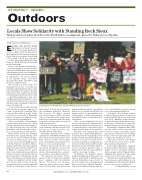
A rally in opposition to the North Dakota Access Pipeline in White sh. GREG LINDSTROM | FLATHEAD BEACON
Judge James E. Boasberg ruled against the preliminary injunction. Moments later, however, the judge’s decision was e ectively put on hold by a federal order to stop construction on part of the Dakota Access Pipeline until the Army Corps can revisit its earlier decisions in the disputed portion.
Brant reveled in the growing success of the gathering and the strength of the message, but recognized a need to fur- ther spread word of the e orts.
Meanwhile, Montana tribes, includ- ing members of the Blackfeet Nation and the Confederated Salish and Kootenai Tribes, have descended on the encamp- ment at Standing Rock, bringing food,  rewood, coats, and sleeping bags.
That’s because despite the decree by the federal government, work on the pipeline hasn’t fully stopped. In areas outside of federal jurisdiction, construc- tion continues, as do e orts to block it.
“We appreciate the District Court’s opinion on the U.S. Army Corps of Engi- neers’ compliance with the National Historic Preservation Act. However, important issues raised by the Stand- ing Rock Sioux Tribe and other tribal
nations and their members regarding the Dakota Access pipeline speci cally, and pipeline-related decision-making gen- erally, remain,” read the joint statement issued by the Justice, Army and Interior departments.
“This case has highlighted the need for a serious discussion on whether there should be nationwide reform with respect to considering tribes’ views on these types of infrastructure projects,” it continued.
The  ght is over a pipeline that could transport more than a half-million bar- rels of oil per day. Its original path crossed the Missouri River just north of Bismarck, but when concerns were raised about a potential oil spill there, the pipeline was rerouted south to run beneath the Stand- ing Rock Reservation. The Missouri River is the reservation’s primary source of drinking water. The tribe says a spill there could be catastrophic for them.
In Montana, the Blackfeet Nation weighed in immediately with a letter of support, particularly as Blackfeet lead- ers and stakeholders wage a battle of their own against the remaining oil and gas leases in the sacred Badger-Two Med- icine area near Glacier National Park, the
source of the Blackfeet creation story and a recreation and spiritual haven.
“As Indian People, we must continue to  ght for the preservation of our water, land and all that a ects our traditional way of life,” Blackfeet Tribal Business Council Chairman Harry Barnes wrote in the letter. “All this a ects our people now and the future generations after us.”
Vernon Finley, chairman of the CSKT, said his tribal council approved the resources to haul a semi-truck contain- ing a dozen cords of  rewood to Standing Rock, as well as sleeping bags and coats “to help as the weather gets colder.”
“This issue is very close to us,” Finley said. “We have been here before, and we must stand in solidarity now.”
At the rally in White sh, organized by Brant and Steve Thompson, of Glacier Climate Action, local architect Richard Smith, a member of the Chippewa Tribe, emphasized the importance of spreading awareness in order to raise support.
“We must all stand in solidarity with the Sioux people, and all of the protectors at Standing Rock, who will in turn help us protect our resources,” Smith said.
tscott@ atheadbeacon.com
56
SEPTEMBER 21, 2016 // FLATHEADBEACON.COM


