


Page 8 - Flathead Beacon // 9.21.16
P. 8
CITY BEAT 14 COURT BEAT 15 Newsworthy
Farming Fresh, Homegrown Healthcare
Local therapeutic farming program earns recognition from Montana Community Services Bureau and state health department
BY CLARE MENZEL OF THE BEACON
On a warm September afternoon,  ve men drove across an open  eld just west of Kalispell in a train of farm vehicles. Les Keller, the semi-retired owner of Centennial Farm, led the group from the community garden, where they’d picked zucchini and green tomatoes, to a barn, where they fed the horses and cows left- overs from the 30 cobs of corn they had eaten for lunch. From there, they drove into the woods and loaded some 20 stray logs onto one truck. It was a productive afternoon, in more than a few ways.
The farmhands in the convoy — Tim Harris, Ryan Trout, Arthur Madeira, and Andrew Williams — are four of 65 men, women, and children who work at 12 farms in Northwest Montana through placements with Flathead Care Farm- ing, a program o ered by the Kalis- pell-based statewide homecare provider A Plus Healthcare. The therapeutic day farming program, now three-and-a-half years old, provides an empowering and evidence-based form of healthcare for folks with developmental or physical disabilities.
“It’s not about free labor for farmers,” said A Plus Healthcare chief operations o cer Maarten Fischer. “It’s to have meaning and purpose, to be physically and socially active.”
Fischer, a Dutch transplant who helped build a now $5 million visitor-ori- ented and therapeutic farming industry in the Netherlands, founded Flathead Care Farming in March 2013, and the program has since gained international recognition. Last week, it earned a 2016 Exemplary Program award from the Montana Community Services Bureau and the Department of Public Health and Human Services’ Medicaid Home and Community Based Services program.
It is also the subject of a recent doc- umentary, The Country Side of Care, produced by Dutch  lmmaker Sanne Hijlkema. After learning that care farm- ing is still an “intriguing new develop- ment in Northwest Montana,” Hijlkema “decided to spend some time with these pioneers,” including Fischer and Keller, to learn about the burgeoning movement in the western United States. The inde- pendent  lm premiered at Flathead Val- ley Community College in August, and will appear at the Delaware Docs With- out Borders Film Festival in October.
“We know that farming has pretty amazing healing powers and calming
powers,” said Pam Gerwe, an owner of Purple Frog Farm in White sh and a host of Flathead Care Farming clients since the program’s pilot run in 2013. “Maarten’s program brings the fund- ing piece — the recognition that there’s therapeutic value, that’s it’s worthy of acknowledging the farmer’s time.”
Farmers, who undergo training to become part of the program and devote signi cant portions of their time to this work, are paid between $50 and $100 daily to host clients. About half of Flathead Care Farming’s clients are referred through Medicaid casework- ers, and Fischer has also partnered
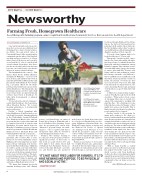
ABOVE Flathead Care Farming worker Andrew Williams sorts corn husks to feed to livestock at Les Keller’s Centennial Farm west of Kalispell.
LEFT Flathead Care Farming workers Ryan Trout, center, and Aurther Madeira help Les Keller pile logs into a truck.
GREG LINDSTROM | FLATHEAD BEACON
with Center for Youth Restorative Jus- tice, the Special Friends Advocacy Pro- gram, Lighthouse Christian Home, the Flathead County Agency on Aging, and the Flathead Job Service to expand care farming’s reach. He hopes to soon extend the program to aging veterans or those with post-traumatic stress dis- orders, and to expand an existing voca- tional rehab program though a partner- ship with FVCC.
Farms are a good place to test a num- ber of skills, Fischer says, and farmers often show their workers what goes into agriculture besides physical labor, like website design or customer interaction.
Positions through Flathead Care Farm- ing are the  rst job that many partici- pants have held, and for others, farms are the  rst workplace where they’ve experi- enced a rmations of their humanity and dignity regardless of their capacity.
“It’s such a basic human right to be treated with respect,” Gerwe said.
Therapeutic bene ts include oppor- tunities for clients who might otherwise just stay at home to exhaust themselves physically and  nd stimulation among friendly company. They cultivate a sense of stewardship and a “perspective change to a more glass half-full,” Fischer said. Being outdoors and working in beauti- ful settings can make a big di erence, Gerwe and Keller noted, and Fischer said that when clients spend time outside on farms, the amount of overall care they need can drop by 50 percent. The high level of medical care many clients receive can be alienating, Fischer said, and many “feel they have escaped” when they visit a farm.
“I didn’t get so much feeling of appre- ciation,” Tim Harris said of jobs he’s held elsewhere. “Whereas here I feel a sense of belonging. Ever since I started, I’ve enjoyed the camaraderie, working with guys like this ... It’s a challenge for some folks who have issues with anger or they might have issues emotionally. This is kind of an outlet for them to be with other people and not feel so trapped.”
Another bene t to the program for many male workers is the chance to interact and work with women in healthy ways. Gerwe says that one client who has struggled with this recently told “one of our workers she was looking particularly intelligent.” The same worker has had dif-  culty with his memory after su ering a traumatic brain injury, but three days after visiting the care farm, he was able to list, in minute detail, the steps to com- plete a farm task. He’s also begun to grow kale at home, something new for the fam- ily, who told Gerwe they’d never eaten the vegetable before their son began working at Purple Frog.
With so many bene ts so readily apparent, interest in Fischer’s program has piqued beyond the region. He reg- ularly receives calls from healthcare workers in other towns hoping he might expand the program. But for now, Fischer says his focus is on growing an inclusive community ethos on farms across the Flathead.
8
SEPTEMBER 21, 2016 // FLATHEADBEACON.COM
“IT’S NOT ABOUT FREE LABOR FOR FARMERS. IT’S TO HAVE MEANING AND PURPOSE, TO BE PHYSICALLY AND SOCIALLY ACTIVE.”
- MAARTEN FISCHER
clare@ atheadbeacon.com


