


Page 21 - Flathead Beacon // 9.23.15
P. 21
abuse which negatively impacts our abil- ity to help families and address child abuse and neglect,” the letter reads.
In a Sept. 18 interview, Corbally said the letter mirrors her division’s concerns about staffing in the Kalispell office, and that only having three permanent work- ers would make it difficult to cover all the responsibilities at the office.
“We obviously are very concerned about this issue,” Corbally said of the turnover rate.
Her division put together a resiliency committee to help with recruitment and retention, she said, and reinforcements at the Kalispell office include retired super- visors and former long-term staff mem- bers who came back, as well as an addi- tional three hires expected soon.
CFSD doesn’t have an exact figure on how much it costs to keep the Kalis- pell office staffed, but “we know that it is expensive.”
“The reality is, we have to pay because this is a critical service from the state and we can’t afford not to have staff in Kalis- pell, no matter what it takes,” Corbally
aving bodies in the office is one thing, but keeping it permanently staffed is another. Corbally said
turnover is a problem throughout her division statewide, often because peo- ple move on from the job or because they weren’t prepared for the challenges that come with it.
“I think it is a more complex job than anyone can comprehend,” she said, not- ing a lengthy list of federal requirements tagged to each case.
Nationally, certain child welfare agen- cies might see turnover in the 90 percent range, according to the Child Welfare Information Bureau. And Corbally said it’s not uncommon to see turnover in the 40 percent range, as her division has experienced in recent years.
In Kalispell, Corbally said the office isn’t receiving enough attention from qualified applicants.
“We are not even getting qualified applicants in a number that’s sufficient to fill the office,” she said.
However, former workers who were either fired from the division or quit on their own accord said the environment at the Kalispell office is unsupportive, and initiative is tamped down.
For several of the workers inter- viewed, problems started in 2011 when CFSD switched its operational model to the Safety Assessment and Management System (SAMS).
Corbally said this systemic change was put in place before her tenure as adminis- trator at CFSD began, but the model was being used in all but seven or eight of the state’s 29 offices at the time.
“It was done not at all to move kids more speedily through the system, but to make it more consistent for families mov- ing through the system,” she said.
By keeping a family with just one social worker, they don’t have to keep bringing a new worker up to speed on the case, Cor- bally said, and it provides for a more con- sistent system statewide.
For the staff, though, the change was abrupt. Diane Piorek, a former supervi- sor in Kalispell and CFSD employee for 23 years, said it caused a divide between the workers and the administration.
“How can you work with families if you can’t work as a family in the office, when you can’t feel safe?” Piorek said. “We can’t work somewhere where the value of what we do isn’t respected.”
Piorek said when she began working with child protection services, the system had two units, each consisting of five or six workers. One unit would investigate and the other would develop treatment plans for the family.
Along with bringing in the new SAMS paradigm, Piorek said division
administrators changed the two-unit model to a one-person team receiving the report, investigating it, and then imple- menting the treatment plan.
That social worker would stay with one case the whole way instead of working on it as a team. It was a major change, Piorek said, and it stretched the child protection crew to the limits.
“That systemic change alone was enough to set a lot of workers on their way,” Piorek said.
The procedural changes also seemed to usher in a new culture in the office, Piorek said. Former employees of the Kalispell office said they were discouraged from discussing cases with one another and were told to stay in their offices.
It’s a management prerogative, she said, but it also shut down an import- ant support network for the social work- ers, who can’t talk about their cases with spouses or friends due to privacy laws.
“We were a family,” she said. “And when we had bad days, we would pull together.”
Once that support disintegrated, Piorek knew it was time to leave. She quit in 2013. She said there was too much change too fast, and it pushed out work- ers who couldn’t or wouldn’t tolerate the change.
Haid.
s
“MY HEART BREAKS WHEN I THINK THAT THERE’S CHILDREN IN THIS COMMUNITY WHO NEED HELP AND THEY DON’T HAVE IT.”
- DIANE PIOREK, A FORMER SUPERVISOR IN KALISPELL AND CFSD EMPLOYEE FOR 23 YEARS
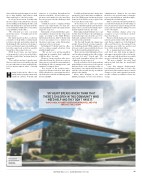
Child and Family
Services in Kalispell.
GREG LINDSTROM FLATHEAD BEACON
SEPTEMBER 23, 2015 // FLATHEADBEACON.COM
21


