


Page 22 - Flathead Beacon // 9.30.15
P. 22
COVER
KOOCANUSA
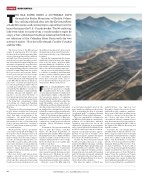
THE ELK RIVER HEWS A SOUTHERLY PATH through the Rocky Mountains of British Colum- bia, rushing cold and clear into the Kootenay River at Lake Koocanusa and converging in a sprawling reservoir basin that spans the U.S.-Canada border. The 90-mile long lake even takes its name from a transboundary esprit de corps, a four-syllable portmanteau merging the third-larg- est tributary of the Columbia River Basin with the two nations it unites – Koo (as in Kootenay), Can (for Canada) and the USA.
The waters, born of the Elk’s glacial origins in southeastern B.C. 140 miles further north, are hailed as premier fish- eries for threatened westslope cutthroat and bull trout. They form both a recre- ational and ecological paradise, provid- ing critical habitat for myriad fish species and a suite of aquatic life, as well as a bas- tion of boating, fishing, lakeshore camp- ing, and picnicking. Lake Koocanusa and its 425-foot high Libby Dam also govern flood protection and generate hydro- electric power for up to 500,000 average homes in a 300,000 square-mile region.
But trouble has been brewing upstream on the Elk, which is known as much as a rich source of energy development as it is a critical spawning ground for threat- ened fish. A growing body of research has revealed that the Elk River contains ele- vated levels of mining contaminants like selenium, nitrogen and sulphate, rais- ing grave concerns about the future of its downstream waterways, where years of testing have shown increasing levels of the hazardous contaminants, which are leaching out of upstream Canadian coal mines and crossing the border into Montana.
The urgency of the issue gained ground in 2013, when a study by two University of Montana researchers uncovered evi- dence that high concentrations of the pollutants – the metal-based element selenium, in particular – present a “sig- nificant threat to the ecological integrity of these streams and rivers,” and urged both U.S. and Canada regulatory bodies to act with urgency.
Weeks after the report, a prominent conservation group listed the Elk as one the top three most endangered rivers in the province, in large part because sele- nium is being released at such a danger- ous rate. According to Erin Sexton, one of the UM researchers who authored the report and continues to track and inform the issue, the toxic pollutants have been shown to impact fish species’ skeletal structure, reproductive abilities and liver and muscle tissues.
Moreover, Sexton said muscle-tissue samples collected between 2008 and 2013 from all seven species of fish pres- ent in Lake Koocanusa show increasing trends in elevated selenium levels, and
the influx of selenium won’t abate even if the mining operations shut down produc- tion today, such is the scope of the mining footprint.
Instead, the company with the largest industrial footprint is proposing expan- sions at its five major operations while investing hundreds of millions of dol- lars in water-quality treatment facilities whose effectiveness remains unproven.
In response to the ballooning problem, a coalition of watchdog environmental groups, scientists, industry players, and a consortium of bi-national regulatory bodies have converged on the issue to pose a question that is in desperate need
ROM A DIAGRAMMATIC PER- spective the question is seemingly straightforward. But in the reality
f an answer: What’s in the water?
oF
of environmental regulatory standards it is exhaustingly complex, compounded by the bureaucratic nuances of regulating industrial pollution that crosses interna- tional boundaries and public and private lands. Meanwhile, science and data are still lacking, and the modeling required to develop a numeric protective water qual- ity standard for selenium that is relevant to Lake Koocanusa and its particular suite of aquatic species is still being developed.
Indeed, developing such a standard is a long ways off, even as the U.S. Environ- mental Protection Agency seeks public comment on a newly proposed national standard, which Koocanusa already exceeds.
“Selenium is a big question mark up there in Lake Koocanusa,” said Eric Urban, the Montana Department of Environmental Quality’s Water Quality Planning Bureau chief. “Right now Mon- tana has a number on the books for reg- ulating selenium that we feel is too high, but we don’t have the science and the data together to say that.”
“It’s a bit of a new frontier,” Urban said of the selenium standard. “Understand- ing how to actually implement it into our water monitoring and discharge permit- ting, that is new to Montana. It’s new to almost every state out there. It’s certainly new to the EPA. So we are a long ways out from adopting a new number for selenium.”
However, even if the EPA approved
a new national standard tomorrow, the magic number would have no short-term effect in stanching the flow of selenium cascading from B.C. coal mines, through the Elk River Valley and into Montana.
There are currently five coal mines in the Elk River Valley that are causing toxic pollution, all of which have launched expansion proposals that are in the exploration, permitting or development stage. Operated by Teck Coal Limited, the world’s second-largest exporter of metal- lurgical coal, the mines produce approx- imately 70 percent of Canada’s total annual coal exports, and directly employ more than 4,500 full-time workers.
In 2013, the B.C. government ordered Teck Coal to address the issue of contam- inants in the Elk River drainage, resulting in the Elk Valley Water Quality Plan and Technical Advisory Committee. The com- mittee was comprised of leading scientists from provincial, state and both Canadian and U.S. federal governments, along with Teck’s staff and contractors. Representa- tives of the Ktunaxa Nation were also at the forefront of the committee.
The plan, the upshot of which was
industry-driven, was approved last November, despite the protests of some stakeholders and committee members. But a new collaborative working group is slated to convene for the first time in late October, and critics of the previ- ous technical advisory committee say it may offer a much-needed opportunity to begin real, meaningful work to address the plight of the Elk, the Kootenay and Lake Koocanusa.
“Last time, the coal company kind of assembled this technical advisory com- mittee of experts, and we met every eight weeks with consultants that the company hired, but it didn’t really change any- thing,” said David Naftz, a researcher with the U.S. Geological Survey’s Wyo- ming and Montana Water Science Cen- ter, based in Helena. “It was toothless because the provincial and the Canadian regulatory authorities were never going to put any pressure on Teck. We had no support from the regulators in Canada so long as they met the selenium stan- dard going into Koocanusa. So while this new working group might not be perfect, it sure beats getting this consulting B.S.
22
SEPTEMBER 30, 2015 // FLATHEADBEACON.COM


