


Page 60 - Flathead Beacon // 10.26.16
P. 60
OUT OF BOUNDS 61 EXPLORE 62 Outdoors
Lake Mary Ronan Gives Life to Montana’s Kokanee Salmon Population State o cials conduct annual harvest of salmon eggs for future distribution across the state
LBY DILLON TABISH OF THE BEACON
AKE MARY RONAN — COME LATE OCTOBER, the silver shimmer of kokanee salmon  ickering in this closed-basin lake  ashes red, the autum-
nal sign of spawning season.
Although they are not native to this 1,500-acre body
of water, these scarlet jewels have become treasured across Montana. This robust population of kokanee creates a prized  shery for sportsmen while also sup- plementing the entire state.
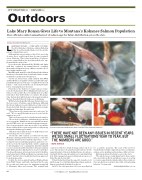
In recent weeks, Montana Fish, Wildlife and Parks sta  have conducted the annual harvest, corralling thousands of salmon in a large o shore net and collect- ing roughly 2 million eggs.
Mark Kornick, manager of the Flathead Lake Salmon Hatchery, led a small team of sta  and volunteers who tackled the repetitious yet vital project.
One by one, Tricia Cycz, a  sh culturist with FWP, and Gar Holmes, a longtime volunteer, grabbed the slip- pery  sh and squeezed out eggs — roughly 150 from each female — and semen from the red, hooked-jaw males before returning them to the water.
From there, the buckets of orange eggs are trans- ferred to the hatchery o  U.S. Highway 93 in Somers, as well as to the satellite Rose Creek Hatchery near Big- fork, where they will fertilize over winter. By spring- time, the hatchery will be home to thousands of salmon that are then distributed to lakes across Montana.
With the help of Lake Mary Ronan, the hatcheries are the lone source of kokanee eggs in Montana. Although the threat of pike increased with last year’s discovery of the predator  sh, the lake’s salmon population remains healthy and abundant, Kornick said.
“There have not been any issues in recent years,” he said. “We see small  uctuations year to year, but the numbers are good.”
That’s welcome news for local and statewide anglers.
“We stock a lot of kokanee, and when they grow, they are very popular,” Mark Deleray, regional  sheries man- ager for FWP, said. “It’s a tremendously important por- tion of our program because we are able to stock hun- dreds of lakes in the region and provide a really strong and popular  shing opportunity.”
Hatcheries have played a key role in Montana’s out- door heritage for over a century.
By the late 19th century, as settlers  ooded into Montana chasing gold and other treasures, a collective sentiment had formed around the importance of pro- tecting the region’s rich  sh populations. Laws were cre- ated to govern the ways that  sh could be caught and to defend against over-consumption. Another valuable resource emerged in 1896, when the federal government built Montana’s  rst  sh hatchery, located on Bridger Creek near Bozeman. A few years later, in 1901, the Mon- tana Department of Fish and Game was organized, and in 1907, the  rst state-run  sh hatchery was approved, located in Anaconda.
In 1912, the state acquired land near Flathead Lake from W.M. Cramer and built a hatchery that became the second state-run source for supplying young  sh to Montana’s lakes and streams. The original land
60
OCTOBER 26, 2016 // FLATHEADBEACON.COM
Crews harvest eggs from spawning kokanee salmon at Lake Mary Ronan. GREG LINDSTROM | FLATHEAD BEACON
“THERE HAVE NOT BEEN ANY ISSUES IN RECENT YEARS.
WE SEE SMALL FLUCTUATIONS YEAR TO YEAR, BUT THE NUMBERS ARE GOOD.”
- MARK KORNICK
consisted of 625 feet of lake frontage and a total of 2.1 acres. The site was to be a hatchery and residence for the superintendent of the state  sh hatcheries. A residence was built, but the superintendent never ended up living in it. State managers began stocking various species of  sh at the hatchery in 1913.
Today, the hatchery has the capacity to handle over 8 million eggs. Over 1 million  ngerling salmon and gray- ling are raised and distributed each year.
In 1970, the state purchased 20 acres near Bigfork
for a satellite operation. The state-of-the-art Rose Creek Hatchery, fully completed in 2011, rears kokanee salmon, arctic grayling and westslope cutthroat trout.
Montana now has 12 hatcheries across the state.
“The hatcheries are really important to those native  sh conservation e orts and when it comes to creating recreation opportunities in lakes where there’s just not the reproductive potential to have wild, self-sustaining  sheries,” Deleray said.
dtabish@ athadbeacon.com


