


Page 56 - Flathead Beacon // 11.2.16
P. 56
OUT OF BOUNDS 57   EXPLORE 58
Outdoors
Safety
for the Snowy
Season
Sixth annual Northern Rockies Snow and Avalanche Workshop welcomes winter recreation enthusiasts and professionals for early-season speaker series
BY CLARE MENZEL
Erich Peitzsch,
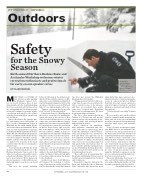
with the Flathead Avalanche Center, checks conditions near White sh Mountain Resort. BEACON FILE PHOTO
MORE THAN 3.4 INCHES OF rain fell last month, marking the Flathead’s rainiest Octo- ber on record, during a time of year when many look to the cloudy sky hoping they’ll see snow instead. But forecasters are anticipating that the heavy precipi- tation will continue for a snowy winter, a prediction welcomed by the valley’s snowshoers, snowmobilers, snowboard- ers, and skiers.
Before the  urries  y, though, win- ter backcountry users will gather on Nov. 5 at the O’Shaughnessy Center in White sh for the sixth annual North- ern Rockies Snow and Avalanche Work- shop, an event organized by local groups, including the Flathead Avalanche Center (FAC), Friends of the Flathead Avalanche Center, and Flathead Nordic Backcoun- try Patrol. Experts will share lessons, insight, and tips that may help attend- ees make better decisions in the back- country, where the threat of avalanches always looms.
“It all gets kicked o  with the work- shop here,” Erich Peitzsch, director of the Flathead Avalanche Center, said of the winter recreation season and the center’s educational o erings. “Every year we’ve had a great turnout. We’ve had pretty diverse (speakers) — folks with forecast- ing backgrounds, researchers, search and rescue.”
This year,  ve people, including
Peitzsch, will speak at the all-day event, which will also include vendors, a ra e, and a video contest with live polling. He’ll start with a quick summary of 2015–2016 operations, the  rst season in Flathead history to see daily avalanche advisories.
“Support, in general, has been really good,” he said. “Folks are psyched.”
Peitzsch also hopes to o cially pass on the torch to a new director, pending the timely selection of his successor. He’s served as the full-time director of the center since 2013, when Glacier Country Avalanche Center was reborn as the FAC. He’s moving on to pursue doctoral work in glacier snow science and research, but, as an employee of the United States Geological Survey (USGS), he hopes to remain involved locally, and to ultimately bring more snow research to the region.
“The goal is to create more of a mar- riage between the operations, and try- ing to ask research questions for what we need to know from an operational stand- point,” he said.
The type of research will depend on funding, he said, but he expects it to be similar to the work that USGS employees conduct in Glacier National Park while forecasting conditions along the Going- to-the-Sun Road.
Another local skier, Todd Wharton, will speak at the workshop to tell the story of his experience in the 2008 Can- yon Creek avalanche, a slide that claimed
two lives just outside the White sh Mountain Resort Boundary.
“It happened in 2008, but it’s still a rel- evant topic because the area (where the slide occurred) is close to the ski area, and there are incidents there nearly every year,” Peitzsch said. “Revisiting (the story) is really important. We learn from our mistakes as humans.”
The three other speakers hail from Calgary to Colorado and will present on snow testing, the monitoring of ava- lanche terrain, and prolonged burial under avalanche debris.
Bruce Jamieson, an award-win- ning avalanche consultant and edu- cator, will address  eld-testing. He’ll weigh the advantages of  eld observa- tions and snowpack tests, and discuss how and when each approach can be best employed. A snowpack test has long been requisite to skiing a backcountry slope, but recent research has suggested that quick  eld observations may be more valuable, and that snowpack tests are most helpful in showing skiers that a slope is unsafe for travel, and less so in determining that it is safe.
“He’s really good at transferring that knowledge, and bringing it from research results to practical applications,” Peitzsch said of Jamieson.
Diana Saly, a master’s student in the Snow and Avalanche Lab at Montana State University, will discuss her work
using digital time-lapse cameras to doc- ument avalanche terrain and avalanche events. A camera installed at Bridger Bowl Ski Area last season captured a remotely triggered avalanche, and Saly will share some images and analysis from that incident.
“It’s a pretty neat case study,” Peitzsch said.
Her research focuses on the relation between compaction and snowpack sta- bility, and she’ll also present  ndings about the correlation between skier usage and slope angle, aspect, and avalanche hazard.
Terry O’Connor, an emergency physi- cian, EMS director, and assistant clini- cal professor for emergency medicine at the University of Colorado, will present on prolonged burials and companion res- cues. The best chance of survival occurs within the  rst 30 minutes of burial, but recent evidence demonstrates that the rate of survival from a prolonged burial remains between 5 and 20 percent. He’ll consider what should be an appropri- ate sense of urgency among rescuers, using the “full faith” response to cardiac arrest, a phenomenon with similar sur- vival rates, as a good model.
The event, which runs from 9 a.m. to 4 p.m., costs $25 for attendees who pre-reg- ister online at  atheadavalanche.org. Tick- ets can be purchased at the door for $30.
clare@ atheadbeacon.com
56
NOVEMBER 2, 2016 // FLATHEADBEACON.COM


