Page 11 - Flathead Beacon // 11.5.14
P. 11
FLATHEADBEACON.COM NEWS NOVEMBER 5, 2014 | 11 Montana Still Grappling with
As states across
the West decide on legalization, Montana has a decision to make about medical marijuana
By DILLON TABISH of the Beacon
 Voters in Oregon, Alaska and Wash- ington D.C. decided this week whether marijuana should be legal, potentially joining Colorado and Washington as the latest states in the U.S. to jump onboard the reform movement.
In Montana, where tension and sus- picion still swirl around the drug after a tumultuous series of events over the last decade, the potential for legalization ap- pears to be waning.
Political science students at Mon- tana State University Billings conducted a survey of 410 random residents recent- ly and roughly 60 percent were opposed to the idea of legalizing recreational use of marijuana. Thirty percent supported legalization, according to the poll, which was released Oct. 17.
The Marijuana Policy Project, the nation’s largest organization working solely on marijuana policy reform from its headquarters in D.C., announced ear- lier this year that it would help fund a voter initiative to legalize and regulate marijuana for Montana adults in 2016, but only if local supporters were able to raise roughly $200,000.
That effort has all but fizzled out, due to an apparent lack of public support.
“The idea was if Montanans were willing to invest in that effort, then MPP was willing to go there,” said Chris Lind- sey, a Missoula-based legislative analyst for MPP. “Some donations were made, but we haven’t really seen the kind of numbers that lead us to think it will hap- pen.”
Similar efforts have failed in the past and the latest failed attempt reflects a dismal view among Montana residents in regard to recreational marijuana use.
“I think it’s dead in Montana,” Mort Reid, president of the Montana Canna- bis Information Association, said of the legalization movement in the state.
Instead, attention is focused on the state’s medical marijuana industry, which is quietly – and cautiously – mak- ing a slow comeback in Big Sky Country.
In October, there were 9,619 reg- istered medical marijuana patients in Montana, including 1,151 in Flathead County, the second most of any county in the state behind Gallatin (1,869). There are 363 providers statewide and 48 in Flathead County, also the second most in Montana, again behind Gallatin (93).
Serving up the
FUTURE
Three Rivers Bank offers many versatile options for real estate loans.
Dig into that first dinner in your new home. We’ve got your financing covered.
www.ThreeRiversBankMontana.com
Medical Marijuana Industry
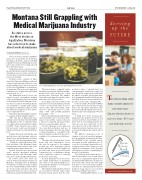
Jars of medical marijuana are seen at a clinic in Kalispell. BEACON FILE PHOTO
The latest figures, compiled by the Montana Department of Health and Hu- man Services, show an increase of 938 patients since June 2012. The number of providers has dipped from June 2012, when there were 390 providers.
According to the state statistics, the majority of medical marijuana patients – 6,307 – are enrolled because of “severe chronic pain.” The next leading condi- tions are “intractable nausea or vom- iting” – 998 – and “painful peripheral neuropathy” – 993.
The medical marijuana industry has existed in limbo in recent years follow- ing a boom-and-bust sequence that saw a drastic rise and fall among providers and users, as well as public opinion.
In 2004, Montana voters approved the controlled production and use of medical marijuana. But the law lacked certain safeguards or oversight for the upstart industry, and by 2011, there were roughly 30,000 patients and 4,438 pro- viders.
The spike led federal agents to crack down and raid dispensaries across the state. In response to the rampant growth, the 2011 Legislature passed Senate Bill 423 to rein in the number of providers and users by preventing the commercial sale of marijuana, among other regulations aimed at reducing medical use of the drug.
In 2012, Montana voters reacted to the sudden proliferation of marijuana and opted to side with lawmakers, re- jecting a ballot initiative to overturn the Legislature’s 2011 law.
The industry challenged the 2011 law in court and U.S. District Judge James Reynolds largely agreed that the state
needed to show a “rational basis” for overturning the original voter-approved law. Reynolds temporarily suspended the limits on profits and patient num- bers, pausing the fatal blow of SB 423 un- til a final decision is issued, which is ex- pected to arrive in the coming months.
In the meantime, Reid and the MCIA have crafted a list of proposals to bring before the upcoming Legislature that they say would add regulations to the in- dustry and prevent rampant growth and abuse.
“I think a lot of the wrong people jumped into the industry for the wrong reasons back then. And I think a lot of them that weren’t willing play by the rules are gone now,” Reid said. “So the ones that are left in the industry are deeply invested in it and are more seri- ous about working in the frameworks of the law.”
The MCIA is proposing a list of changes to the state’s medical marijua- na law, including designating the Mon- tana DPHHS as the oversight agency; increasing provider application fees to cover the cost of inspecting facilities; al- lowing providers to hire employees; and adding post-traumatic stress disorder and epilepsy to the list of qualifying ill- nessesforcardholders.
“The industry now is much more re- formed than what it was in 2011, when there was a community backlash. It was an industry that didn’t have enough con- trols at the time,” Reid said. “But right now there’s a lot of sick people in Mon- tana that are suffering and they will be deprived of any legal access to medical marijuana if SB 423 takes effect.”
[email protected]
www.