


Page 49 - Flathead Beacon // 12.9.15
P. 49
OUT OF BOUNDS 50 Outdoors
On the Front Lines of Climate Change
With Paris climate talks underway, impacts to Montana’s hunting,  shing and wildlife heritage detailed in report
MBY TRISTAN SCOTT OF THE BEACON
ontana’s hunters and anglers have as much vested in the Paris climate negotiations as
the state’s abundant suite of wildlife, according to research compiled by the National Wildlife Federation, which recently released a report detailing what’s at stake culturally, ecologically and economically if a solution is not forthcoming.
As 150 world leaders at the 2015 United Nations Climate Change Confer- ence hash out a binding agreement for curbing greenhouse gas emissions, sci- entists studying moose, cutthroat trout, mountain goats, and other wild animals in Montana are sounding the alarm about climate impacts in the Treasure State.
The National Wildlife Federation’s report is entitled “Game Changers: Cli- mate Impacts to America’s Hunting, Fishing and Wildlife Heritage,” and out- lines the historic role of hunters and anglers in conservation and the many ways in which the changing climate is a ecting hunting and  shing oppor- tunities and the state’s robust outdoor economy.
The report touches on a range of spe- cies that require cold-water and high-ele- vation habitats for survival, but for which a warming world is threatening – from moose and mountain goats to cutthroat trout, whitetail dear and snowshoe hares.
The report comes on the heels of the U.S. Environmental Protection Agen- cy’s release of the Clean Power Plan, a new strategy to reduce carbon pollution from the nation’s power plants, and in the midst of international talks about climate change, which are taking place in Paris Nov. 30-Dec. 11.
Dave Ditlo , a spokesman for NWF, said the iconic  sh and wildlife species of Montana are culturally and econom- ically critical to the state.
Citing a study that concludes Mon- tana’s economy has more than $1 billion riding on hunting,  shing and wildlife watching, Daniel Iverson, communica- tions manager for Montana’s O ce of Tourism and Business Development, said more than 80 percent of Montana’s visi- tors in 2014 reported they came for out- door activities, whether hunting, skiing, visiting a state or national park, or wild- life watching.
He added that last year outdoor enthu- siasts spent more than $240 million on out tters and guides.
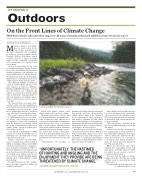
An angler  shes the Middle Fork Flathead River. BEACON FILE PHOTO Ditlo  said climate change could
adversely a ect that outdoor economy. Historian and outdoor ethicist Jim Posewitz said hunters and anglers were some of America’s  rst supporters of conservation and wildlife management, and still play a key role in conservation and economic support. Through various excise taxes and the purchase of hunting and  shing licenses and stamps, sports- men and women provide critical fund- ing to state  sh and wildlife agencies for conservation. They also contribute some $90 billion to the national economy each
year.
“Unfortunately, the pastimes of
hunting and angling and the enjoyment they provide are being threatened by climate change. Many of the cherished species important to these sportsmen and women, including big and small game, birds, and  sh, are facing increas- ingly dangerous situations brought on by warmer waters, shorter winters, and lon- ger droughts,” the report states.
Mountain goats, an iconic species syn- onymous with a visit to Glacier National Park, dwell in high, rugged areas, a trait the NWF report says makes them more vulnerable to warming temperatures. The report says high altitudes are warm- ing faster than lower altitudes.
Bruce Smith, a biologist who has writ- ten about mountain goats, said unlike other species, goats are beholden to rare habitat requirements, and can’t just move on when their high-elevation homes are no longer suitable.
“They already live on islands in the sky,” he said, adding that they can’t climb any higher.
Posewitz said he was encouraged by the ongoing talks in Paris, and that he hoped the talks would spur action among outdoor enthusiasts, similar to the The- odore Roosevelt-era of conservation, a movement that gained prominence under the former president during the late 19th and early 20th.
E orts by Roosevelt and others changed the relationship people had with nature and helped preserve wild- life, and its success created “a model of restoration that worked.”
He hopes that the talks on climate change can look to that time as a model and  nd a way to deal with the rising temperatures.
Read the full report at www.nwf.org.
tscott@ atheadbeacon.com
“UNFORTUNATELY, THE PASTIMES
OF HUNTING AND ANGLING AND THE ENJOYMENT THEY PROVIDE ARE BEING THREATENED BY CLIMATE CHANGE.”
- NATIONAL WILDLIFE FEDERATION’S REPORT
DECEMBER 9, 2015 // FLATHEADBEACON.COM
49


