


Page 98 - Flathead Living // Spring 2015
P. 98
WELL
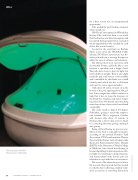
The float pod at the ISO Float Center in Whitefish.
for a float session was an entrepreneurial opportunity.
If he needed the pod, Gardner surmised, others would, too.
ISO Float Center opened in Whitefish in January 2014, and it has been so successful that Gardner has now hired an employee and has started having regular hours, instead of the by-appointment-only schedule he used for his first year in business.
Located in the storefronts on Railway Street across from the Whitefish Public Library, ISO Float Center houses one flo- tation pod and now a massage therapist to add to the aura of calmness and relaxation.
The white pod sits in its own room, with an attached shower, and looks like a cross between a spaceship and a hippo’s head. The pod’s door closes to shut out light, but isn’t lockable or airtight. There is also a light inside the pod, with various colors available and controllable by the floater via a small control panel, which also has a call button and a port to connect personal audio.
Only about 10 inches of water sit in the bottom of the pod, equaling about 200 gal- lons, but its magnesium sulfate content is so high that it has six times the buoyancy of the Dead Sea. Gardner said clients weigh- ing more than 300 pounds and stretching more than six feet, three inches have floated comfortably.
The water inside is kept at 94 degrees Fahrenheit, giving it near-body tempera- ture warmth. This is important, Gardner said, because after about 15 minutes of floating still, a client’s skin starts to forget it is contacting the water, giving a feeling of anti-gravity.
Being still and having no pressure any- where on the body is especially restorative, according to the national Flotation Tank Association. FTA board members Thomas Fine and John Turner, both of whom study Restricted Environmental Stress Therapy (REST) at the University of Toledo College of Medicine, have found that floating in buoyant liquid kept at skin temperature with- out light or sound leads to deep relaxation, and many patients with chronic pain use relaxation to cope with their circumstances.
The source of the relaxation wasn’t clear in the research, they reported, but they posited it could be due to allowing complete relax- ation in muscles or removing distractions
96 FLATHEAD LIVING | SPRING 2015
PHOTO BY GREG LINDSTROM


