


Page 48 - PureMontana // 2016
P. 48
FLATHEAD LAKE
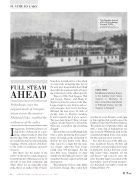
The Klondyke docked at Port Polson during the early 1900's.
COURTESY PHOTO - THE MUSEUM AT CENTRAL SCHOOL
LOCAL PRIDE:
The MuseuM aT CenTral sChool
is the leading local history museum in Montana. To learn more about steamboats or Flathead history, visit the museum in Kalispell.
FULL STEAM AHEAD
Steamboats, once the original mode of transpor- tation across the massive Flathead Lake, enabled the settlement of the valley
Imagine this. It’s 1880 and you’ve set- tled by the southern tip of a spar- kling, expansive lake at what feels like the edge of the universe. Your fam- ily’s hands have built a town with all the trappings of home, and just a few hours to the south sit settlements and more resources.
But there’s also the matter of the north—to the north is a dark, dangerous, beautiful mystery. Mountains rise up on all sides of your little settlement, and where there’s not an impassible rocky peak, there’s an endless body of water.
Some have traveled on foot or horseback on rocky trails around the lake, but for the most part, homesteaders don’t think about the risks and uncertainty of travel- ing to the interior of the valley up north.
 en, in 1884, Fred Lingren, Neil and George Nelson, and Hugh F. Sinclair ventured to sail across the lake. Large enough to carry 20 tons and sev- eral passengers, their vessel, the Swan, delivered the men across 28 miles of choppy water to Dooley’s Landing. It wasn’t smooth, but it was a success. Two years later, James C. Kerr, a former captain on Lake Superior, converted the Swan into a steamboat and everything changed.
 e new Swan crossed Flathead Lake twice a week, permitting the transpor- tation of enough goods and people to develop the new harbor town. More ships came. In a single  ve-day span, one steamer called the Tom Carter carted some 580 passengers. For the next  fty years, hundreds of ships would brave the Flathead’s waters—and steamboats became a sign of growth and development.
 e popularity of these ships didn’t last forever, though.  ey sealed their
own fate, in a way. Steamers soon began to ship supplies that would connect the Flathead to the Great Northern Railway.  e railway was completed in 1892, and with a train stop in Kalispell (it was later moved to White sh), need for the steamboat dwindled. Some even sunk in the lake and were never retrieved.
Just after the turn of the 20th cen- tury, steamboats became obsolete and eventually, car travel replaced rail travel in popularity. Look at the boats on the lake today—sleek, beautiful, all fun and  nesse—and you’d be none the wiser that their legacy traces back to the heavy-duty, steam-powered predeces- sors that made it possible to settle the Flathead Valley.
48 PURE MONTANA // PureWestRealEstate.com // 2016


