Page 18 - Flathead Beacon // 1.14.15
P. 18
18 | JANUARY 14, 2015
CHEAP OIL’S RIPPLE EFFECT
FLATHEADBEACON.COM
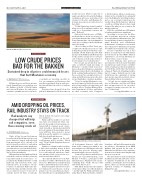
Oil fields in Williston, ND. SHUTTERSTOCK PHOTO
nearly six years, which is expected to spark a production drop in the Bakken, resulting in job losses and reduced tax revenue for the state, said Montana Pe- troleum Association executive director Dave Galt.
“If this thing stays down for awhile, when you roll everything together, you could see a devastating economic im- pact,” Galt said.
Galt noted that the price of Willis- ton Basin Sweet, about $33 a barrel, is even lower than the $46 a barrel of West Texas Intermediate, the benchmark for crude oil, according to the Rocky Moun- tain Oil Journal.
“We’re looking at West Texas pric- es right now, which isn’t good,” he said, noting that production will drop expo- nentially. “North Dakota has 180 drill- ing rigs on the Bakken and Montana has 10 rigs, and we can expect to see a 50 per- cent reduction on both sides of the bor- der. It’s going to be a trail down fast.”
But oil and gas production repre- sents a relatively small percentage of Montana’s economy, which is far more diverse than North Dakota’s. And while Montana workers fled to the Bakken oil fields seeking high-paying jobs during the recession, the economy is now recov- ering, and with lower gas prices the state is reporting higher consumer spending.
“It’s not to say that Montana’s econo- my is not impacted by the drop in crude prices, but we will see both positive and negative effects,” Barbara Wagner, Mon- tana Department of Labor and Indus- try chief economist, said. “Compared
to North Dakota, which is much more reliant on the oil industry, we primarily serve the Bakken by providing workers, and so our economy is much more di- versified than North Dakota’s, which is a really good thing when we have rapid changes like what we are seeing in the market right now.”
Still, the contributions of Montana’s oil and gas industry are significant.
According to a report for the Mon- tana Petroleum Association, written by Scott Rickard of Montana State Uni- versity-Billings Center for Applied Eco- nomic Research, total contributions by Montana’s oil and gas sector include more than 15,600 Montana jobs paying two-thirds more than the state average.
It’s also contributed a total of $2.3 billion, or nearly 6 percent of Montana’s gross domestic product (GDP), which is equivalent to an average Montana in- dustry of twice or more its size.
In 2013, Montana state and local governments collected nearly $1 million per day in taxes and revenues contribut- ed by oil and gas production industries and the firms and workers that depend- ed upon it. This level of funding would be hard to replace, Rickard reported, and would mean the equivalent of raising state income taxes by one-third, or more than doubling vehicle-licensing fees.
“Oil and gas are significant indus- tries in Montana, and they will likely play an important role in our state’s economy for many years into the fu- ture,” Rickard said.
[email protected]
NORTH DAKOTA
LOW CRUDE PRICES BAD FOR THE BAKKEN
Sustained drop in oil prices could mean job losses that hurt Montana’s economy
By TRISTAN SCOTT of the Beacon
Falling oil prices and lower interna- tional demand have cast a shadow over the Bakken oil fields of North Dakota and eastern Montana. As crude prices continue to plank down across the state,
economists are reporting a positive ef- fect on consumers and businesses but say that a sustained drop in crude pro- duction will hurt the state’s oil and gas industry.
Gas prices have dropped below $2 a gallon in Montana for the first time in
RAIL INDUSTRY
AMID DROPPING OIL PRICES, RAIL INDUSTRY STAYS ON TRACK
Rail analysts say cheaper fuel will help rail companies, even those moving crude oil
By JUSTIN FRANZ of the Beacon
Crude oil has become big business for railroads in North America in recent years. America’s largest railroads went from moving just 9,500 carloads of oil in 2008 to well over 400,000 carloads in 2013. And while that statistic might sug- gest railroads are concerned about drop- ping oil prices, rail analysts say it’s actu- ally good for the industry.
Independent analyst Anthony Hatch said while crude by rail has grown by leaps and bounds in recent years – es- pecially in the Bakken oil fields – it still makes up only a fraction of the cargo railroads move. According to the As- sociation of American Railroads, dur- ing the first nine months of 2014, crude oil accounted for just 1.6 percent of carloads moved by Class 1 railroads,
which include the largest rail compa- nies in America.
Hatch said the number of cars mov- ing crude oil is minuscule when com- pared to the number of cars moving con- tainers full of consumer goods, catego- rized by AAR as intermodal. And with prices dropping at the gas pumps, Amer- icans will have more money to spend, which means the number of containers full of goods will only increase.
“I think the impacts on the rail- road business will be positive,” Hatch said. “I don’t think (dropping oil prices) will hurt them.”
Similar to consumers who now have a little extra spending money in their pockets because of prices at the pump, so too will railroads, which use a mas- sive amount of fuel every year for loco- motives and other vehicles.
“It seems like whatever loss in busi- ness they see will be offset by the drop in fuel costs,” Edward Jones analyst Logan Purk recently told the Associated Press.
Industry analysts and observers also note that just because the price is drop- ping does not necessarily mean oil pro- duction will come to a grinding halt. New
A BNSF Railway oil train. JUSTIN FRANZ | FLATHEAD BEACON oil development, however, could slow
down in the coming year, which is one area analysts say could impact railroads because they won’t be moving equip- ment and supplies for new oil wells.
“Domestic production will still grow but the rate of growth will drop,” said Thomas O’Conner, a principal of ICF International, a Virginia-based energy- consulting firm. “Crude by rail could slow down, but not a lot.”
That likely means that the number of oil trains rolling out of North Dakota – and through the Flathead Valley and along Glacier National Park’s southern
boundary – will probably remain steady. According to information from BNSF Railway, and released by the state of Montana, last fall there were anywhere from 14 to 18 oil trains traveling through the area every week.
The movement of crude by rail made headlines in 2013 and 2014 after a series of explosive derailments in the Unit- ed States and Canada, most notably in Quebec, where an oil train derailed and exploded, leveling 30 buildings and killing 47 people.
[email protected]