Page 20 - Flathead Beacon // 1.14.15
P. 20
20 | JANUARY 14, 2015
CHEAP OIL’S RIPPLE EFFECT
FLATHEADBEACON.COM
CANADIAN TOURISM
PLUNGING OIL PUTS ALBERTA ON EDGE
Montana’s northern neighbor prepares for big cuts that could impact the Flathead Valley
By JUSTIN FRANZ of the Beacon
Scan the parking lot at Whitefish Mountain Resort on any given weekend in January and you’ll see red and white license plates with “Alberta – Wild Rose Country” just about everywhere.
Albertans have been coming to the Flathead Valley for years and for good reason, said Donna Townley, an econo- mist at the University of Lethbridge and part-time Flathead Valley resident. For many years, when the Canadian dollar was strong, the Flathead was an inex- pensive getaway for Albertans. Accord- ing to the Whitefish Convention and Visitors Bureau, 18 percent of visitors to Whitefish in the first nine months of 2014 came from Alberta.
But now oil prices are dropping and Alberta is facing “the most serious fiscal circumstances we’ve seen in a genera- tion,” according to Alberta Premier Jim
Prentice. The question now is will Cana- dians be flocking to the Flathead as they have in the past?
Alberta’s fortunes and its govern- ment budget are both closely tied to oil and, because of that, it has been con- sidered Canada’s strongest economy for years. Taxes from the oil industry make up a huge part of the provincial budget, but as a result of dropping oil prices Premier Prentice announced last week that Alberta was, for the first time in years, facing a deficit to the tune of $500 million.
Andrew Leach, a professor of busi- ness at the University of Alberta in Cal- gary said the dropping oil prices would result in steep cuts in the provincial budget that will be released in March. How those cuts will impact average Al- bertans, who have enjoyed some of the highest average incomes in all of Cana- da, is yet to be seen. But it is possible that it will result in Albertans being a little more frugal in the coming years.
Dropping oil prices is also impacting the value of the Canadian dollar, which is a commodity-based currency. When the price of oil goes down, so too does the value of the loonie. Economists said the decline of the Canadian currency could
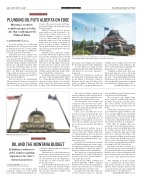
The Canadian Visitor Center in West Glacier. GREG LINDSTROM | FLATHEAD BEACON
Montana State Capitol. BEACON FILE PHOTO
have a more direct impact on tourism in the U.S. than a decline in the oil industry. “As the dollar goes down in value suddenly my ski trip to Whitefish Moun- tain Resort got a lot more expensive,”
Leach said.
However, Townley, the economist at
the University of Lethbridge who stud- ies the impact of Canadian tourism in Montana, doesn’t expect the lines at the border crossings to disappear. She said that while the economy in Alberta may
The 2015 Legislature, which is un- derway in Helena, will eventually deter- mine the state’s budget, with the gover- nor’s proposal as part of the process.
Forecasting the state’s budget and revenues for the next two years can be a tricky process, especially when the fi- nances are dependent on dynamic mar- kets, like that of crude oil.
Crude oil is currently priced un- der $50 per barrel, a situation the state hasn’t seen often in the last 15 years. These prices are an important piece of Montana’s revenue puzzle, because the state collects royalties and taxes levied on oil and gas production throughout the state.
The grouping of natural resource taxes is the second-largest revenue gen- erator for the state, behind “major tax- es,” which include income tax, property tax, vehicle taxes and fees, gambling tax- es, insurance premium taxes and corpo- rate license taxes.
In fiscal year 2014, the state brought in $167 million in natural resource taxes. Oil and gas production taxes accounted for $109 million of that total, and U.S. mineral royalties another $27 million.
The “major tax” group along with all the natural resource taxes made up 89.2 percent of the state’s general fund rev- enue in fiscal year 2014.
The governor’s Office of Budget and Program Planning (OBPP) estimates that the state’s revenue from natural re- source taxes will increase to $180 mil- lion in the fiscal year 2017 forecast.
As a whole, the state expects the tax- es from natural resources to generate
struggle in the coming years, lower fuel prices would help other industries and the rest of Canada, which could help sta- bilize Alberta’s economic situation.
“Canadian tourism won’t just stop. But people may not come as often and when they do they’ll be spending less,” she said. “I don’t think Flathead Valley businesses need to worry, they just need to know that Albertans may be spending less and will be looking for more sales.”
[email protected]
$347.7 million in general fund revenue over the 2016-2017 biennium.
The governor’s 2017 budget takes into account the volatility of the oil mar- ket. When it was proposed in November, there were already caveats about the drop in oil prices happening across the world.
“If the dip in oil prices persists, it is unclear what the impact would be on the U.S. economy and Montana,” the budget overview states. “Cheaper energy inputs would be welcome in some parts of the economy, but could put the brakes on the current revival of the U.S. oil industry.”
Now that the Bakken shale has opened up to its current production lev- els, oil prices are increasingly important for revenue projects. But if oil prices continue to drop, the ripple effect could affect more than just the budget: the more expensive drilling operations may have to shut down, though deeper price cuts for crude oil would need to happen before there is a mass shutdown of wells, according to the OBPP projections.
But with total state revenues pro- jected to increase by 5.5 percent in fiscal year 2016 and another 6 percent in 2017, how big of a role oil prices will play in the state’s revenue projections will only be- come clearer as the markets themselves do.
“The volatility of oil prices makes even a month-ahead forecast uncer- tain, because unexpected events such a political unrest, natural disasters, and economic shocks can cause rapid, large swings in prices,” the OBPP stated.
[email protected]
As Bakken continues to yield, oil prices gaining importance for state’s revenue projections
By MOLLY PRIDDY of the Beacon
Development of the Bakken shale formation continues to be the driving force of the oil industry in Montana, ac-
counting for high-paying jobs and a drop in unemployment.
This increase in oil production also means more money for the state, given the taxes levied on the energy sector. It also means there is greater importance on the price of crude oil for the state’s projected revenues.
Last November, Montana Gov. Steve Bullock released his biennial budget proposal for 2016-2017, which includes the governor’s priorities, budget, and revenue projections.
STATE BUDGET
OIL AND THE MONTANA BUDGET