


Page 22 - Flathead Beacon // 3.23.16
P. 22
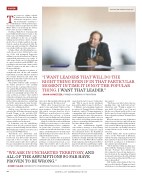
Former Gov. Brian Schweitzer. BEACON FILE PHOTO
COVER
Two years ago, riding a riptide of disillusioned liberals, Brian Schweitzer emerged as a color- ful and dynamic challenge to the establishment of both political par- ties and speculation erupted about a 2016 White House run featuring the former Democratic governor of Montana.
By May, a Wall Street Journal pro le had solidi ed Schweitzer’s status as the Democrats’ anti-Hillary Clinton – a pop- ulist challenger on the rise, a straight- talking maverick whose dusty cowpoke motif of boots, brisket and bolo ties cap- tivated a nation disenchanted with the status quo and yearning for a Washing- ton outsider with executive experience.
It helped that, after  nishing his sec- ond term as governor, Schweitzer became one of the only prominent Democrats willing to speak critically about Clinton, earning him appearances on a suite of cable news shows, and a lofty platform as a paid contributor with MSNBC, dis- patching broadcasts from a home studio cobbled together in his wine cellar on Georgetown Lake.
In the end, Schweitzer’s fondness of straight-talk and o -the-cu  remarks landed him in trouble when he insulted Sen. Dianne Feinstein and joked that Majority Leader Eric Cantor was gay in a National Journal pro le.
The public-relations ga e prompted the former governor to come crashing down from his soaring political pirou- ette, and the Brian Schweitzer experiment was abandoned with the same urgency as it had been gushingly adopted. But the same political acrobatics that enabled Schweitzer’s dramatic rise on the national radar have returned,  guring prominently in the 2016 presidential race, and pitting the GOP’s unrestrained scrum of politi- cal theater and name-calling against the Democrats’ enthusiasm de cit.
And in a race that favors a political outsider like billionaire business mogul Donald Trump as the probable GOP nominee and a Washington insider like Clinton as the Democrats’ presumptive choice, it begs the question – Does Sch- weitzer wish he was in the mix?
If Schweitzer was the anti-Hillary Clinton, then he’s the political doppel- ganger to Donald Trump, but the former White sh farmer said he’s not interested in a run for the White House.
“Absolutely not,” Schweitzer said. “I am very careful now and have been for the last year. Every time my phone rings and I don’t recognize the num- ber, I don’t answer and I don’t call back. Because invariably it is somebody trying to get me to run for president, and I’m not
“I WANT LEADERS THAT WILL DO THE RIGHT THING EVEN IF IN THAT PARTICULAR MOMENT IN TIME IT IS NOT THE POPULAR THING. I WANT THAT LEADER.”
- BRIAN SCHWEITZER, FORMER GOVERNOR OF MONTANA
interested. My email inbox blows up with the same requests. Not interested.”
While other Democrats have been quick to line up behind Clinton as the party nominee, Schweitzer has repeat- edly raised concerns about her ties to Wall Street, as well as her vote to autho- rize military force in Iraq — a decision that became the  ashpoint in her drawn out 2008 primary against Barack Obama.
Early on, Schweitzer endorsed Martin O’ Malley, even serving as co-chair of the former Maryland governor’s campaign. As Democratic governors, Schweitzer said the two men worked together closely, and he saw  rsthand how “he didn’t just talk about his progressive values, he actu- ally put them into action.”
“Here is a candidate who is measured in what he says, he is a student in all things political, economical, historical, a can- didate who would be able to describe to you in detail every piece of public policy
enacted in the last 50 years,” Schweitzer said. “This is a good, decent, intelligent man, and he didn’t even get to  rst base.”
O’Malley’s statesmanship stands out in contrast to Trump’s  air for all things bombastic, and yet Trump maintains a commanding lead in national Republi- can polls in part because of his unconven- tional campaign tactics, which center on large rallies and galling statements that generate constant media buzz and do lit- tle to knock him o  his axis.
As some establishment Republi- cans outline a strategy to deny Trump of the 1,237 delegates required to clinch the nomination before the Republican National Convention in Cleveland in July, and Democrats envision a dream scenario in which a Trump nomination prompts the GOP to lose the White House and the Senate and put a dent in the party’s House majority, Schweitzer said Trump’s viabil- ity in the general election should not be
discounted.
“The Democrats who believe that are
smoking their own belly button lint,” Schweitzer said. “Trump is going to be very viable. He is able to say ‘I am not like the rest of them’ and he is able to say that because he doesn’t take their money. Democrats underestimate Trump at their own peril.”
When he ran for governor, Schweitzer refused special interest and PAC money for his campaign, and his folksy and hon- est persona would surely engage the same base of voters who cite Trump’s status as a nonpolitician as the reason for their adoration.
Robert Saldin, who teaches political science at the University of Montana, said the Trump campaign phenomenon shares plenty of characteristics with the short-lived ascendancy of Schweitzer’s (speculative) presidential bid.
“The Schweitzer thing has huge par- allels with the Trump movement,” Sal- din said. “You have these shtick-y out- sider elements, these strong-man perso- nas, the bravado, the upending of typical norms and conventions about how things are done in the political world. There are some real parallels.”
Still, Saldin acknowledged that try- ing to predict whether Trump is going to self-destruct or be derailed between now
“WE ARE IN UNCHARTED TERRITORY, AND
ALL OF THE ASSUMPTIONS SO FAR HAVE
- ROBERT SALDIN, UNIVERSITY OF MONTANA POLITICAL SCIENCE PROFESSOR
PROVEN TO BE WRONG.”
22
MARCH 23, 2016 // FLATHEADBEACON.COM


