


Page 23 - Flathead Beacon // 3.23.16
P. 23
and the Republican National Convention is a fool’s errand, particularly as every political pundit expected the nation to reach peak Trump last summer.
“We keep expecting that it will blow up. But I don’t think it will before he gets the nomination. I don’t see any way he doesn’t get the nomination short of the party trying to take it away from him at the convention,” Saldin said.
Former Republican Congressman Rick Hill, who was the GOP candidate for governor of Montana in 2012, has become a vocal critic of Trump and said his rise gives him deep concerns about the state of the Republican Party.
Prior to U.S. Sen. Marco Rubio drop- ping out of the race, Hill endorsed the Florida Republican, but he’s now throw- ing his support behind U.S. Sen. Ted Cruz, R-Texas, although Hill said he would also consider supporting Ohio Gov. John Kasich, with whom Hill served alongside in Congress.
Any Republican is better than Trump, he said.
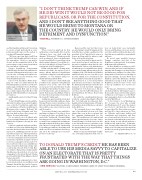
“I don’t think Trump can win, and if he did win it would not be good for Republi- cans, or for the Constitution, and I don’t see anything good that he would bring to Montana or the country,” Hill said. “He would only bring detriment and dys- function. And we have other strong can- didates. It is just infuriating.”
It’s not merely elected o cials who are increasingly  ummoxed by the out- landish developments coloring the 2016 election.
Political consultant and strategist Bar- rett Kaiser, a University of Montana grad- uate who divides his time between Wash- ington, D.C., and Billings, has two decades of political experience. He helped former Democratic U.S. Sen. Max Baucus win reelection campaigns in 2002 and 2008, and in 2012 organized an unprecedented reelection campaign for Democratic U.S. Sen. Jon Tester, whose successful bid was characterized by deploying cutting-edge social media outreach. Prior to that, Kai- ser cut his teeth in politics working under Jim Messina, the architect of reelection campaigns for President Barack Obama in 2012 and British Prime Minister David Cameron in 2015.
But traditional campaign tactics have been turned on their ear, and Kaiser said Trump’s durability has touched a para- lyzing nerve in establishment political
thinking.
“There is just no playbook for this
in Montana or nationally. Not even the old-timers have ever dealt with this dynamic,” Kaiser said. “I think you would need an advanced degree in mathemat- ics and a crystal ball to accurately portray what is going to happen. It’s as if this elec- tion is for the Mayor of Crazy Town. It’s straight out of the Twilight Zone.”
Saldin said that while a Trump nom- ination is probable, the intense level of unease among high-level Republicans could lead to support for an independent candidate, or even blanket pledges to abandon Trump and the GOP.
“There seems to be a wide swath and possibly even a majority of Republican primary voters at the elite level who are in open revolt, and they have clearly decided that they will not be able to sup- port Trump under any circumstances. And if that means that Hillary Clinton becomes the next president, well, that is the tradeo ,” Saldin said.
Saldin also questioned the wisdom of Democrats betting with con dence that a Trump-Clinton contest would go to the latter given the many unknown elements that could become a factor between now and November.
“Once you get down to two candidates, anything can happen. It is risky to cheer for someone because you think they are unelectable,” Saldin said. “Stranger things have happened so it is a risky scenario, and so many of our assumptions and what we thought we knew about how these things play out have been upended. I’m hesitant to say with any con dence how things will shake out. We are in uncharted territory, and all of the assumptions so far have proven to be wrong.”
Kaiser said the very fact that voters are gravitating toward Trump under the belief that he is a viable candidate for the president of the United States evinces a deeper problem with the nation’s con - dence in its political system.
“It is very clear that the American elec- torate is in a bad mood, and they are cry- ing out for candidates that don’t  t a tra- ditional mold,” Kaiser said. “And whether it is what we are seeing with Bernie (Sand- ers) or with Trump, when you have docile candidates like (Jeb) Bush and O’Malley and Kasich who are not even able to get traction I think it is a testament to the level of dysfunction in American politics.”
Erik Iverson is a seasoned political professional and former chairman of the Montana Republican Party who has managed several statewide campaigns, including two U.S. Senate races. He also served as chief of sta  to Montana’s for- mer Republican U.S. House Rep. Denny Rehberg.
Recently, the consulting  rm Iverson works for conducted polling for Florida Gov. Jeb Bush and he witnessed  rst- hand how the turbulent wake of Trump’s jet wash knocked out Bush as a contender in the GOP race.
“It’s obviously been a very di erent type of presidential election cycle than any we have seen in the recent past, but the campaign fundamentals are the same. The candidates need to understand what is motivating the electorate, and to Donald Trump’s credit he has been able to use his media savvy to capitalize on an electorate that is pretty frustrated with the way that things are going in Washing- ton, D.C.,” Iverson said.
While it’s unclear what kind of in u- ence a Trump nomination will come to
bear on down-ticket races nationally, Iverson said Montana voters are notori- ous ticket-splitters with political procliv- ities that assess candidates on an individ- ual basis.
He noted some parallels between Trump’s candidacy and that of the Republican gubernatorial frontrunner in Montana, Greg Gianforte.
“In Greg Gianforte you have a politi- cal newcomer and a successful business- man who like Trump is rejecting lobbyist and PAC money, and those are some of the things that we found serve as the biggest appeal for Trump,” he said. “But I don’t think in a place like Montana a Trump nomination is going to help or hurt the Republican Party because voters tend to size up candidates on a case-by-case basis.”
For his part, Schweitzer is still unde- cided about who he will support as pres- ident, and he hasn’t softened his opinion on Clinton, or on Obama, or on the Wash- ington quagmire that is so heavily in u- enced by Wall Street.
“I don’t want to be in Washington, D.C., because the ones who actually run Washington, D.C. aren’t the leaders we vote for. I call them the ‘Be Team,’ because they’ll be there when you come and they’ll be there when you go. They are lobbyists and former sta ers and consultants and strategists, and they are so burrowed into the roots of corpo- rate America that when they start beat- ing the drum, elected o cials without a backbone fall right in line,” Schweitzer said. “I want leaders that will do the right thing even if in that particular moment in time it is not the popular thing. I want that leader.”
tscott@ atheadbeacon.com
“I DON’T THINK TRUMP CAN WIN, AND IF HE DID WIN IT WOULD NOT BE GOOD FOR REPUBLICANS, OR FOR THE CONSTITUTION, AND I DON’T SEE ANYTHING GOOD THAT HE WOULD BRING TO MONTANA OR
THE COUNTRY. HE WOULD ONLY BRING DETRIMENT AND DYSFUNCTION.”
- RICK HILL, FORMER U.S. CONGRESSMAN
Former U.S. Representative Rick Hill.
BEACON FILE PHOTO
TO DONALD TRUMP’S CREDIT HE HAS BEEN ABLE TO USE HIS MEDIA SAVVY TO CAPITALIZE ON AN ELECTORATE THAT IS PRETTY FRUSTRATED WITH THE WAY THAT THINGS ARE GOING IN WASHINGTON, D.C.”
- ERIK IVERSON, POLITICAL CONSULTANT, FORMER CHIEF OF STAFF FOR DENNY REHBERG
MARCH 23, 2016 // FLATHEADBEACON.COM
23


