


Page 64 - Flathead Beacon // 3.25.15
P. 64
64 | MARCH 25, 2015 FLATHEADBEACON.COM
OUTDOORS
Renewed Lake Trout Suppression Efforts Underway
As Mack Days fishing derby opens with an expanded format, other native rout recovery projects show promising results | BY TRISTAN SCOTT
tThe biannual Mack Days fishing tournament opened to sun and initial success the weekend of March 21 – 24, when anglers claimed a total of 3,774 lake trout, an invasive spe- cies that exploded in Flathead Lake and has since decimated native trout popu- lations.
And while the fishing derby has his- torically served as a prominent tool to regain a measure of control on the booming lake trout population, a recent plateau in catch rates and the implemen- tation of other, more aggressive suppres- sion efforts has given biologists with the Confederated Salish and Kootenai Tribes pause to reconsider the derby.
“We had hoped to get a greater har- vest this year, and I think we are on the path toward achieving that,” Barry Han- sen, CSKT fisheries biologist, said. “But future contests depend on the results. If we’re not convinced that we are accru- ing benefits then Mack days would not be implemented. It would go out with all the other tools.”
Flathead Lake contains about 1 mil- lion lake trout, and annually the two Mack Days fishing tournaments remove about 50,000 fish, while another 20,000 are removed through recreational fish- ing. But that’s about 13,000 fish below what’s needed to see declines in the population, and as a result the tribes are implementing a gill-netting program to gouge the population more aggressively.
Last May and again in October, the Tribes moved forward with gill-netting in Flathead Lake, implementing the measure in tandem with recreational angling and the fishing contests.
The new plan calls for removing 25,000 fish by way of the general recre- ational harvest, 45,000 fish through the Mack Days fishing contests, and between 20,000 and 30,000 fish through gill-net- ting.
That target figure represents about a 30 percent increase in the harvest mea- sured over the last several years.
The decision to move forward with gill-netting generated intense contro- versy between state and federal agen- cies, and came after an extensive envi- ronmental analysis of the effects of the practice, as well as other methods of lake trout suppression, which are outlined under the Flathead Lake and River Fish- eries Co-Management Plan, said Han- sen, who led the EIS process.
Cynthia Bras, of the CSKT fisheries department, said this year’s opening day total at Mack Days was one of the best ever with 1,825 entries.
This year the event also includes
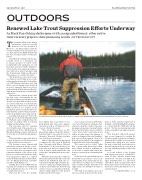
A researcher nets lake trout on Quartz Lake in an effort to suppress the exploding population and preserve native bull trout. PHOTO COURTESY OF CHRIS DOWNS
more fishing days in an effort to boost participation and total catch. Anglers turned in a total of 3,774 lake trout en- tries over the first weekend.
“The weather was great on Fri- day and the anglers, many who had not fished all winter, were anxious to get on the water,” Bras said. “Friday’s total was one of the best over the years.”
And as tribal and state agencies work to suppress the lake trout in Flathead Lake, biologists with Glacier National Park and the U.S. Geological Survey are pioneering new efforts to suppress lake trout in remote backcountry lakes and reintroduce dwindling bull trout popu- lations.
With the upstream lakes of Glacier National Park invaded by lake trout that radiated out of Flathead Lake, the eco- logical network that supports native spe- cies is becoming increasingly fragment- ed. But recent results have shown strong evidence of success, and indicate that the efforts could be applied to other invaded habitats and broader ranges.
At a recent presentation in West Gla- cier, Carter Fredenberg, a fisheries biol- ogist, presented the results of the ongo- ing suppression project on Quartz Lake, located in the park’s remote northwest corner, where lake trout invasion was still in its early stages. The aim was to reduce or eliminate lake trout by gillnet- ting, a project that required a boat to be helicoptered in and all of the supplies to be hauled in by biologists and mules.
The team located so-called “Judas fish,” captured and radio-tagged them, then tracked the fish to spawning ar- eas in order to capture and remove the densest concentrations of spawning lake trout.
In five years, the Quartz Lake project has shown strong evidence of success in reducing lake trout, and is hailed as one of the first successful projects of its kind and a leading example that lake trout suppression, once thought to be futile, is possible.
“The bull trout numbers increased last year, giving us hope that the popu-
lation is stable and that suppression is working,” said Clint Muhlfeld, an aquat- ic ecologist with the USGS who led the project. “It’s the most promising results to date of any lake trout suppression pro- gram.”
Now, biologists with both agencies have received approval to continue the federal program on Quartz, and apply a similar method of lake trout removal to Logging Lake, which was once among the most robust bull trout fisheries in the park, but where the species is now on the cusp of blinking out due to lake trout invasion.
A second element to the Logging Lake suppression project, scheduled to begin in June, involves translocation of bull trout – the first of its kind in the upper Columbia basin –to a safe haven called Grace Lake, an upstream body of water that is protected from lake trout invasion by a waterfall, which serves as a natural barrier.
[email protected]


