


Page 16 - Flathead Beacon // 4.22.15
P. 16
16 | APRIL 22, 2015 NEWS FLATHEADBEACON.COM Commissioner Accepts CSKT Lobbying Complaint
Tribes will respond to
allegations of using ‘dark
money’ to support water
rights compact
By TRISTAN SCOTT of the Beacon
The Montana Commissioner of Politi- cal Practices has reviewed and accepted a complaint filed by a Flathead County Re- publican leader alleging the Confederated Salish and Kootenai Tribes and a Wash- ington, D.C.-based public affairs firm did not disclose lobbying activities support- ing the tribal water compact during the current legislative session.
The complaint, filed by Jayson Pe- ters, chairman of the Flathead County Republican Central Committee, names CSKT, public affairs firm Mercury LLC, registered lobbyists Mark Baker and Shel- by DeMars, and the pro-compact group Farmers and Ranchers for Montana (FARM), which the complaint identifies as a “grassroots lobbying group working on the tribes’ behalf.”
Montana Commissioner of Political Practices Jonathan Motl said he received the complaint April 3. The CSKT have 20 days to review the complaint and respond, and the office will then conduct an inves- tigation.
According to Motl, the alleged rules violation falls in a “gray area” surround- ing the regulation of grassroots lobbying efforts, which he said deserves further clarification through a rules change.
The complaint argues that FARM has “chosen to use dark money and skirt Mon- tana lobbying laws to hide the full amount of funds to lobby the Montana Legislature and other elected officials.”
“This is a breach of the public trust and
open government,” the complaint states. According to rules governing lobbying in Montana, lobbyists must register with the state if they engage in face-to-face dis- cussions with legislators and disclose the in-kind value, or cash value, of their con-
tributions.
The same rules don’t apply to so-
called “grassroots” groups that make con- tributions that are less quantifiable – for example, by urging constituents in a law- makers’ legislative district to contact the lawmaker and urge him or her to vote a certain way.
“The problem with our lobbying laws is that we don’t have good regulations,” Motl said. “There is very little that is cur- rently considered to be lobbying. When we take a look at this we are going to find that there is a problem with the law.”
Motl drew comparisons to recent local efforts by the conservative group Ameri- cans for Prosperity-Montana to target Rep. Frank Garner, R-Kalispell, because the freshman lawmaker refused to sign a blanket pledge opposing Medicaid expan- sion in Montana.
“The sort of grassroots activity that people are concerned about is not just confined to one entity,” Motl said. “AFP held town meetings. Did you find that anywhere in a complaint?”
The complaint contains copies of what the complaint states are minutes from June 2014 tribal council meetings. Ac- cording to the minutes, the tribal council voted on June 3 to allocate $600,000 for a “Water Rights Budget.”
The complaint alleges the council lat- er agreed to pay Mercury $200,000 to ob- tain the services of lobbyist Mark Baker to work on behalf of the compact legislation, and that the money should have been re- ported to the Commissioner of Political Practices.
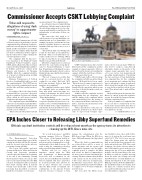
Montana State Capitol building. BEACON FILE PHOTO CSKT Communications Director Rob
McDonald said the complaint is another example of compact opponents’ efforts to distract from the debate surrounding the compact, which the state House of Repre- sentatives passed last week.
“CSKT’s legal staff is still reviewing the complaint and will respond in a timely manner,” McDonald stated in an email. “Given the tone of compact opponents, it’s not unexpected to see a baseless attack launched by the opposition, which seems to be done to distract from the actual con- tent of the compact.”
DeMars called the complaint “sad and disappointing but not surprising” and said the timing of the complaint, which came immediately before the hearing of the compact by the House Judiciary Com- mittee, “lays bare the ill intentions of the Compact’s opponents.”
“This is merely more of the same op- portunistic political tactics that we have come to expect from Compact oppo-
nents,” she wrote in an email. “While we have tried to conduct a respectful and substantive debate on the merits of the compact, many opponents have resort- ed to scare tactics, fear-mongering and spreading misinformation. Considering the tone and tenor of their misinforma- tion campaign thus far, this complaint is not surprising and confirms that they have no intention to engage in an honest debate about the benefits of the Compact, or even deal in actual facts about its con- tents. They intend only to mislead Mon- tanans.”
Motl said that given the amount of in- fluence by outside groups this legislative session, he wouldn’t be surprised if more lobbying complaints follow.
“If we get a number of complaints that we are not able to satisfactorily resolve based on the current statute, then there is work that needs to be done in terms of bet- ter regulations,” he said.
[email protected]
EPA Inches Closer to Releasing Libby Superfund Remedies
Officials say draft institution controls will be released next month as the agency turns its attention to cleaning up the W.R. Grace mine site
By JUSTIN FRANZ of the Beacon
The Environmental Protection
Agency plans on unveiling a report in the coming weeks that will lay the ground- work for its next steps in the asbestos poisoning cleanup in Libby.
The report will outline preferred cleanup methods for Libby and Lincoln County and long-term institution controls that will signal the beginning of the end of the community cleanup that began more than a decade ago. The report comes just months after the EPA released its human health assessment that stated cleanup efforts in Lincoln County had drastically reduced the poisoning that has killed or sickened hundreds of residents over the years.
“It’s a work in progress,” said EPA program manager Rebecca Thomas. “The release of the human health as- sessment (in December) was a huge milestone in the cleanup and we’re look- ing forward to these final decisions ... We want to help the community redevelop and get past this Superfund cleanup.”
Thomas said it’s too early to announce exactly what the EPA and Department of Environmental Protection will recommend in the report, due in early May, but said that it will recommend that more properties be cleaned and that some asbestos be left in place. Thomas also revealed that the EPA would recommend the continuation of the Lincoln County Asbestos Resource Program to help
manage the contamination after the EPA leaves town. When the EPA does leave, DEQ will manage the Superfund site.
When the draft recommendations are released there will be a series of public meetings and the agency will accept public comment. Once the public comment period is complete, the EPA will release its final recommendation for how to move forward and finish the cleanup. Thomas estimates that the EPA could remain on site for another three to five years. Since the cleanup began, the EPA has cleaned more than 2,000 properties and Thomas said it would like to complete 300 to 500 more within the next few years.
But even after the EPA’s clean-
up of Libby is done, there will still be more to do just up the road in an area called OU-3. The 30,000-acre area in- cludes the former mine site and the land around it that has remained rela- tively untouched since W.R. Grace and Company closed the asbestos mine in 1990. Christina Progress is the project manager for the OU-3 area, which also includes the Kootenai River. She was in Libby recently for a public meeting about the mine site cleanup and said that W.R. Grace recently finished a re- medial investigation of the site under EPA supervision. Now the EPA will be- gin feasibility study to determine how the mine site could be cleaned. Prog- ress said it would take at least a year be- fore that study is completed.


