


Page 22 - Flathead Beacon // 5.11.16
P. 22
COVER
SUN ROAD
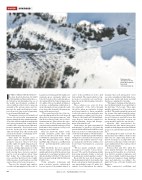
Plowing operations along Going-to-the-Sun Road in Glacier National Park in 2014.
COURTESY GLACIER NATIONAL PARK
IN THE 83 YEARS SINCE GOING-TO- the-Sun Road’s dedication, the thrill of driving Glacier National Park’s sce- nic byway has not diminished. As one of the world’s most dramatic roadways, it entices millions of motorists to queue up annually at the entrance gates and ven- ture into the park’s wild interior, trans- ported on a two-lane portal of pavement to an otherworldly landscape.
The majority of visitors to the Sun Road observe the spectacular transmountain expanse during the busy summer months, often clinically, through their windshields and on dry pavement. But a small, hard- scrabble tribe of park personnel knows it far more intimately – inch by inch, stone by stone, by the grit of the sedimentary cli s, the abrupt drop-o s, and the glide cracks in its massive overhanging snow-  elds and avalanche paths.
They know the fragrant smell of splintered pine trees packed tight in an avalanche run more than 50 feet deep and the sight of toppled lodgepole jack- strawed across the snow-entombed roadway, striking haphazard poses like pick-up sticks. They know how to set to work clearing these obstacles, negotiat- ing the road’s precipitous oxbow turns that de ne the vertigo-inducing tra- verse, and they know how to do it right, with a measure of safety and success that ensures they arrive home in one piece.
They are the intrepid park employ- ees who each spring pioneer the route to
Logan Pass, hewing a path through heavy, avalanche-prone snowpack, which can tower 80 feet above the roadbed in places, obscuring all but the faintest impression of a white ribbon of asphalt. At Glacier, crews face a challenging combination of deep, wind-packed snow, avalanches, and steep drop-o s alongside the numerous turns on the narrow road.
“These guys know the lay of the ter- rain, they know where the road drops o  when they do their pioneering run,” said Jim Foster, Glacier Park’s chief of facil- ity management. “That’s where the expe- rience comes in. They know where they can plow safely and without danger. They know where they can plow so they’re not hanging out over thin air.”
They also know the names of the 40-plus avalanche paths that could release destructive snow slides onto the road without a moment’s notice – names like The Grizzly, Swede Point, Weep- ing Wall, Alps of America, and Haystack Creek – and they know the safety zones nearby.
This knowledge has been amassed through experience, but their safety was signi cantly bolstered by the advent of an avalanche-forecasting program in 2002, which is facilitated by the U.S. Geological Survey in partnership with the National Park Service.
Today, avalanche technicians and snow scientists provide sophisticated forecast reports to determine when it is
safe to work, and when it is best to pull back and wait. The experts ski above trig- ger zones to perform tests, and deter- mine the snow stability and potential for avalanche.
These advances are a far cry from the safeguards of the 1930s through the 1950s, when an avalanche lookout used hand signals or threw snowballs to alert the operator if an avalanche was approaching, according to a 2002 report, “Going-to-the-Sun Road: Cultural Land- scape Report,” which was compiled to inform planning, design and manage- ment of the famed road.
In the 1960s, the park experimented with having U.S. Air Force jet planes  y past the Garden Wall and break the sound barrier in order to set o  avalanches and cut down on the number of delayed slides.
At ski resorts like Alta and Snowbird in Utah, plow crews and snow scientists use explosives and artillery cannons to trig- ger avalanches, but Foster said his crew doesn’t have that luxury in a national park.
“We use passive avalanche control, meaning we let nature release them,” he said. “We can’t be blowing up grizzly dens using avalanche bombs, so instead we send snow scientists up there on skis.”
Even with the new safety measures, the monumental task of clearing the Sun Road each spring is daunting and peril- ous, particularly because 35 miles of it remain closed throughout the winter,
meaning that each spring plow crews encounter an unknown labyrinth of ava- lanche runs, debris and heavy snowfall that has accumulated for months.
“The biggest challenge is that when we start working in April, we are plowing for the  rst time,” Foster said. “These guys might be plowing 40 or 50 feet above the roadbed. They understand the snow and the terrain, they understand the nature of it, but every single year is a little bit dif- ferent. It throws a curveball at you. But the knowledge they have accrued can pretty much be applied to any obstacle.”
Obstacles have characterized the Sun Road since 1910, when it was a mere twinkle in Park Superintendent William Logan’s eye, and they have persisted ever since.
Inscribing the 52-mile road onto the natural masonry of Glacier Park’s rocky cli s was an engineering marvel, dis- missed by many as an impossible feat, and every year throngs of visitors wonder in astonishment how the road was etched into these mountains.
Between 1921 and 1933, when the entire length of Going-to-the-Sun Road was opened to the public, it cost $2.5 mil- lion, 490,000 pounds of explosives and three lives to build – built by men armed with shovels, hammers, hemp climbing ropes and explosives, according to the April 1937 issue of Paci c Builder and Engineer.
They constructed sca olding and
22
MAY 11, 2016 // FLATHEADBEACON.COM


