


Page 23 - Flathead Beacon // 5.11.16
P. 23
Overview of Avalanche Paths
in the Going-to-the-Sun Road Corridor
COURTESY USGS
trestles that hung out into space, hauled supplies on horseback and scaled 100- foot ladders, blasting through mountain sides at a rate of 100 feet a day.
Technology has changed since those early years, but in many ways, work on the Sun Road has never ceased.
That much is apparent to summer- time visitors who for the past decade have observed work crews reconstructing his- tory on the Sun Road, repaving its surface and restoring and rebuilding the miles of stone guardrails that edge the highway, walls that for more than eight decades have su ered the crush of winter and wind, the poundingofavalanchesandspringtorrent.
But during Glacier Park’s silent season, beginning April 1 and generally running 10 weeks – an average that is entirely at the mercy of Mother Nature – the snow-re- moval crews converge on the road to begin an annual chore that harkens summer.
Anticipation of the iconic highway’s seasonal opening to the public is a spring refrain, and local residents guess aloud at the date they might be able to drive the full length of the Sun Road. Some years, the work is completed in May; others, not until mid-July.
Meanwhile, business owners have his- torically pressured park administration for an early opening of the Sun Road, which unleashes a  oodgate of visitors into Glacier’s gateway communities.
“By the 1950s, local businesspeople increasingly pressured the NPS admin- istration to open the Sun Road early,” according to the Cultural Landscape Report. “Until at least the 1950s, the Road was opened as soon as one 8-foot wide cut had been made. Then the policy changed, and both lanes had to be open the length of the Road before it could open to the public.”
Just as the guessing rises to a cre- scendo and spring teeters on the brink of summer, the opening arrives and Glacier
National Park opens in earnest.
But few of the visitors guessing in the valley below understand the peril- ous work of the elite force perched high on the icy cli s above, scouring the Sun Road corridor face and carving a precip- itous path as the weight of winter over-
hangs their wild and vertical o ce. Avalanche dangers is the No. 1 threat, followed closely by sliding over the ledge on “borrowed snow,” or recently moved snow that sits deceptively on the edge, according to the Cultural Landscape
Report.
In May 1953, crews encountered the
heaviest snowpack on record at the time, and the constant specter of dan- ger turned into disaster when a slide caught four employees who were work- ing to clear snow after a storm, retracing their progress below Haystack Creek as the road was repeatedly buried by fresh snowfall and new slides.
Around 10:30 a.m., and without warn- ing, a massive bank of snow broke loose in the funnel above the roadway. Two men died, while another was partially buried and a fourth, Jean Sullivan, was com- pletely buried for more than seven hours. The following month, he returned to the Sun Road and resumed his snow-clearing duties.
Sullivan recalled the incident in Dave Walters’ Montana Camp re Tales: “I had asked Bill [Whitford], who had his head stuck out of the cab window, and George [Beaton] if they felt it was safe. George said, ‘Hell yes, Jean. Let’s blow it out and we’ll be out of here in thirty minutes.’ He just got the words out of his mouth when I heard a little s-w-i-s-h. We call this kind of a quiet slide a ‘sneaker.’ I looked up and the snow slide was coming – no more than eighty feet above us – and I hollered.”
Re ecting on the near-death experi- ence more than a decade later, Sullivan’s wife, May, summarized the e ect that the
avalanche had on her husband. According to Walters, May explained:
“Before ’53, there were times when Jean was just absolute hell to live with. But after he’d been buried for seven hours on Going-to-the-Sun Road he became a dear.”
Other accidents have occurred throughout the years, but none have been fatal.
In 1964, a bulldozer and operator trig- gered a wet slab that carried both o  the road. The driver was injured but sur- vived. Other incidents and close calls have resulted in buried machinery or costly damage to infrastructure. Slides in April 1991 caused $150,000 damage to the Sun Road.
This year, the crew on the park’s west side includes  ve permanent employees, two seasonal employees, and two con- tract avalanche technicians, according to Glacier Park spokesperson Margie Steigerwald. Of these, four are operating equipment, one is a supervisor and the others are helping out in multiple ways. On the east side there are three perma- nent and two seasonal employees.
They work on a  eet of safety-yellow rotary plows, excavators and bulldoz- ers, which anchor to the snowpack with spiked cleats, seeking purchase on rock- laced ice masses above sheer vertical banks above the McDonald Creek Valley.
The half-million dollar machines are capable of clearing 4,000 tons of snow an hour, and the crews will remove up to 140,000 tons of snow from the Sun Road by the time the road opens.
Steigerwald said pressure to open early from the business community has eased, due in part to the park’s e orts to be more transparent with the plowing status, which is regularly updated on an interactive online map.
Foster, chief of facility management, said employee safety is the top priority, and the decision to wait until April 1 to start plowing allows bears and other ani- mals a chance to emerge from hiberna- tion in peace.
“We have really reached out in a pretty aggressive campaign to let the general public and business community know what we do and why we do it, and that has paid dividends,” Foster said. “We are not just twiddling our thumbs up here.”
The crews employ an operational risk management model that analyzes every possible scenario, as well as a Green, Amber, Red (GAR) analysis to determine whether the job can be done safely.
“We are not going to take any unnec- essary risks. We are all about getting our people home safely,” Foster said.
“In a way it’s a dance with nature, and we take it seriously.”
tscott@ atheadbeacon.com
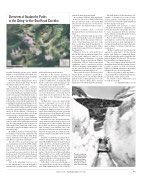
Three men standing up in convertible pointing to depth of newly cleared snow drift near Logan Pass along Going-to-the- Sun Road, circa 1930s. COURTESY GLACIER NATIONAL PARK
MAY 11, 2016 // FLATHEADBEACON.COM
23


