


Page 54 - Flathead Beacon // 5.18.16
P. 54
OUT OF BOUNDS 55 EXPLORE 56 Outdoors
POINT OF ROCKS
NEW GUIDE FOR CLIMBING AREA NORTH OF WHITEFISH WILL HIT SHELVES MAY 23
A CLIMBER’S GUIDE:
IBY CLARE MENZEL OF THE BEACON
N 2008-2009, THE MONTANA
Department of Natural Resources and
Conservation, tasked with generating revenue for the state’s school
system with resources in
the Stillwater State Forest,
began logging in the 93,000 treed acres north of Olney. Close to a decade later, the forest is growing back. Waist- high saplings have shot up in the clearings and wild ow- ers are encroaching on the logging roads, one scar that remains on the land.
For Flathead rock climb-
ers, the creation of these
roads was an accidental
blessing. Providing easy
access to new parts of the
forest, the roads opened up
3,000 acres of rocky ridges
and cli s. Since then, curi-
ous climbers have set some
200 routes in the area, which they began calling Point of Rocks.
One hundred eighty-three routes are detailed in the region’s  rst guidebook, “Point of Rocks: A Climber’s Guide,” which also includes Stillwater Can- yon and Drive-In Theatre, two popular climbing spots nearby. The text, com- piled by Kalispell climber Brett Eckert, will be sold for $19.95 at Rocky Moun- tain Out tter and Sportsman & Ski Haus starting May 23.
The 200 copies available will quickly  nd a permanent place on the shelves of local climbers, next to well-worn guides for Stone Hill and the Kila Crags, the Flat- head’s two other bolted climbing areas. Where Stone Hill, west of Eureka, o ers quality but far-away climbing, and Kila o ers proximity, Point of Rocks strikes a happy medium – reasonably close, rela- tively good rock.
In the guide, Eckert describes its cli s of ancient argillite, a hard sedimentary rock formed from consolidated clay, as “a step or two above Kila choss and a little more broken than Stone Hill.” At just 30 minutes north of White sh, Point of Rocks is close enough for climbers to visit for a few casual hours after work or on a weekend.
“Point of Rocks embodies all that is great about climbing in the valley,” Eck- ert said. “Tucked away in the woods, this wild locale is removed from the hus- tle and bustle of civilization, yet readily accessible to visitors.”
Most routes are between 40 and 70 feet tall, though some top out above 100 feet. The majority of climbs are mostly well- bolted sport routes, but the guide does detail 33 “trad” and mixed routes that traditional climbers will enjoy. There is also a growing collection of bouldering problems on the talus below.
“The climbing opportunities here deliver a range of challenges for nov- ices to advanced climbers alike,” Eck- ert said. “Point of Rocks may fall short of world class designation – there is noth- ing harder than 5.13, the climbs aren’t particularly tall, and the rock quality is slightly less than bomber – but judged on its merits, the sum of all its parts makes for a truly unique climbing experience.”
Yet, according to Eckert, Point of Rocks has been “pretty o  the radar,” because without an o cial guide, beta about the area has spread through the climbing network slowly, primarily by word-of-mouth. Unlike Stone Hill, with cli s rising up in two massive tiers above Montana Highway 37, Point of Rocks is easily missed by the unenlightened. The ragged rock is shrouded by gently roll- ing hills, and it’s accessible by several paths with trailheads at the end of windy,
doubletrack dirt roads.
“When I  rst came here, we were won-
dering if we were on the right road,” Eck- ert said.
Indeed, one of Point of Rocks’ chief draws is its remote feel. Though the guide will certainly attract larger crowds from the Flathead Valley and Canada, Eckert is more excited to share the area than he is worried about tourists.
“I’ll put up a route so I can climb it, but I get just as much enjoyment or more watching other people climb it,” he said.
In any case, Eckert is con dent that, so long as climbers care for and respect the spot, the layout will help retain its wild qualities.
“Another notable characteristic of the area is the spread-out nature of the climbing sectors,” Eckert writes in the guide. “Many crags sport a half dozen or less routes and short hikes are required to move between di erent zones. For some, this lack of quick and accessible, heavily concentrated climbing will be a turn-o , but others, especially nature lovers who eschew crowded crags, will  nd them- selves right at home in the peaceful sol- itude of these far  ung cli s.”
clare@ atheadbeacon.com
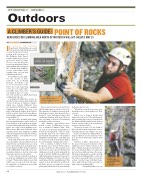
Brett Eckert climbs at Point of Rocks. GREG LINDSTROM | FLATHEAD BEACON
Brett Eckert clings to holds while climbing “Fly Paper.”
GREG LINDSTROM | FLATHEAD BEACON
54
MAY 18, 2016 // FLATHEADBEACON.COM


