


Page 54 - Flathead Beacon // 6.1.16
P. 54
OUT OF BOUNDS 56   EXPLORE 57
Outdoors
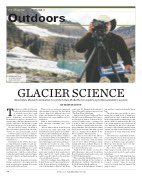
Dan Fagre takes repeat photographs of Grinnell Glacier. BEACON FILE PHOTO
GLACIER SCIENCE
Since before the park’s formation, researchers have  ocked here to explore a pristine mountain ecosystem
The history of Glacier National Park viewed through the prism of scienti c research is a rich one indeed. Since before the park’s formation, researchers have  ocked here to explore a mountain eco- system that to this day remains relatively pristine and intact, and is home to some of the most unique species on the planet.
For more than a century, the wilds of Glacier Park have provided the ideal lab- oratory for the professionally curious — scientists and researchers seeking to unravel the mysteries that lie within one of the planet’s most fascinating expanses of wilderness.
Beginning in the 1950s, these pio- neering biologists sought research per- mits and assembled teams to explore the park’s most iconic wildlife species — griz- zly bears, mountain goat, bighorn sheep, and wolverine — and the results of those studies have held signi cant policy impli- cations for Glacier and national parks in general.
But even before the permit system was in place, and prior to development of the park, scientists were making discoveries in the wilds of Glacier Park.
BY TRISTAN SCOTT
Those early researchers documented their  ndings to provide the  rst index of more than 1,000 di erent species of plants and hundreds of species of ani- mals spread out across 1 million acres of wilderness.
With so much unknown, they were, quite literally, venturing into terra incognita.
“A lot of what we know about the park is based on the really early stu ,” said David Benson, a biology professor at Mar- ian University in Indianapolis, Indiana.
Benson has spent nearly 20 summers as a naturalist in Glacier Park while also performing  eld research on the white- tailed ptarmigan, and in his public pre- sentations he touches on some of the earliest recorded discoveries within the park’s boundaries.
“If you’ve ever picked up an old  eld guide and wondered how people knew what to put in it, it’s based on this really early research from before the park was even established,” he said.
In 1900, for example, James Blake pub- lished “Some new N. American Mosses” in the Botanical Gazette, attributing sev- eral of the  ndings to Glacier Park. Four
years later, T.J. Fitzpatrick documented a few of the park’s unique fern species in “The Fern Flora of Montana.”
And in 1949, Forrest Luthy and Fred Zwickel from the Montana State Univer- sity Biological Station, followed moose around in rubber rafts, scouring pond bottoms to  nd out what the animals were noshing so intently with their sub- merged muzzles. They documented what they learned (they were snacking on pond lilies) in “Summer Food Habits of the Moose in Glacier National Park.”
The “Please Don’t Feed the Sheep” signs near Many Glacier? That com- mon-sense caveat has a history dating back 90 years, when 26 bighorn sheep inexplicably died at Many Glacier; 10 years later, another two dozen animals were dead in the same area.
Puzzled by the deaths, a researcher with Montana’s Livestock Sanitation Board began investigating the cause, and by 1938 he had an answer.
The researcher, Hadleigh Marsh, doc- umented his  ndings in the Journal of Mammalogy, entitled, “Pneumonia in Rocky Mountain Big Horn Sheep.”
The cause of the pneumonia, it turned
out, was due to visitors feeding the sheep hay.
The sheep were susceptible to pneu- monia due to high levels of lungworm, which lived in a type of snail uncommon in the high-summer grazing ranges, and which couldn’t be transmitted in the cold, low-elevation winter ranges. But visitors were drawing the sheep into their win- ter ranges earlier than normal by laying out hay, creating an ideal habitat for the worm-infested snails, which the sheep then ate.
“The obvious recommendation was to stop feeding the sheep,” Benson said. “A lot of this early research led to a less car- nival- or petting-zoo type atmosphere. Everyone now knows you’re not sup- posed to feed the wildlife.”
Since those early critical years of burgeoning research, much more has been discovered about the park and its inhabitants.
In August 1967, Cli  Martinka had been on the job for just two weeks, hired as Glacier National Park’s  rst o cial research scientist, when he received news of a tragedy that has haunted the park ever since.
54
JUNE 1, 2016 // FLATHEADBEACON.COM


