


Page 55 - Flathead Beacon // 6.1.16
P. 55
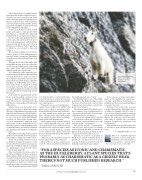
A mountain goat climbs the cli s along the Highline Trail near Logan Pass. BEACON FILE PHOTO
Two young women, at campsites miles apart from one another, situated on oppo- site sides of 9,000-foot Heavens Peak, had been fatally mauled by grizzly bears. They were the  rst bear-related fatalities since the park’s inception in 1910, and the tragedy was indelibly etched into history as the “Night of the Grizzlies.”
Scant research had occurred at that point, and rangers could provide little information or insight into what had prompted the bears’ aggressive behavior.
In the weeks and months that fol- lowed, and as the incident grew in noto- riety, park management and the public began raising questions and concerns about bears in Glacier Park — questions to which no one seemed to have any answers.
The incident would prove to be a bell- wether event for bear management in national parks, prompting Martinka’s designation as the park’s full-time bear biologist.
Through the decades, Martinka, who died in March 2014, grew one of the larg- est research programs in the country, and the results of his early research would in uence park policy for decades.
“He de nitely really built the pro- gram and made the Glacier National Park research division one of the top ones in the country for a park-based science pro- gram. That was all his doing,” said Kate Kendall, one of Martinka’s hires, whose pioneering work in grizzly bear DNA research provided the  rst reliable data on grizzly populations in Glacier Park and the Northern Continental Divide Ecosystem.
As he built the program and assem- bled a team by adding scientists to the research division, Martinka encour- aged other projects that history books will forever count as Glacier Park’s most in uential.
Among them were Dan Fagre’s cli- mate research project, which has shown that rates of warming in the park are two times the global average and will lead to the extinction of its namesake glaciers by the year 2030; Riley McClelland’s research on bald eagles; Frank Sing- er’s work on ungulates, mountain goats, wolves and resource management; Leo Marnell’s aquatics and amphibian stud- ies; Kim Keating’s assessment of bighorn sheep habitat; and Carl Key’s work in  re ecology.
Martinka’s leadership inspired much of what is now known about the park, as well as what continues to be discovered.
Today, the growing body of research is chambered under the auspices of the Crown of the Continent Research Learn- ing Center (CCRLC), which is designed to communicate research and science results in national parks.
Tara Carolin, director of the center, is in charge of administering research per- mits at Glacier Park, and issues between 50 and 75 of them every year, with proj- ects ranging from long-term studies on the habitats of carnivores to short-term monitoring of insects and micro-bacteria.
is to help facilitate scientists with their research, but also to ensure the research helps bene t park management and in u- ence smart policy.
This past year, research and monitor- ing has been conducted on wildlife and plant species such as mountain goats, harlequin ducks, hawk owls, huckleber- ries, bats, grizzly bears, wolverines, and more. In past years, other studies have been conducted on the e ects of wild re, alpine plants and diatom fossils.
In one unique study, cultural artifacts were sought through a process called “ice patch archaeology,” which relies on the theory that, as glaciers and ice  elds recede due to global warming, cultural tools, artifacts and organic materials preserved inside will emerge through the erosion process.
“There is an extremely broad range of monitoring going on,” Carolin said.
Much of the research is conducted out of the U.S. Geological Survey’s Northern
Rocky Mountain Science Center.
For Tabitha Graves, one of the USGS’ newest hires, huckleberries have become the focus of her research — not for their delicious taste, but rather as a method to
predict bear behavior.
Her thesis is simple: The ability to pre-
dict a bumper crop of huckleberries or, conversely, a dearth of the delicious fruit, can help predict bear behavior.
Research has shown that 15 percent of a bear’s diet is made up of huckleber- ries, a fun fact gleaned from a not-so-fun research study – scat analysis.
The berries provide essential nutri- ents for bears, and if you’ve ever hiked trails lined with huckleberry bushes in Glacier Park, you have probably stepped over piles of berry-loaded bear scat.
And yet, for a species as popular as huckleberries, little is known about its phenology – in other words, its cyclic, seasonal behavior and how it’s a ected by habitat and variations in climate.
“For a species as iconic and charis- matic as the huckleberry, a plant spe- cies that’s probably as charismatic as a grizzly bear, there’s not much published research,” she said.
If Graves can predict the seasonal variables that produce a hulking harvest of hucks, for example, she’ll be able to forecast bear behavior and better inform public land and wildlife managers. Ulti- mately, she envisions a predictive mod- eling map to analyze the correlation between huckleberry production and bear behavior.
And just like that, the next generation of research is born in Glacier National
Park.
GLACIER
JOURNAL
NATIONAL PARK SERVICE
Navigating the Last Best Place Glacier Park 101
Trip Planner
GLACIER JOURNAL ■ SUMMER 2016 1
FG RL EA CE I - E SR JU OMU MR NE AR L 2. C0O 1 M6
covers, at locations across the valley.
YOUR GUIDE TO THE CROWN OF THE CONTINENT
tscott@ atheadbeacon.com
This story originally appeared in Glacier Journal. Pick up the inaugural issue, which features four separate commemorative
A CENTURY OF THE
Carolin says the mission of the CCRLC
“FOR A SPECIES AS ICONIC AND CHARISMATIC AS THE HUCKLEBERRY, A PLANT SPECIES THAT’S PROBABLY AS CHARISMATIC AS A GRIZZLY BEAR, THERE’S NOT MUCH PUBLISHED RESEARCH.”
- TARA CAROLIN
JUNE 1, 2016 // FLATHEADBEACON.COM
55


