


Page 56 - Flathead Beacon // 7.20.16
P. 56
OUT OF BOUNDS 57 EXPLORE 58 Outdoors
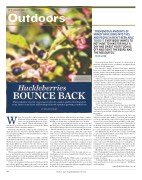
Huckleberries along the trail to Sixmile Peak. BEACON FILE PHOTO
Huckleberries
BOUNCE BACK
This summer’s berry crop expected to be earlier and better than last year, but researchers still stumped about optimal growing conditions
BY MOLLY PRIDDY
W hen the weather starts warming the Flathead Valley in spring, certain ques- tions start stirring in the back of peo- ple’s minds. When will Going-to-the- Sun Road open? How does the  re season look? What
adventures will be had this summer?
But by the time Fourth of July sparkles and pops, the
main question on everyone’s mind is simple, sweet, yet ever-perplexing. What are the huckleberries going to look like this year?
The huckleberry is one of the most-sought-out fruits in Northwest Montana, often in contention with the Flathead cherry as the o cial fruit of summer. However, the major di erence between the two berries is how they are cultivated: Cherries can grow successfully in orchards, whereas huckleberries must be plucked from the wild.
This means humans are dependent on nature’s good graces and mysterious recipe for optimal huck growth each year. Last year’s crop was dismal, a ected by record heat and drought conditions that lasted all summer and decimated crop yields.
It was a hot summer further marred by major wild-  re activity, which also impacts the next season’s huck- leberries. In Flathead National Forest, where people can
pick up to 10 gallons of hucks before needing a commer- cial permit, the berries in areas untouched by last year’s wild res look like they’re slightly ahead of schedule.
“In the  re areas from last year we’re not seeing any huckleberries,” Deb Mucklow, district ranger for the Spotted Bear Ranger District of the national forest, said. “Outside the  re areas, we are seeing some huckleber- ries, and they did start ripening a little bit earlier than some years. I would tell people they should come and expect to look, but people are picking, and people are  nding some nice berries.”
In Glacier National Park, U.S. Geological Survey researcher Tabitha Graves said that, compared to last year, this year’s berry yield looks fuller, and the bushes at lower elevations produced berries earlier than aver- age, though “average” is a bit of a hazy concept when huckleberries are concerned.
“The upper elevations (5,500 feet and above) cer- tainly appear to be more along what we think of as aver- age,” Graves said.
Graves’ work with the USGS seeks to predict how the huckleberries will grow based on various factors, not because she wants to unlock the berry’s secrets, but because the berry’s annual yield plays a signi cant part in the lives of the park’s bears.
“TREMENDOUS AMOUNTS OF MONEY HAVE GONE INTO THIS AND PEOPLE HAVEN’T BEEN ABLE TO DO IT. EVERYBODY WANTS TO NOT HAVE TO HIKE FOR HALF A DAY AND SWEAT YOUR TUCHUS OFF AND FIGHT THE BEARS AND THE MOSQUITOS.”
- PAT MCGLYNN
Research shows that 15 percent of a bear’s diet is made up of huckleberries, yet Graves said much about the berry is still unknown.
For instance, despite decades of attempts, humans have yet to domesticate the huckleberry in a meaning- ful way. People can grow the plant from a seed, but get- ting the plants to produce fruit on a consistent basis has proved elusive.
“There seems to be this situation where it’s not only the pH and it’s not only the elevation and it’s not only the soil type, but it seems to be something about that envi- ronment that is not able to be replicated,” Pat McGlynn, agriculture extention agent for Flathead County, said. “It is the million-dollar question and it is complex.”
Researchers at Cornell University have tried to  nd a combination between the Adirondack low-bush blue- berry, a very close relative to the huckleberry that has also proven di cult to domesticate, and at least 500 other blueberries to see if they can get the ornery plants to cooperate with orchards.
So far, the e ort has been fruitless.
“Tremendous amounts of money have gone into this and people haven’t been able to do it,” McGlynn said. “Everybody wants to not have to hike for half a day and sweat your tuchus o  and  ght the bears and the mosquitos.”
Finding a productive huckleberry patch can be an arduous journey into higher elevations and untamed greenery, and many people tend to keep their picking spots a secret from others who would like to take part.
Businesses using local huckleberries either have to pick them or buy berries from independent pickers who venture into the woods to  nd them, making the hucks precious and also more expensive than typical fruits.
But Mucklow, the Forest Service ranger, asked that people stay mindful when out picking berries, due to their importance to local bears.
“I’m encouraging everyone to have bear spray with them. People should pick in groups, chatting, making noise,” she said. “We  nd that noise is very helpful, so trying not to be quiet and stealthlike is the way to go. Be noisy, let others know where you are, and don’t be terri- torial. The berries are there for everybody.”
McGlynn, who is conducting a study with Flathead Valley Community College on what types of dark fruits are viable in the valley, said the mystery of the huckle- berry can be maddening for some, but it also shows the wonder of nature.
“I always think, ‘Here’s one thing the Creator made that man hasn’t been able to mess up yet,’” McGlynn
said, laughing.
mpriddy@ atheadbeacon.com
56
JULY 20, 2016 // FLATHEADBEACON.COM


