Page 23 - Flathead Beacon // 8.20.14
P. 23
FLATHEADBEACON.COM
COVER
AUGUST 20, 2014 | 23
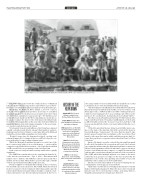
PTribal members are seen seated during the dedication of the Kerr Dam in 1939. COURTESY CONFEDERATED SALISH AND KOOTENAI TRIBES
HISTORY OF THE
POLSON – Five miles below the southern shores of Flathead own a major hydroelectric facility. It will also mark the successful
Lake, wedged between a rugged river canyon where a great water-
fall once roared, Kerr Dam plays a prominent role in the landscape. “The first thing we should always start with when we talk about
KERR DAMN
reclamation of a section of land that holds great meaning.
Blockading the Flathead River behind a 200-foot concrete
arch, the 194-megawatt plant produces an average of 1.1 million July 16, 1855: The Treaty of Brian Lipscomb, a CSKT member and CEO of Energy Keepers. megawatt-hours of electricity per year, enough to power more than Hellgate establishes the “And it’s a very significant site to us as a tribal people. This is a reli- 100,000 homes annually. It can generate up to $60 million a year Flathead Indian Reservation. gious site. It’s a cultural site. It always has been. It always will be.” on the wholesale market in the West, depending on energy prices. But others, such as Republican State Rep. Verdell Jackson, who It can also regulate the shore levels of the largest freshwater lake Feb. 8, 1887: The Dawes Act represents House District 6 in and around Kalispell, see the deal in west of the Mississippi while at the same time feeding 13 different opens up Indian reservations for a different light and describe it as part of a power grab that could reservoirs that provide vital irrigation supplies to the area’s farm- non-Indian settlement. worsen an already bitter battle over water rights within the reser- ers, ranchers and other property owners. vation.
Yet alongside its power and influence, Kerr Dam has remained 1921: Applications are filed with “If the tribe gets what they are trying to get with the water com-
equally contentious and divisive among tribal members and non- the Federal Power Commission pact or the dam or the lawsuits, they will control all the water in
Indian property owners trying to coexist amicably on the Flathead for licenses to develop five western Montana,” Jackson said. “Of course they also want to take
Indian Reservation while grappling over water rights. power sites on the Flathead private property away from non-Indians on the reservation. They
Nearly 80 years since the dam was developed, creating a sig- nificant domino effect of impacts that are still felt today, the con- troversial subject is approaching a tipping point.
While the Montana Legislature prepares to revisit one of the most controversial subjects in recent memory — a water-rights compact for the Flathead Reservation — the Confederated Salish and Kootenai Tribes are preparing to take over Kerr Dam.
Both events are being met with scrutiny, and both are equally significant.
The CSKT have remained devoted to acquiring the dam for de- cades, and one year from now — Sept. 5, 2015 — that mission will finally come to fruition. The CSKT are slated to pay nearly $18.3 million for the facility, which will be operated through a tribally owned corporation known as Energy Keepers, Inc.
For the roughly 5,000 tribal members living on the reservation, the deal will represent a milestone. The CSKT, which was formed in direct response to the development of Kerr Dam and became the nation’s first tribal government with a federally recognized consti- tution, will now become the first tribal government in the U.S. to
River within the Flathead Reservation.
want to take away their water rights and their property. And be- cause they say they’re a separate nation, they don’t have to follow state laws.”
An age-old dispute over who controls the water and how much is allocated throughout the reservation will reach the forefront once again this winter when the Montana Legislature convenes in Helena. State lawmakers will decide whether to approve the latest version of the Flathead water compact, a complex document that outlines who controls water flowing in and out of the reservation. The CSKT, which filed multiple lawsuits over claims to the water earlier this year, proposed a compact to the state in 2013. But the Legislature rejected the deal, sparking uncertainty over present and future water claims across western Montana.
The latest version that’s likely to be proposed during the up- coming winter session appears no less divisive.
“Half of my constituents are lobbying me hard in favor of it and half are lobbying hard against it. This is the most controversial and divisive issue I’ve seen in my time serving,” said Janna Taylor, a Republican from Dayton serving Senate District 6.
1930: The Federal Power Commission issues the first 50-year license to the Rocky Mountain Power Company for the Kerr project site. Rocky Mountain Power begins construction of the dam.
1931: Due to the Great Depression, a lack of funding halts construction of the dam for five years.
June 18, 1934: The Indian Reorganization Act allows tribes to exercise sovereign authority through the creation of constitutions that establish tribal governments.
Kerr Dam is that it’s parked in the middle of our reservation,” said