Page 24 - Flathead Beacon // 8.20.14
P. 24
24 | AUGUST 20, 2014
COVER
FLATHEADBEACON.COM
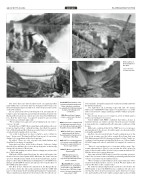
Historic photos of the development of Kerr Dam.
COURTESY CONFEDERATED SALISH AND KOOTENAI TRIBES
The tribes have also historically focused on acquiring tribal land within the reservation that was designated by Congress in 1872 by buying back parcels that were sold to homesteaders in the early 20th century.
At one point in the 1930s, following the U.S. government’s at- tempt to spur development and settlement in Indian Country, the Flathead Reservation was only 20 percent owned by CSKT mem- bers. Now the tribes’ have “reacquired” nearly 70 percent of the reservation, according to Lipscomb.
“We’ve always been aggressive about taking back our own re- sources,” he said.
Lloyd Irvine, a CSKT tribal councilman and longtime advocate for protecting the tribes’ cultural heritage, described the acquisi- tion of tribal lands and Kerr Dam as essential to protecting the res- ervation from being dissolved over time.
“On a day-to-day basis, we have to fight to protect what we have,” Irvine said. “Getting back Kerr Dam is part of our vision. And we’ve been working on this for a long time.”
He added, “There are a lot of people who think Indians just shouldn’t be in charge of anything.”
Lipscomb and other tribal leaders dispute Jackson’s claims that the tribes will have free rein to dry up irrigators or drastically change the operation of Kerr Dam.
“People are making assertions that are simply are not based in fact,” Lipscomb said.
When the CSKT acquire Kerr Dam, the tribes will acquire the identical license that regulated PPL Montana, the dam’s current operator. PPL Montana, which is based in Pennsylvania, is plan- ning to sell 11 dams in Montana, including Kerr, to NorthWestern Energy and NorthWestern has already agreed to transfer Kerr to the CSKT in the fall of 2015.
The Kerr license, which is documented on the Energy Keep- ers’ website, shows the rules and regulations that the CSKT will have to follow under the Federal Energy Regulatory Commission. Those regulations include flow restrictions for the river, flood con-
Oct. 4, 1935: Tribal members of the Confederated Salish and Kootenai Tribes ratify their constitution, becoming the first tribal government to adopt a federally approved constitution.
1936: Montana Power Company resumes construction of the Kerr project.
1938: Construction is completed and the dam begins operations. A year later it is dedicated and named after Frank Kerr, then president of MPC.
1976: The CSKT files a competing application with the Federal Energy Regulation Commission for relicensure of Kerr Dam.
1985: CSKT successfully negotiates co-licensure status with MPC and the option to acquire Kerr Dam as the sole owner in 2015.
1999: PPL Montana acquires Kerr Dam from MPC.
2012: Energy Keepers, Inc.,
is established by CSKT as a corporation that will run Kerr Dam once it is acquired.
March 3, 2014: After a lengthy arbitration process, the final price for Kerr Dam is set at $18 million. Two days later, CSKT gives formal notice of its intent to purchase the dam on Sept. 5, 2015.
trol standards, drought management standards and fish and wild- life habitat standards.
“It’s right there all in writing,” Lipscomb said. “To change that license with FERC would require a very public process. If the tribes ever intend to change anything, it will be with an open pub- lic process.”
The current license is set to expire in 2035, at which point a new license will have to be issued.
Celeste Miller with FERC confirmed that when a license is transferred from one entity to another, the new operator or holder is responsible for complying with all terms and conditions of that license.
Miller also confirmed that if the CSKT were to ever propose an amendment to the license, it would require an extensive public vetting through FERC.
Another concern, raised by Lake County commissioners, is the loss of tax revenue once the tribes acquire Kerr Dam. Last year PPL Montana paid $978,179 in property taxes to Lake County, ac- cording to tax statements obtained by the Beacon. Of those funds, $619,847 supported schools and $292,080 supported county ser- vices.
“There is concern that a piece of tax base will go away,” Lip- scomb acknowledged. “There’s concern that the tribes won’t pay taxes so that revenue will be lost for local government and schools. Well the tribes don’t operate that way.”
Lipscomb said the CSKT tribal council is reviewing options to replace the lost tax revenues, including potentially payment in lieu of taxes or another form of reimbursement.
“We’re trying to get all of that assessed,” Lipscomb said. “Obvi- ously we benefit from those services as well. We have kids in the schools. We drive on the county roads.”
Yet Jackson remains skeptical. He said he does not believe the CSKT intend to meet the FERC license conditions. He also wor- ries that the tribes won’t honor historic water deliveries to irriga- tors, particularly as the water rights compact approaches a boiling