


Page 25 - Flathead Beacon // 9.14.16
P. 25
Cree Indians. It is attached to contro- versial legislation that would remove the Interior Department’s ability to grant tribes federal recognition, and leave that power solely with Congress.
Zinke, joined by U.S. Sen. Steve Daines and Little Shell chairman Gerald Gray, told reporters on a conference call that it was the  rst time the committee had advanced a Little Shell bill in the 38 years that the tribe has been pushing for fed- eral recognition. The tribe is already rec- ognized by the state of Montana.
“I’m con dent about bringing this to its  nal conclusion,” Zinke said.
The committee also endorsed a Zinke bill that would end a moratorium on federal coal leases by 2019, re-start lease applications that were  led when the moratorium took e ect in January and allow a panel to review any future changes to federal lease regulations.
Federal o cials put a hold on all coal leasing on public lands to review the leas- ing program and determine whether roy- alty rates need to be raised. Zinke and Daines, who is sponsoring a similar bill in the Senate, said the moratorium has led to mine closures and job losses in the industry.
Soon after the committee hearing, Juneau held a news conference in Helena saying the  rst bill she would introduce if elected would be to bar sta ers of inde- pendent-expenditure committees, also known as super PACs, from working for members of Congress for two years.
Zinke’s chief of sta , Scott Hom- mel, was the treasurer of the Special Operations for America PAC that Zinke founded in 2010. SOFA PAC spent nearly $200,000 in support of Zinke’s candidacy in 2014.
“This bill is another way to prevent special interests and dark-money groups from having a more direct impact on the laws that Congress passes,” Juneau said. “Congressman Zinke’s shady way of doing business has no place in Congress.”
Zinke spokeswoman Heather Swift called Juneau’s announcement a “press gimmick” and said Hommel is a Marine veteran who does good work on Mon- tana’s behalf.
HELENA
4. Jobs Report: Montana Wages Low, but Rising
Montana’s wages are still among the lowest in the nation, but they are rising faster than the national average despite declines in the energy industry, accord- ing to a report released last week.
Jobs and wages have emerged as key issues in this year’s governor’s race between Democratic Gov. Steve Bullock and Republican challenger Greg Gian- forte. Both candidates addressed jobs and wages in separate public appear- ances Tuesday as their campaigns kick into high gear two months before the Nov. 8 election.
Bullock presented the Montana Department of Labor and Industry’s annual Labor Day report in Helena. The report says the average wage in Montana rose 3 percent in 2015 to $40,065, while in ation was only 0.1 percent, giving the state its biggest one-year jump in real
wage growth since o cials began ana- lyzing the data in 1990.
During the last 10 years, state wages have increased by an annual average of 3.2 percent, compared with 2.7 percent nationally, according to the report.
A stronger economy and tighter labor market are driving the growth, the report said. It also cited the state’s relatively low unemployment rate and high entrepre- neurship as strong economic indicators.
The news wasn’t all rosy. The report noted that mining and utilities — which make up more than 8 percent of the state’s gross domestic product — declined nearly 14 percent, with oil and gas drill- ing being a particular drag. The transpor- tation industry also fell more than 6 per- cent in 2015, likely because of decreased demand for trucking and rail by the energy industry.
Wages dropped about 2 percent in eastern Montana because of low oil prices, but the increases in the south- western part of the state around Boze- man and Butte more than o set the fall, according to the report.
Montana has a long way to catch up to the rest of the nation in wages. The average wage in Montana is about three-quarters of the national average, and Montana consistently ranks in the bottom  ve states.
Gianforte, citing IRS tax data, repeat- edly says in campaign appearances that Montana ranks 49th in wages. Montana Labor Department chief economist Bar- bara Wagner put the state’s ranking at 47th in 2015.
The report released said the low wage rankings are partially explained by the large number of part-time workers in the state, and that Montana’s ranking rises to 45th when comparing states’ hourly wages.
Montana State University political sci- entist David Parker also has pointed out that the IRS data Gianforte cites may be skewed by Montana having a relatively large number of retirees, who don’t report any income.
BILLINGS
5. Montana Re-opens Short Stretch of Yellowstone River
Montana has re-opened a short stretch of the Yellowstone River to  sh- ing, boating and other activities after o cials reported not  nding any more dead mountain white sh there in the last week.
The roughly 4-mile section re-opened Sept. 9 is at the south end of the Paradise Valley.
It includes waters from the Carbella boat launch downstream to the Point of Rocks Fishing Access Site.
On Aug. 19, Montana wildlife o cials closed a 183-mile stretch of the river and its tributaries to prevent the spread of a deadly parasite believed to have killed tens of thousands of white sh.
All recreational activity remains pro- hibited along a 47-mile stretch of the Yel- lowstone from Point of Rocks to the U.S. Highway 89 bridge east of Livingston.
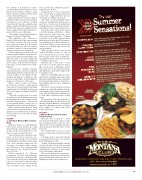
Mesquite
Grilled Ribeye
Caramel Bacon Curds
SEPTEMBER 14, 2016 // FLATHEADBEACON.COM
25
Bacon Gouda Bison Burger
Huge Breakfasts to Perfectly Grilled Angus Steaks • Cocktails • Montana Microbrews
1301 S. Main, Kalispell 260-4401 www.montanaclub.com


