


Page 23 - Flathead Beacon // 9.14.16
P. 23
1985-1989 CFAC begins cutting operating costs while threat- ening to close the plant as leverage with politicians and government agencies, while residents wait with anxiety. The plant gains huge cuts in electricity rates and property taxes as a result. The market recovers and CFAC becomes a money-making machine.
1989 CFAC is evaluated under the Montana Comprehensive Environmental Cleanup and Responsibility Act and is referred from the CECRA List to the DEQ Hazardous Waste Program as a generator of hazardous waste.
1989 Duker and Broussard dismiss their chief  nancial o cer, Revo Somersille, after Somersille raises concerns about their  nancial practices.
Jan. 30, 1992 Roberta “Bobbie” Gilmore, an accountant at CFAC,  les a lawsuit against CFAC, claiming the owners had failed to properly pay workers their share of the company’s pro ts. The lawsuit claims employees received $84.2 million during the previous six years while Duker and Broussard took in $231.4 million, which was funneled to o shore bank accounts.
Jan. 21-21, 1998 In a case garnering national attention,
U.S. District Judge Jack Shanstrom holds hearings that conclude
the  ve-year pro t-sharing lawsuit. Duker agrees to pay the workers $97 million, nearly double his previous o er and eight times the initial proposal he made in 1995.
May 28, 1999 Glencore AG, a global commodities trading and mining giant based in Switzerland, purchases CFAC. Within a year, Glencore enacts production curtailments.
Jan. 2001 For the  rst time in its history, the entire plant is idled. March 2002 Production restarts and, for the next seven years,
runs between 10 and 60 percent of capacity.
October 2009 CFAC halts production inde nitely, eliminating nearly 200 jobs.
2012 State Senator Dee Brown, R-Hungry Horse, initiates the EPA Superfund assessment of the CFAC site.
April 2013 The EPA agrees to investigate the CFAC site for possible Superfund listing.
June 30, 2014 U.S. Sen. Jon Tester criticizes Glencore
for misleading the community of Columbia Falls and says, despite Glencore’s public statements, the company “never had any intentions of [reopening CFAC].”
July 2014 DEQ begins talks with Glencore about the state having authority over the investigation so cleanup can be completed more quickly.
December 2014 CFAC ends negotiations with DEQ after the two sides are unable to agree on the terms of the Administrative Order on Consent.
Jan. 8, 2015 Tester writes EPA Administrator Gina McCarthy urging her to list CFAC as a Superfund site.
March 2, 2015 Glencore announces that it is permanently closing the plant.
Jan. 2016 Calbag Resources, a Portland, Oregon-based  rm that specializes in decommissioning industrial sites, begins tearing down and salvaging all of the above-ground materials at the CFAC property, including more than 50 structures.
Feb. 2016 The Columbia Falls City Council sends Tester a letter encouraging him to continue to push for Columbia Falls Aluminum Co. to be added on the National Priorities List for Superfund sites.
May 18, 2016 Wells are installed on the CFAC site to begin studying ground and water samples.
Sept. 9, 2016 The EPA declares CFAC a Superfund site.
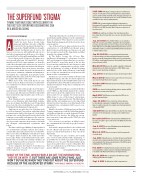
THE SUPERFUND ‘STIGMA’
TOWNS THAT HAVE DEALT WITH CLEANUPS IN THE PAST SAY SUPERFUND DESIGNATIONS CAN BE A MIXED BLESSING
“This Superfund has been with us for 30 years and it’s had a signi cant impact on the community,” Davison continued. “There have been some positive things that have happened, but there has also been some negatives.”
One of the positives in Anaconda has been the construction of a NorthWestern Energy power plant. Davison said he hopes as time goes on, and more people learn about the Superfund and what it entails, the stigma will fade.
In The Dalles, Oregon, the 305-acre Mar- tin-Marietta Aluminum Co. plant was closed in 1987 and designated a Superfund site soon after- ward. Nearly 30 years later, much of the site has been cleaned up and delisted. Part of it was recently sold to a private company and is ready for indus- trial development, according to Kathy Ursprung with the Port of The Dalles. However, some small pieces of the site remained fenced-o  and are still monitored for contamination.
Another success story is found near Bonner and the Milltown Dam. After the site was designated a Superfund, the dam on the Clark Fork was removed along with more than 6.6 million cubic yards of con- taminated sediment. Today, the area along the river is a state park.
As state and federal o cials considered whether to list CFAC as a Superfund, many in the commu- nity worried about the implications. Some resi- dents pointed to an example two hours away in Libby, home to one of the largest environmen- tal cleanups in American history. The EPA added Libby and the surrounding area to the Superfund list in 2002 after it was discovered that much of the community was contaminated with cancer-caus- ing asbestos.
Mark Peck, a native of Libby and current Lincoln County commissioner, said the Libby Superfund is a lot di erent than the recently designated Colum- bia Falls site. For starters, the Libby site encom- passes an entire town, whereas the CFAC site only covers 960 acres.
“It’s a lot more personal here in Libby because the contamination is literally in people’s homes,” Peck said.
Peck said it’s important that local residents and elected o cials ask questions of federal o cials and get as much information as they can about Superfund.
“If I could give one piece of advice, it’s to make sure everyone understands what’s happening, to go in with your eyes wide open and to stay engaged with the process,” he said. “The Superfund program is a good one and it’s there to protect the public. But there are rami cations as well that are long term and are di cult to undo.”
jfranz@ atheadbeacon.com
ABY JUSTIN FRANZ OF THE BEACON
nita Bailey has been a realtor in Mineral County for more than a decade, help- ing people  nd their own slice of Big Sky Country. For the most part, the hunt for a home in the Clark Fork Valley is straight- forward, but Bailey says at least a few
times a year someone will suddenly back out of a deal after learning about a little piece of local his- tory: the Flat Creek Iron Mountain Mine and Mill.
Located just north of Superior, the mine oper- ated sporadically from 1909 until 1953, harvest- ing silver, gold, lead, copper and zinc ore from the earth. Even though it was only active for a total of 27 years, its impacts have far outlasted its lifespan. An Environmental Protection Agency investiga- tion in the 2000s found elevated concentrations of lead, arsenic, antimony, cadmium and manganese throughout the community. In September 2009, the EPA added the mine and town to the Superfund program’s National Priorities List.
While most of the town itself has been com- pletely cleansed, Bailey said some potential buy- ers couldn’t get over the fact that the area was once contaminated.
“Most of the time, when people do get the infor- mation, they’re OK with it,” Bailey said. “But there are some people who just won’t buy here when they  nd out about the Superfund because of the asso- ciated stigma.”
That dilemma can be found in many commu- nities across Montana with Superfund designa- tions. According to the EPA, there are 17 Superfund projects in the state, including the recently added Columbia Falls Aluminum Company site.
Jim Davison, executive director of the Anaconda Local Development Corporation, said a Superfund designation is a double-edged sword. On one hand, putting a site on the National Priorities List holds companies responsible and improves the environ- ment, Davison said. But on the other hand, some developers and companies don’t want to deal with the stringent environmental regulations that follow.
The Anaconda Copper Mining Company mined ore around Butte and Anaconda for more than a century. The Anaconda smelter was closed in 1980. Three years later, the EPA placed it and more than 300 square miles of land on the south end of the Deer Lodge Valley on the National Priorities List. Thirty-three years later, the cleanup continues. As a result, Davison said the area has lost out on some major developments in recent years.
“Some companies don’t want to touch this area with a 10-foot pole, even after the cleanup, because of the regulations,” he said.
“MOST OF THE TIME, WHEN PEOPLE DO GET THE INFORMATION, THEY’RE OK WITH IT. BUT THERE ARE SOME PEOPLE WHO JUST WON’T BUY HERE WHEN THEY FIND OUT ABOUT THE SUPERFUND BECAUSE OF THE ASSOCIATED STIGMA.”-ANITA BAILEY, MINERAL CO. REALTOR
SEPTEMBER 14, 2016 // FLATHEADBEACON.COM
23


