


Page 21 - Flathead Beacon // 9.14.16
P. 21
W hen Columbia Falls Mayor Don Barn- hart describes his community, he por- trays a city bubbling with vitality and untold potential. He also renders a stubborn, hardscrabble town with a proud blue-collar past and an inordi-
nate degree of loyalty to its guts and grit. Columbia Falls is unabashedly authentic, he
says, warts and all.
The combination of those characteristics is
what the mayor believes makes his community unique, better equipping the town and its residents to endure hard times and bounce back stronger, forever booming after even the most devastating busts.
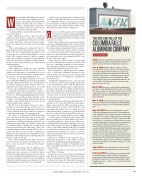
That’s why Barnhart is unfazed by the U.S. Environmental Protection Agency’s decision last week to list the Columbia Falls Aluminum Com- pany property as a federal Superfund site, even as some of the town’s residents, as well as company brass and a handful of political representatives, balk at the designation, calling the federal environ- mental cleanup program ine ective, improvident and stigmatizing.
But not Barnhart.
“This town is never going to become something
it’s not,” Barnhart said. “We are who we are. So whether it’s Superfund or something else, we’re going to get it done our way. We are going to clean it up and move on, and that’s all that matters.”
On Sept. 9, the Environmental Protection Agency added the CFAC property to the Superfund program’s National Priorities List, designating it for critical cleanup among the nation’s most con- taminated sites. Nine other properties across the U.S. were also formally listed as Superfund sites.
And while the listing is designed to ensure a thorough cleanup, it is something of a scarlet letter for the once-thrumming aluminum plant along the Flathead River near Glacier National Park, a crit- ical piece of Columbia Falls’ industrial backbone and blue-collar identity, which for years stood out as the region’s largest employer.
But the deserted manufacturing site is also a blemish on a proud landscape and the source of unresolved environmental and public health con- cerns, leading the federal government to trigger its foremost hazardous waste cleanup program.
According to Joe Vranka, the EPA’s Superfund unit supervisor in Montana, the program will ensure that the property’s owner, Glencore, a global commodities trading and mining giant based in Switzerland, and possibly other former owners, will be held  nancially accountable for cleaning up any hazardous materials and addressing other envi- ronmental impacts. The program will also devote grants and other resources to the community to help spur redevelopment and revitalization at the CFAC site, while facilitating a Community Advisory Group to engage residents.
The actual cleanup plan will only be developed after the initial remedial site investigation is com- plete, a process slated to wrap up around 2020, Vranka said.
Barnhart acknowledges that the EPA’s involve- ment doesn’t fast-track the cleanup, but he and other stakeholders take a measure of comfort in know- ing that the Superfund designation assures Glen- core’s accountability, particularly after the company earned a reputation around the world for failing to voluntarily complete hazardous cleanups, and locally for  ip- opping on its intent to reopen the plant.
“Nothing is going to happen fast,” Barnhart said. “You have to have patience. But before I’m done and gone, I think there will be something great on that property, maybe an industrial park with good-pay- ing jobs. I’m not sure what, but there will be some- thing that’s positive for this community.”
G
of promises to reopen.
News of the permanent closure soured residents
and former aluminum plant workers who held out hope that the facility would reopen and reanimate the downtrodden community after the recession.
U.S. Sen. Jon Tester remains dubious of Glen- core’s intentions, particularly after spending years trying to broker a deal that would allow the plant to start up again before encouraging the EPA to list the site under Superfund.
Other skeptics of Glencore have come around since the company began acting in good faith early last year, committing $4 million to the investiga- tion and future cleanup and raising hopes that a Superfund designation was unnecessary.
Even though the company insists it’s commit- ted to a “long-term, sustainable solution” for the shuttered plant, the majority of the stakeholders involved in the process leading up to listing felt it was for the best.
“It’s kind of an unhappy victory — a victory not to be celebrated,” said Joe Russell, public health o - cer for the Flathead City-County Health Depart- ment. “I am not standing up here saying this is a victory for the people or for public health, but I do know that it is going to keep the public process mov- ing forward. It gives us assurance that the process is going to move forward. It puts the full force of the federal government behind keeping this thing moving forward.”
Russell emphasized that the polarizing debate of whether or not to list the CFAC site under Super- fund is moot, and the EPA never had a choice. Although CFAC negotiated with the EPA for the Superfund Alternative Process, which uses the same investigation, cleanup process and standards that are used for sites listed on the NPL, such a pro- cess requires the responsible party to fully commit.
“An alternative designation only works when the responsible party is all in. And we don’t have a responsible party here,” Russell said. “Glencore is not taking full responsibility for this site on its own. And as long as they’re not all in, the EPA knows that it has to go through with the listing. We don’t want to get four years down the line and all of a sudden realize we have nothing to cover these costs. From a purely regulatory perspective, there was no other alternative to listing.”
Russell also dismissed the argument that a Superfund designation would stymie economic growth in Columbia Falls by stigmatizing the com- munity, pointing to examples of Superfund sites in Somers and White sh that have not been a deter- rent to growth.
“Those communities aren’t su ering,” Russell said. “They’re thriving.”
Erin Sexton, a research scientist at the Flathead Lake Biological Station of the University of Mon- tana who participated in CFAC’s Community Liai- son Panel, welcomed the Superfund designation because it places the  nancial onus on the polluter
THE RISE AND FALL OF THE
COLUMBIA FALLS ALUMINUM COMPANY
BY DILLON TABISH
1914 The Anaconda Copper Mining Company  rst explores building an aluminum plant somewhere in the Flathead Valley if and when a hydroelectric dam is built, either on Flathead Lake or upstream.
Oct. 8, 1950 The Harvey Machine Company, a Los Ange- les-based manufacturing  rm, announces it has purchased 1,000 acres of open farmland one mile north of Rose Crossing near the county airport to build a massive aluminum plant. The Korean War prompted a 70 percent increase in aluminum production capacity, leading to the development of new facilities in Wenatchee, Wash- ington, The Dalles, Oregon and eventually Northwest Montana. The creation of Hungry Horse Dam made it possible to develop a large plant in this corner of the state.
Early 1951 New plans are crafted to build an aluminum plant near the base of Teakettle Mountain two miles northeast of Columbia Falls. Project managers also look at other possible locations in Coram and the Halfmoon Flats area. The Harvey Machine Company  les an application for a $70 million loan with the government to build one plant near Kalispell.
Nov. 6, 1951 After the Harvey Machine Company fails to gain  nancing to build the massive facility, the Anaconda Copper Mining Company acquires their interests in the Flathead Valley aluminum plant.
Aug. 30, 1952 The Anaconda Company announces plans
to build a new aluminum plant near the base of Teakettle Mountain outside Columbia Falls. The company ditched plans to build the large facility o  Rose Crossing after farmers raised concerns about poten- tial damage to crops and livestock. C.F. Kelley, chairman of the ACM board of directors, says the Anaconda Company intends to construct a completely modern plant, “so that no damage of any kind will result from its operation.” The plant is hailed in local newspapers as an important industrial development that will shepherd in a new era of economic stability in Northwest Montana, despite lingering concerns about the ecological repercussions. “There has been considerable apprehension in the valley by farmers and sportsmen as to the possible destruction of plant and wildlife by waste products from the plant. These fears are without foundation,” an editorial written by the Daily Inter Lake on Aug. 31, 1952 stated. “Thanks to the foresight of Cornelius F. Kelley, chairman of the board of the Anaconda Aluminum Company, this plant will not cause the slightest damage to our farms, forests or streams.”
June 1953 The Anaconda Company receives more than 750 applications to work at the new plant, which is under construction.
February 1955 Nearly 1,600 workers are employed to build the new aluminum plant, including the 130-foot tall paste plant, which becomes the tallest building in the Flathead Valley. The main building where the potliners are stored and the aluminum is made is 1.75 million square feet — or 40 acres — in size, making it the largest building in Montana.
lencore closed the plant in 2009, citing high electricity rates and poor aluminum market conditions, and permanently shuttered the facility in March 2015 after breaking a string
SEPTEMBER 14, 2016 // FLATHEADBEACON.COM
21


