


Page 21 - Flathead Beacon // 9.21.16
P. 21
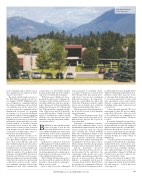
Flathead Valley Community College. BEACON FILE PHOTO
local community, and so whatever areas the community needs support in, that’s our job to meet those.”
The quick and thorough response to the Weyerhaeuser layo s was the lat- est example of FVCC ful lling its mis- sion of helping the community address the gamut of challenges and needs that can suddenly arise. In the heart of the recent recession, the community college dramatically increased its programs in response to a 55 percent enrollment growth that saw the student population spike to nearly 2,800, making FVCC the fourth largest of any college or university in Montana. At the same time, as a sub- stantial number of veterans returned home from service overseas, the college made room for a new Veterans’ Center in 2014, hoping to provide added resources and assistance for VA bene ts, college-re- lated issues and civilian matters.
This fall, despite the economic recov- ery, the college remains as relevant as ever. Enrollment remains robust with more than 2,263 full-time and part- time students taking classes this semes- ter, a 4.3 percent increase over last year. Roughly 43 percent of the student body is non-traditional, meaning 27 or older, while the number of local high school graduates attending FVCC has risen in the last decade. The slate of two-year aca- demic programs, four-year partnerships with other state universities, professional certi cations and non-credit commu- nity continuing education classes keeps expanding as well. Also, construction
is underway on a $7.7 million student housing facility with 124 beds, which is expected to be  nished next summer.
“Fifty years ago, I think a lot of peo- ple knew the importance of having edu- cation here, but I don’t know if they real- ized what a di erence they were going to make,” Karas said. “I often say it’s like the Jimmy Stewart movie, ‘It’s a Wonderful Life.’ What would this community be like if the college never existed? It would be a very di erent place, I think. It would still be a beautiful place and we would still have a lot of great people here. But I think the college has truly made a di er-
it was yesterday. It was the late
1950s and McLaren was a coun- selor at Flathead High School. He began interviewing seniors before graduation and asked them a simple yet important question: What are your plans after high school?
As McLaren recalls, most of the boys said they planned to stick around the val- ley and  nd work in the timber industry or in some other blue-collar endeavor, fol- lowing in their fathers’ footsteps. Most of the women planned on becoming stay-at- home mothers or work as a secretary or in other administrative positions.
“Most of them, when I mentioned col- lege, they said they could never a ord to go away to college. It was too expensive,” McLaren said recently.
seniors planned on attending college, according to McLaren’s research from 1952 through 1962. And among those, only about 7 percent were graduating with a four-year degree. In comparison, down the road in Missoula, where the University of Montana resided, roughly 40 percent of students were attending college and graduating with a degree.
McLaren presented the information to the local school board, led by chairman Owen Sowerwine.
“When I gave them my report, (Sow- erwine) almost broke down and cried,” McLaren said. “He said, ‘We’ve got to do better than that.’”
Sowerwine, a well-known conserva- tionist and community  gure, took it upon himself to  nd an answer. Recently retired, Sowerwine spent the ensuing years traveling the country studying what other communities similar to the Flathead Valley were doing to improve their residents’ livelihoods through higher education. At  rst, his thought was for Kalispell to develop a junior college, which could provide education programs mostly for university transfer students.
Instead, Sowerwine discovered another phenomenon that was sweep- ing the nation. In the early 1960s, the community college model was a new and rapidly expanding movement that focused on post-secondary education linked to a community and its speci c economic characteristics. By 1965, there were nearly 900 community colleges in the U.S. Instead of focusing on research,
faculty members were principally tasked with providing high-quality instruction. Students could either gain two years of schooling that would vault them on to a four-year university, or they could take specialized courses that trained them for occupations right out of school, including engineering, technology and construction.
“Owen came back and said, ‘We don’t want a junior college. We need a commu- nity college. We need to take care of all of the students in our community, not just college transfer students,’” McLaren recalled.
Sowerwine organized a group of advo- cates and planners who would shape this dream and make it reality. He organized what is now known as the “Original Five:” McLaren; Norm Beyer, director of the local state employment agency; Thelma Hetland of the Federated Women’s Club; and Les Sterling, one of the owners of KOFI Radio.
Over the next few years, the group ral- lied support throughout the community, visiting with men’s and women’s civic groups and other residents to explain why a two-year college could have an imme- diate and lasting impact on locals of all ages and abilities. A majority of Flathead County voters needed to approve the request to fund the college.
The decision arrived on April 1, 1967, with news coverage from across the state reporting on the results. Late in the night, the tally came in — 3,013 in favor and 2,308 opposed.
21
ill McLaren, 88, remembers it like eB
nce in a lot of lives.”
In fact, only 20 percent of Kalispell
SEPTEMBER 21, 2016 // FLATHEADBEACON.COM


