


Page 22 - Flathead Beacon // 9.21.16
P. 22
COVER
FVCC
FVCC’S 50-YEAR LEGACY
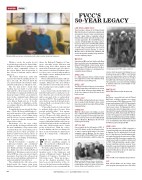
Bill and Lois McLaren, who were actively involved in the college’s creation. GREG LINDSTROM | FLATHEAD BEACON
LATE 1950S & EARLY 1960S
Owen Sowerwine, chairman of the Flathead County High School board and a well-known community and environmental advocate, begins envisioning plans for either a junior college or community college in Kalispell to help students and residents improve their economic opportunities. His friend, Bill McLaren, a counselor at Flathead High School, begins conduct- ing surveys among seniors from 1952-1962 and  nds only roughly 20 percent of graduates were going on to attend college, and among those only 7 percent completed their four-year education. In contrast, Missoula, home to the University of Montana, had over half the graduates attending college and 40 per- cent were completing a degree.
MID 1960S
Sowerwine and McLaren band together with Norm Beyer, head of the local state employment agency in Kalispell, Thelma Hetland, a former teacher, and Les Sterling, owner of KOFI and the president of the Asso- ciated Chambers of Commerce, to develop plans for a community college in Kalispell.
APRIL 1, 1967
In a highly anticipated election, Flathead County voters approve the creation of the community college with 3,013 in favor and 2,308 opposed.
APRIL 2, 1967
The college’s  rst board of trustees is sworn and im- mediately begins hiring sta . Chet Ross was elected as the  rst board chairperson. Kent Newman was the  rst vice-chairperson. Everit Sliter was the  rst board secretary.
APRIL 9, 1967
Dr. Larry Blake, a Kalispell native who was serving as dean at another Paci c Northwest college, returns home to become the  rst president of Flathead Valley Community College.
SPRING 1967
While the college awaits state funding, an anony- mous community donor gives FVCC $13,000 to fund operations and prepare for the inaugural fall semes- ter. The school hires its  rst teacher in May, Donald Garner of Bremerton, Washington, who will teach psychology and sociology.
SEPT. 25, 1967
Classes begin for the  rst fall semester at FVCC. A total of 611 students enroll in the fall quarter, twice as many as expected, which makes it the largest community college in Montana. The  rst classes are held at night at Flathead High School, taught by seven initial faculty members, while the college also
Members of the 1967 Board of Trustees. Seated from left: Dr. Herman Ross and Lillian Tubbs. Standing from left: Kent Newman, Charles Cox, Cort Peacock and Carl Clogston. Not pictured: Perry Melton. COURTESY FVCC
Within a week, the newly elected board hired a president, Dr. Larry Blake, a Flathead High School graduate who had led other community colleges in the region. Blake’s  rst decision was to hire a dean of students, and he tabbed McLaren.
“He said he wanted me, and I said, ‘Larry, I don’t know anything about col- leges.’ He said, ‘No, but you know the area and you know the students. That’s all that really matters,’” McLaren said.
The two men went to work. State funding was not slated to arrive until July, and the college was facing its  rst few months of organization without any  nancial support when an anonymous donor in the community gave Blake and McLaren $13,000 to cover the initial costs. Glacier Bank sent one of its o - cers, Leo Shepherd, to help  gure out the accounting, which he did with the bank paying his salary.
In a night that is now legend, the three men — Blake, McLaren and Shepherd — met in the upstairs of the county library with a typewriter, a few folding chairs and the vision of a new community col- lege. It was here that the dream trans- formed into reality.
Excitement over the new college spread quickly. Sterling would advertise the new community college on the radio everyday while the curriculum grew to include practical college programs in business and forestry, among others, as well as 20 to 30 courses of general inter- est to adults, including homemaking, home repair and dance.
By fall, 611 students — a mixture of traditional students and community members — enrolled in classes at the new Flathead Valley Community Col- lege. Night classes were held at Flathead High School. Morning sessions were held at the VFW bar or in several local church basements. Years later, the college set up shop in various buildings on Main Street and eventually in Central School.
The administrative o ce was estab- lished inside the former train depot building downtown next to Depot Park,
where the Kalispell Chamber of Com- merce currently resides. McLaren and Blake set up their o ces upstairs and turned the downstairs into a bookstore and center for students. That  rst semes- ter, there were seven faculty members who taught courses, making it nine total with Blake and McLaren.
The faculty and their families did a lit- tle of everything in those early years. For example, McLaren’s wife, Lois, Blake’s wife and others often worked as custodi- ans, cleaning classrooms at night or early in the morning.
Lois, a stay-at-home mother with four kids who had hoped to someday get a col- lege education, also enrolled as a student and became part of the second graduat- ing class at FVCC. The roughly 40 grad- uates that year marched through down- town and held a ceremony in the former Liberty Theater.
“It was a big step for a lot of people just to graduate high school because their parents probably didn’t,” Lois remem- bered recently. “There were six of us in our 40s. We were all a little afraid to go to college and compete with these kids in classes ... I was going to attend (the Uni- versity of Montana in Missoula), but we still had four kids at home and when the time came, I didn’t want to move ... It was pretty isolated here. With the college, we were  nding out there are things out there in the world that we didn’t know about. It’s changed the community, I
216-acre sprawling campus on
the north side of Kalispell, has a well-established tradition.
“From its earliest days, Flathead Val- ley Community College has been a tre- mendous asset to the businesses and citizens of Flathead County,” Kalispell Chamber of Commerce President Joe Unterreiner said. “From my perspec- tive as the chamber president, there have been several initiatives at the col- lege over the last few years that will have lasting bene ts for our economy and the
Breaking ground on the FVCC campus. COURTESY FVCC
relied on church basements in the Kalispell area, an abandoned garage and the VFW bar to hold morning classes. The auto mechanics classes are held at the National Guard Armory. Forestry classes are held at the Saddle Club at the Flathead County Fairgrounds. The faculty o ces are located at the Depot building in downtown, where the current Chamber of Com- merce is located.
WINTER 1967
Another 588 students enroll in the winter term.
1968
Neil Eliason, a successful track coach at Flathead High School, establishes a women’s cross country and track program at FVCC. Within a few years, FVCC became a national power. In 1971, FVCC placed fourth at the national intercollegiate meet, behind three large four-year schools. The Mountainettes 440 re- lay team won the national championship in a record time of 49.0. The team placed third the following year, ahead of Oregon, UCLA, Stanford and other elite uni- versities. The team placed second in 1972. The Moun- tainettes won the National Junior College champion- ship in 1977 and  nished second in 1976. Eliason went on to coach at Montana State University in 1977 and the FVCC program was dropped in 1980.
JUNE 9, 1969
The  rst graduating class of FVCC is honored in a ceremony in the lodge room of the former Elks Temple in downtown. The class dedicated itself to the prin- ples of J. Hugo Aronson, a Swedish immigrant with- out formal education who became governor of Mon- tana in the early 1950s. Aronson was a member of the college’s general advisory committee and advocated for FVCC. “Flathead Community is a people’s college,” President Larry Blake said in the ceremony. “It was through the cooperation of hundreds of people in this area that we now have a college here. This class is dedicated to Hugo Aronson because he always was, and still is, a man for the people.”
1970
FVCC voted No. 1 rural community college in the U.S.
1972
Hugh and Eyler Adams start the college’s logger sports program, showcasing the state’s rich history
ifty years later, FVCC, with its tF
hink.”
22
SEPTEMBER 21, 2016 // FLATHEADBEACON.COM


