


Page 22 - Flathead Beacon // 10.7.15
P. 22
COVER
CHARLES CONRAD
in the Confederate Army that sneaked behind enemy lines and disrupted the Union Army’s efforts. The boys fought in the last two years of the war before returning home to find their family’s plantation was struggling, like much of the South. Charles and William ventured West, arriving in Fort Benton in 1868 with only a silver dollar between them, as legends goes.
The boys developed into successful businessmen, taking over a mercantile company that transported supplies using riverboats along the Missouri River and wagons. Charles became known for building strong relationships with Indian tribes living throughout the Montana territory, and in the 1870s he helped negotiate a treaty between the British government in Canada and five tribes following the Nez Perce War.
Charles spent over 20 years prospering in Fort Ben- ton as a multi-millionaire before the mysterious north- west corner of modern Montana called his name. On his way to Spokane in search of greater opportunity, Con- rad journeyed the entire length of Flathead Lake in the fall of 1890 with his wife Alicia and their young child. The utopian beauty of the new land awed the Conrads, and Alicia would later say it seemed as though they had entered paradise.
Author James E. Murphy described this turning point in history in his 1983 book, “Half Interest in a Sil- ver Dollar: The Saga of Charles E. Conrad.”
“The colors of fall marched up the foothills and moun- tains, blazing in the bright fall sun,” Murphy wrote. “As the Conrads watched the passing scenery, there began a love affair with the Flathead Valley that would warm their hearts and glow within them for as long as they lived.”
At the time, Demersville was the largest community in the valley. Conrad and his close friend, James J. Hill, the chief executive in charge of the Great Northern Rail- way, devised a plan to build the railroad’s new division
point for the region in a new com- munity north of Demersville.
With opportunity in mind,
Conrad founded the Kalispell
Townsite Company with a few
men from the railroad, and they began platting a new community. A friend of Conrad’s recommended it be named after the tribe of Indians known to frequent the area.
In 1891, Kalispell was born. Within only a few years, the community had blossomed with Conrad as its most famous and successful resident. He was involved in banking, real estate, mining and cattle ranching.
“Everything he touched turned to gold,” said Mary Miers, a staff member
for eight years at Conrad
Mansion.
He was a passionate out- doorsman who took his fam- ily on adventures into mod- ern day Glacier National Park, and established a large bison herd along his 72 acres of property in Kalispell. The herd, which had a strong bloodline, later helped estab- lish the National Bison Range in Moiese.
Conrad’s time in Kalispell was short. He died Nov. 28, 1902 in his bedroom in Kalis- pell. Historians say it was from complications associ- ated with diabetes and tuber- culosis. The news of his death made headlines across the country — “Montana Pioneer
“IT’S AN ICON — THE HOUSE THAT THE FOUNDER OF THE CITY BUILT. IT’S TRULY AWESOME INSIDE.”
- EVERIT SLITER
Dies,” the Salt Lake Tribune read in November of that year. The newspapers described him as one of Montana’s most prominent and important citizens, similar to the Copper Kings of Butte and Anaconda.
Indeed, Conrad left behind a massive legacy. But not long after his passing, as Kalispell thrived into the 20th century, the mansion that stood as prominent as the man who built it began crumbling with time.
In early October of 1973, Chris Vick, the great-grand- son of Charles Conrad, met with the Kalispell City Council in a closed meeting. On behalf of the fam- ily, Vick offered the city a monumental gift — the historic Conrad Mansion.
Completed in 1895, the 13,000-square-foot mansion along Woodland Avenue boasted an enormous stature. It sat in the middle of an entire city block with three sto- ries and 26 rooms and included state-of-the-art features for the turn of the century, including electricity and an elevator.
Yet the famous mansion had become hardly dis- tinguishable by the 1970s. Many of its windows were boarded up. Overgrown shrubs and trees engulfed the run-down facade. Vandals had even broken in and looted parts of the building.
22
OCTOBER 7, 2015 // FLATHEADBEACON.COM
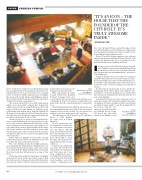
Brit Clark gives a tour of the Conrad Mansion. GREG LINDSTROM | FLATHEAD BEACON
ABOVE
A small mobile home sat on the southeast corner of the property where Alicia Conrad Campbell, the young- est daughter of Charles and Alicia Conrad, was living as an elderly woman, unable to pay the heating bills for the massive old home. Sev-
eral years after Alicia and her
late husband George Camp-
bell moved into the trailer
outside, it was difficult to even
The taxidermy room at the Conrad Mansion GREG LINDSTROM | FLATHEAD BEACON
BELOW


