


Page 23 - Flathead Beacon // 10.7.15
P. 23
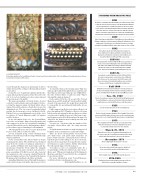
CLOCKWISE FROM LEFT
Stained-glass windows at the Conrad Mansion; Details on a hand-carved black oak library table at the Conrad Mansion; An antique typewriter in Charles Conrad’s library from the late 19th century.
CONTINUED FROM PREVIOUS PAGE
1891
As Charles settled into the Flathead Valley, he and his friend, James J. Hill, the chief executive in charge of the Great Northern Railway, saw an opportunity for a new division point for rail service in the region. Charles formed the Kalispell Townsite Company with three other men, who were on the board of directors with the railroad. Charles crafted the original layout for a new town called Kalispell. He platted the town site and lots began selling in the spring of 1891.
1892
After Conrad meets with Hill in St. Paul, Minnesota, Great Northern Railway establishes its division point in Kalispell, leading to the city’s rapid growth. Conrad forms several bedrock businesses in town, including Conrad National Bank, and acquires large sections of land.
1892
Alicia Ann Conrad is born in Kalispell, the youngest of three children born to Alicia and Charles Conrad. Charles Davenport and Catherine Conrad, the other children, were born in Fort Benton in 1882 and 1884, respectively.
1893-94
Conrad and other residents lobby the Montana Legislature to create a new county for Kalispell and its surrounding towns, which were part of Missoula County. Lawmakers debated whether the county seat should be Kalispell or Columbia Falls, and Conrad’s influence pushed Kalispell to the top.
1892-95
Conrad pays renowned Spokane architect Kirtland Cutter to design a new mansion in a forested section of Kalispell. After three years of construction, the 13,000-square-foot, three-story home is finished with eight massive sandstone fireplaces and 26 rooms, including three bathrooms.
Fall 1900
Teddy Roosevelt visits his friend Charles Conrad and stays at the mansion in Kalispell. The Conrads hosted many prominent guests, including Charles M. Russell, the famed Montana artist.
Nov. 28, 1902
Charles Conrad passes away at age 52 inside his Kalispell mansion. Conrad had diabetes, and several historians believe he died from complications associated with the disease and tuberculosis.
1923
Conrad’s widow, Alicia, dies in the Conrad Mansion.
1964
Charles Conrad’s youngest daughter, Alicia Campbell, lives in the mansion until 1964, when she moves into a trailer outside the home because the costs of maintaining the mansion were overwhelming.
1973
Alicia Campbell and Charles Conrad’s great-grandson Chris Vick offer the mansion to the City of Kalispell to be used as a museum and memorial for the city’s founder.
March 19, 1974
Kalispell voters reject a referendum asking permission for the city to acquire the Conrad Mansion and maintain it using public funds. A group forms to preserve the mansion.
December 1974
Alicia Campbell gifts the mansion to the city.
1975
Restoration efforts begin in the mansion, which had been ransacked by vandals and filled with clutter.
1976
The first public tours are offered through the mansion.
1976-2015
Popularity of the museum and mansion grows, with over 8,000 visitors annually from May to October.
travel through the mansion as mountains of clutter climbed toward the ceilings, reflecting Alicia’s habit as a hoarder.
Seeing the once-elegant home fall into further dis- repair, Alicia and her grandson, Vick, offered it to the city to be restored and preserved as a museum and memorial open to the public.
The proposal sparked a citywide debate. Several councilors and residents expressed support for pre- serving the mansion using city funds while others claimed it would be a misuse of tax dollars to save the dilapidated site. The city council eventually balked and put the decision up to voters. In March of 1974, Kalispell voters overwhelmingly rejected the city’s acceptance of Conrad Mansion, with 1,325 against and 860 in favor.
In the aftermath of the vote, the Conrad Man- sion’s fate sat in limbo. Mayor Larry Bjorneby and other supporters of the city’s acquisition, including councilor Everit Sliter, were distraught after Kalis- pell residents opposed funding a local landmark.
“We thought the house was a treasure that should be preserved,” Sliter recalled recently.
A local nonprofit group, led by chairman Sam Bibler, took on the large task of saving it with the help of Alicia and Vick.
It was around this time when volunteers began cleaning up the clutter. The shrubbery was trimmed away from the outside, revealing an eminent pres- ence, panels of Tiffany-style stained glass and dia- mond paned windows. From inside the uniquely designed rooms, treasures emerged, such as historic guns; a painting of Teddy Roosevelt, who stayed at the mansion on a few occasions; original Charles M. Russell sculptures given to the Conrads by the famous Montana artist; handmade oak tables and desks.
A small pathway was cleared through the mansion and residents began touring the mysterious relic for
the first time.
“I remember that as the turning point. That was
when people walked through the house and they saw that this was truly something special,” Nikki Sliter, the wife of Everit Sliter, recalled recently. “That’s when public opinion changed.”
In December 1974, the city accepted the Conrad Mansion as a gift from Alicia Conrad and her family. As part of the agreement, the nonprofit group would be responsible for operating and funding the site as a museum.
Public support swelled as restoration efforts took place throughout 1975. Thanks to Alicia’s collecting habits and people giving back items that were taken over the years, roughly 90 percent of the home’s orig- inal items were placed back throughout the home. By July 1976, the mansion was formally unveiled and regular tours began.
“It’s an icon — the house that the founder of the city built,” Everit Sliter said. “It’s truly awesome inside.”
Today the mansion is almost completely supported by public visitors, fundraisers and memberships.
There are about a dozen guides every year who give daily tours; each guide must memorize 23 pages of history before earning the honor of wear- ing white gloves and leading a tour. In recent years, much-needed repairs have been paid for by commu- nity businesses and residents, further illustrating the widespread support for the mansion.
“It really is a source of community pride. It’s a wonderful place with a lot of historical connections,” Miers said. “When you think about little Kalispell, Montana and what Conrad did for the community, it’s pretty incredible.”
For more information about Conrad Mansion, visit http://www.conradmansion.com.
[email protected]
OCTOBER 7, 2015 // FLATHEADBEACON.COM
23


