Page 16 - Flathead Beacon // 11.5.14
P. 16
1
41
1
6
6
1
N
A
N
O
O
V
V
E
E
M
M
B
B
E
E
R
R
5
5
,
,
2
2
0
0
1
1
4
F
5
5
0
0
Y
Y
E
E
A
A
R
R
S
S
O
O
F
F
M
M
O
O
N
N
T
T
A
A
N
N
A
F
L
LA
AT
T
H
HE
E
A
AD
DB
BE
E
A
AC
CO
O
N
N.
.C
C
O
O
M
M
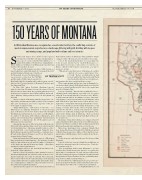
150 YEARS OF MONTANA
In 1864, when Montana was recognized as a new frontier territory, the conflicting currents of western expansionism surged across a landscape glittering with gold, bristling with teepees and mining camps, and populated with outlaws and secessionists
Settlers and miners were drawn to the region’s potential for gold while the Lincoln administra- tion, eager to secure it for the United States, rec- ognized the influx of Confederate sympathizers, whose influence would prevent Montana from achieving statehood for another 25 years.
The region held immense promise while facing an uncertain future, and while much of it remained the wild and untrammeled landscape it had been
for thousands of years, the immediate fo-
Falls and the author of “Montana: Then and Now,” which compares where Montana started and where it is today.
One of the fascinating themes in researching the book, he said, emerged as he tracked Montana’s eco- nomic history of resource extraction to its current con- fluence, which trends toward conservation as a way to promote tourism.
“When you look at the history of Montana, it really is a history of resource exploitation,” Par-
rett said. “Before you had gold you had beavers, and by the time Lewis and Clark were headed back they were already meet-
ing trappers who were exploiting that resource.”
Then came mining and prospecting in Bannack, lo- cated near what today is Dillon and which served as the territory’s capital briefly in 1864, before the capital was
moved to Virginia City.
Parrett continued: “But all of those industries are re-
ally hard on the environment, especially coal, oil, copper and gold. You can only take those resources once. Where- as with tourism, that is an infinite resource, but ironi- cally it hinges on preserving and not touching the other stuff. When these guys first arrived, there was no over- sight. They could pollute with impunity and the resourc- es were basically theirs for the taking. Today, the second leading economic driver in the state is tourism, and it’s poised to become No. 1. I call it catch and release capital- ism. You are endlessly cycling people through the state, and tourist dollars stay in Montana, whereas money from resource extraction ends up back East in the pock- ets of investors.”
Montana’s ethnic diversity has also changed, Parrett said, noting that in 1870 almost 20 percent of Helena’s pop- ulation was Chinese, and more African Americans lived in Montana than any surrounding states or territories.
Mixed-race marriages were common, though they were banned between 1909 and 1953 with the exception of Native Americans, since white settlers had been rais- ing families with Montana’s first residents from the be- ginning.
Today, however, only four states are less diverse than Montana.
Parrett said a key reason behind the prohibition on mixed-race marriages was the territory’s pro-Confeder- ate leanings early on.
“The government didn’t want Montana to go into statehood as a Confederate state, but to be recognized we had to have a constitution,” he said. “As part of their Con- federate leanings they passed a bunch of legislation that was prejudicial, bigoted and racist, like prohibiting mar- riage between whites and the Chinese.”
He noted that one of Montana’s more progressive mo- ments in its history was the 1972 Constitutional Conven- tion, which revised the state’s outmoded constitution.
[email protected]
cus on resource extraction, the Civil War
and the push of white Americans into In-
dian lands laid the groundwork for what is now crystal- lized as the 150-year history of Montana Territory and the American West.
In May 1864, when President Abraham Lincoln signed it into law, Montana became the newest United States territory. Since then, the population has increased from 80,000 residents to more than 1 million, and roads, cities, industry and agriculture have left their mark on the land.
And yet, much of Montana and the progressive, in- dependent, and interwoven philosophies of its residents have gone unchanged, and create a tapestry of the na- tion’s spirit of expansionism.
“Many Montanans – and visitors to the state – see Montana as an enduring monument to our pioneering past. I often hear out-of-state visitors share the thought that Montana is what America once was,” said Ken Egan, Jr., author of “Montana 1864: Indians, Emigrants, and gold in the Territorial Year,” published by Riverbend Publishing to commemorate the 150th anniversary of Montana’s territorial status.
Among the characters who turned up in Montana in 1864, and who populate Egan’s new book observing the territorial milestone – Montana wouldn’t achieve state- hood until 1889 – are frontierswoman Calamity Jane, Native American war leader Crazy Horse, vigilante sher- iff and outlaw Henry Plummer, and Crow chief and vi- sionary leader Plenty Coups.
Egan explained that, while many aspects of Montana have undergone a transformation – the transfer of tribal lands to American property and the impact of industry on the landscape among the most profound – others have remained relatively unchanged.
“Montanans still love the land with an almost reli- gious zeal,” Egan explained.
But the region’s potential to mine natural resources was the primary draw, not only for fortune seekers scour- ing the landscape for seams of gold and other minerals, but for those who looked to take advantage of the mining camps and boomtowns cropping up by “mining the min- ers,” as Egan puts it – that is, to sell goods and services to the gold seekers and their families.
Aaron Parrett is a professor at the University of Great
BY TRISTAN SCOTT