Page 20 - Flathead Beacon // 11.5.14
P. 20
20
NOVEMBER 5, 2014
150 YEARS OF MONTANA
FLATHEADBEACON.COM
100 YEARS LATER, MONTANA STANDS OUT AS A CHAMPION FOR WOMEN’S SUFFRAGE
THANKS TO ADVOCATES LIKE KALISPELL’S EMMA INGALLS, MONTANA BECAME ONE OF THE FIRST STATES TO GIVE WOMEN THE RIGHT TO VOTE ON NOV. 3, 1914
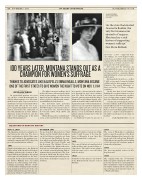
Jeannette Rankin.
COURTESY JEANNETTE RANKIN PEACE CENTER
“As the state that elected Jeannette Rankin, the very first woman ever elected to Congress, Montana has a rich history of supporting women’s suffrage.”
Gov. Steve Bullock
the voters — 1,830 — supported wom- en’s suffrage, one of the highest tallies in the state, according to historical data organized by the Women’s History Mat- ters Project, a website created to com- memorate the 100th anniversary.
Two years after the milestone, In- galls rightfully became one of the first two women elected to the state’s House of Representatives, alongside Maggie Smith Hathaway, a Democrat from Ra- valli County.
Montana didn’t stop there — on Nov. 7, 1916, voters made Jeannette Rankin of Missoula the first woman elected to Congress. She earned Montana’s at- large seat in the U.S. House of Repre- sentatives.
“As the state that elected Jeannette Rankin, the very first woman ever elect- ed to Congress, Montana has a rich his- tory of supporting women’s suffrage,” Gov. Steve Bullock said this week.
“On this the 100th Anniversary of women’s suffrage in Montana, Montan- ans should be proud of our past and con- tinue to work to ensure all Montanans have access to a defining right of our de- mocracy – a right so many fought for – the right to participate in choosing our leaders.”
[email protected]
1903
The town of Whitefish is established and becomes the main line of the Great Northern Railway after it moved to the north end of the valley from Kalispell. Whitefish grows rapidly, and by spring of 1905 it boasts 950 residents, many of them railroad workers.
1905
The first automobile arrives in Ka- lispell via rail.
1909
The original town site of Columbia Falls was platted during the 1890s but is not incorporated as a city until now. The community is supported mainly by the timber industry. At the same time, up north, Lincoln County is formed out of Flathead County.
BY DILLON TABISH
 In a watershed moment 100 years ago, on Nov. 3, 1914, Montana men de- cided to allow women to vote. The land- mark decision split 53 percent in favor and 47 percent opposed and made Mon- tana the 10th state in the U.S. to ap- prove equal voting rights for non-native women, well before the ratification of the 19th Amendment in 1920. (Native American women would not earn the right to vote until passage of the 1924 Indian Citizenship Act.)
The fight for women’s suffrage dated back to the 1840s, when women’s rights slowly began gaining a foothold in the American psyche thanks to the tireless efforts of pioneers like Susan B. Antho- ny and Elizabeth Cady Stanton.
The movement made particular progress in the American West, and in 1890 Wyoming became the first state to give women the vote, followed shortly by Colorado (1893), Utah (1896) and Idaho (1896).
While Montana was establishing it- self as a state in 1889, the first attempts
were made to allow women the right to vote through the state’s first constitu- tion. The effort fell short but carried forward, gaining steam with the help of Flathead County’s Emma Ingalls, a Re- publican feminist who founded the Ka- lispell Inter Lake with her husband. In- galls became an outspoken champion of women’s rights and civic reform across Montana. Perhaps in part due to her in- fluence, voters in Northwest Montana almost entirely swung in favor of the di- visive proposal.
In Flathead County, 61 percent of
1893
Flathead County is created out of Mis- soula County because of the long dis- tance to Missoula. A year later, Ka- lispell is named the county seat.
1901
The town of Bigfork is formally platted by Everit Sliter, who operated a large or- chard there. The hydroelectric plant is built the same year to serve the valley with electricity.
1903
Teddy Roosevelt dedicates the Yellow- stone National Park entrance arch at Gardner.
MILESTONES IN MONTANA HISTORY
NOV. 8, 1889
The Montana territory is admitted to the Union as the 41st state. The state’s first constitution is drafted this same year and remained the primary gov- erning document until 1972, when the present constitution was ratified.
1891
Charles Conrad moves to the Flathead Valley along with the Great Northern Railway, spurring the creation of Ka- lispell, which was platted in the spring and replaced Demersville as the divi- sion point for the railroad. Charles and his brother William were successful partners in cattle raising, real estate, banking and mining. Charles, consid- ered the father of Kalispell, lived in his large mansion in the heart of the city until he died in 1902 at age 52 from com- plications of diabetes and tuberculosis.
OCTOBER 1891
Troops from Fort Missoula force Chief Charlo and the Salish tribal members out of the Bitterroot and relocate them to the present-day Flathead Reserva- tion, which eventually includes the Bit- teroot Salish, the Pend d’Oreille and the Kootenai. The Hellgate Treaty of 1855 established the Flathead Reserva- tion, but over a half million acres passed out of tribal ownership during land al- lotment that began in 1904. The Con- federated Salish and Kootenai Tribes became the nation’s first tribal govern- ment with a federally recognized con- stitution.