Page 22 - Flathead Beacon // 11.5.14
P. 22
22 NOVEMBER 5, 2014 150 YEARS OF MONTANA FLATHEADBEACON.COM
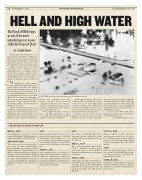
HELL AND HIGH WATER
The Flood of 1964 reigns as one of the worst natural disasters to ever strike the Treasure State
BY JUSTIN FRANZ
Floods have long signaled the com- ing of spring and summer in Montana. Every year people nervously watch the riverbanks. But regardless of how high the waters may rise, they rarely com- pete with the second week of June 1964.
Fifty years later, the floods of 1964 still reign as one of “Montana’s worst natural disasters,” according to scholar Aaron Parrett. In just a matter of days, 20 percent of the state had been impact- ed by the flood that caused millions of dollars of damage to homes, roads and bridges.
The flooding was caused, in part, because of below-normal temperatures between March and May that delayed the normal mountain snowpack melt. By June, many area streams and rivers were already high when a weather sys- tem brought heavy rains to the region. While the flood impacted communities all across western and central Mon- tana, some of the worst hit areas were the Flathead Valley and the Blackfeet Indian Reservation.
West of the divide, the floods in- flicted more than $24 million worth of damage, yet it was nothing compared to the human toll east of the divide on the Blackfeet, where at least 30 people were killed and 260 homes were destroyed.
Flood of 1964. PHOTO COURTESY OF NORTHWEST MONTANA HISTORICAL SOCIETY AND MUSEUM AT CENTRAL SCHOOL
However, the devastation there was largely overlooked. The largest news organizations that were close to the res- ervation, in Kalispell and Great Falls, were preoccupied with the flooding in their own neighborhoods.
“We all knew what was going on here,” said Mike Billedeaux, a survi- vor of the flood who grew up near Babb. “But the rest of the world didn’t.”
Billedeaux was playing in the near- by hills on June 8, 1964 with his broth- er when the Lower Saint Mary Lake breached its banks. He recalled having to swim to their submerged house in or- der to save the family’s two pets, a dog named Dolby and a cat named Cat.
Another survivor, Darrell Wil- liamson, said the flood forced major changes on the reservation and after-
1917
Fire breaks out at the Granite Moun- tain mine in Butte, killing 163, in the deadliest hard-rock mining disaster in U.S. history.
SEPT. 1, 1923
Three men from Billings, R.T. Fergu- son, J.C. Whitham and Elers Koch, achieve the first recorded summit of Granite Peak, Montana’s tallest peak at 12,799 feet.
JULY 4, 1923
Jack Dempsey defends his world heavy- weight boxing championship with a 15-round decision over Tom Gibbons in Shelby. It remains the first and only world heavyweight title fight held in Montana.
wards many people moved to towns like Browning and Heart Butte. Slowly but surely the Blackfeet’s relationship with the land began to change, Williamson said. The flood is something neither of them will ever forget.
“I can’t tell you what I did yester- day, but I can tell you about the flood of 1964,” Williamson said.
[email protected]
OCT. 24, 1926
Charles Marion Russell, Montana’s most famous cowboy artist, dies at age 62. C.M. Russell was a world-renowned artist of over 2,000 paintings. In March 2014, an oil painting of his sold for $1.25 million.
1930
The first commercial cherry orchard on the east shore of Flathead Lake is plant- ed. A cherry growers’ cooperative is or- ganized five years later.
JUNE 18, 1932
Sir Charles Arthur Mander of London dedicates Waterton-Glacier Interna- tional Peace Park at the Montana-Al- berta border.
MILESTONES IN MONTANA HISTORY
MAY 11, 1910
Concluding two years of fierce debate, President William H. Taft signs into law a bill creating Glacier National Park.
AUG. 20-21, 1910
The largest forest fire in American his- tory roars across western Montana, northern Idaho and northeast Wash- ington. Known as “The Big Burn,” the blazes consume 3 million acres, includ- ing parts of the present-day Flathead and Kootenai national forests, and kill 87 people, mostly firefighters. The fire is largely responsible for shaping the identity and mission of the U.S. Forest Service.
1914
Montana women win the right to vote, six years before the passage of the 19th Amendment, after residents vote 53 percent in favor. Native American wom- en are still not allowed to vote until the passage of the 1924 Indian Citizenship Act.
APRIL 2, 1917
After much debate over whether a woman should be allowed in, Jeannette Rankin, 36, of Missoula, is introduced as the first female member of the U.S. Congress. Four days later, Rankin is one of the few lawmakers to vote against de- claring war on Germany.