


Page 56 - Flathead Beacon // 11.23.16
P. 56
EXPLORE 59 OUT OF BOUNDS 57 Outdoors
Montana on High Alert After Mussel Discovery
O cials trying to prevent ‘nightmare’ scenario of mussel infestation in state’s pristine lakes, rivers
FBY DILLON TABISH OF THE BEACON
ACING A DIRE SCENARIO WHERE MONTANA’S pristine rivers and lakes could become signi - cantly damaged, state o cials are devising a
strategy to contain and prevent the spread of harmful aquatic invasive species after mussel larvae were discov- ered earlier this month in two reservoirs.
Local and state o cials are on high alert after the  rst positive test for invasive mussels in Montana. Tiber Res- ervoir in north-central Montana east of Shelby tested positive for the larvae of aquatic mussels, and tests from Canyon Ferry Reservoir near Helena show “suspect” but inconclusive results, according to the state Department of Fish, Wildlife and Parks.
As a result, the National Park Service has temporar- ily closed all waters in Glacier National Park to water- craft, along with the Blackfeet Nation, which closed res- ervation waters to all boats. The U.S. Fish and Wildlife Service closed the Jessup Mill Pond near Creston to all boating access.
The Montana Invasive Species Advisory Council, a statewide group encompassing multiple public agencies and private stakeholders, is developing a plan to address the troubling discovery. The plan would include con- tainment and monitoring strategies, according to state o cials.
“The state has been aggressively trying to prevent this,” Mark Deleray, FWP  sheries manager for Region One, said of the initial discovery of aquatic invasive species.
“Everyone, of course, has hoped this wouldn’t hap- pen, but now it has, and we’re trying to put together a strategy to deal with it.”
The Flathead Basin Commission has crafted a let- ter intended for the governor’s o ce calling on o cials to close Tiber and Canyon Ferry reservoirs, increase resources to address the threat and study whether Flat- head Lake and its watershed have been infested.
“This is a game-changer,” Caryn Miske, executive director of the Flathead Basin Commission, said.“Be- fore now, we were trying to prevent this from entering our state. Now it’s essentially right on our doorstep, and that makes it much more di cult and requires more resources. We have to do what we can to defend (the Flathead watershed).”
The miniscule mussels, which cling to boats and other watercraft and can colonize rapidly, threaten to have ecological and economic consequences in the last stronghold in America without a devastating infesta- tion. Other lakes across the U.S., including the Great Lakes and Lake Mead, have fallen victim to mussel infestation, which leads to cascading e ects throughout the ecosystem, including deleterious impacts to the food web and water clarity. Most noticeably, mussels promote the growth and spread of deadly algae blooms.
Once zebra and quagga mussels become established in a water body, they are impossible to fully eradicate.
Further analysis is underway at Tiber and Canyon Ferry to determine whether a full adult population of mussels has been established. Divers are planning to inspect the reservoirs and samples are being taken to  nd
out the exact locations of these potential populations. “When there are adult mussels, they have the poten-
tial to increase and spread rapidly,” Deleray said. E orts are also underway to study whether other water bodies may have been infested with mussels, including Flathead Lake, which is considered one of the
cleanest lakes in the world.
Last week, o cials from Idaho, Oregon, Washing-
ton, Montana and three Canadian provinces gathered in Boise to discuss the troubling discovery.
“It’s the nightmare you don’t want,” Montana State Rep. Mike Cu e, R-Eureka, said.
U.S. Sen. Steve Daines, R-Montana, issued a letter to the U.S. Army Corps of Engineers on Nov. 21 requesting expedited funding for inspection stations in Montana.
“Should the larvae propagate, it will have detrimen- tal impacts on Montana’s ecosystem, obstruct irrigation and hydropower infrastructure, and negatively impact our economy,” Daines said in the letter.
Jim Elser, the director of the Flathead Lake Biological
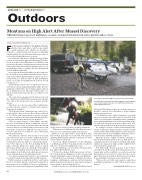
ABOVE A boat is cleaned at an FWP watercraft inspection station in Ravalli.
LEFT Deb Tirmenstein, with the Flathead Basin Commission, and her dog Ismay search a boat for aquatic invasive species at an FWP watercraft inspection station in Ravalli. BEACON FILE PHOTO
Station in Yellow Bay, said more preventative measures should be enacted across Montana to defend against aquatic invasive species.
“I do think the state could be doing more, especially when you consider the stakes that are involved, both on the recreational side, including boating, swimming, water quality and  shing, but also the agricultural side, for irrigation and power generation,” Elser said. “The amount of money that’s at stake here is just staggering.”
According to research conducted in 2014 by the Uni- versity of Montana, Flathead Lake’s pristine identity had an estimated $6-8 billion impact on shoreline prop- erty values and is worth roughly $1.6 billion in “nature- based tourism” in Flathead and Lake counties.
Montana spends roughly $1 million annually to defend against aquatic invasive species, with awareness campaigns and detection stations established during the summer. In comparison, Idaho spends roughly $10 mil- lion in the battle against AIS.
Tom McDonald, division manager of the Confed- erated Salish and Kootenai Tribes Natural Resources Department, said he would like to see all boats entering Montana from out of state be required to  rst receive approval from a check station. He also believes the pub- lic needs heightened awareness about the threat.
“This needs to carry the same negative connotation as drinking and driving,” he said. “But it’s nowhere near
that yet.”
56
NOVEMBER 23, 2016 // FLATHEADBEACON.COM
dtabish@ atheadbeacon.com


